The Mosaic That Changes With Distance
From one distance the Deësis mosaic in Hagia Sophia gives you three faces. From another it shows a field of individual surfaces that carry small differences in color and light.
In this story 4 sections
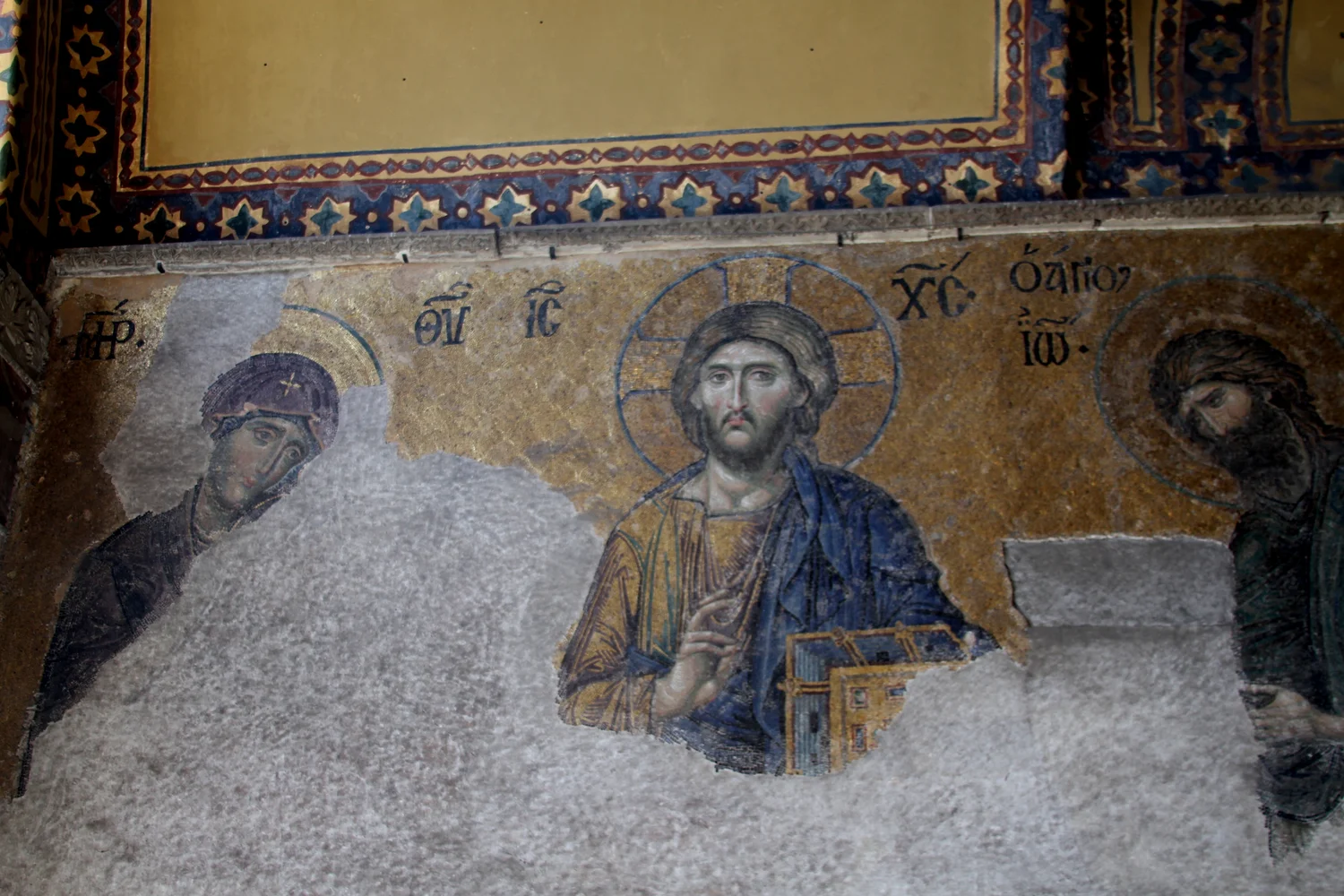
There is a useful interval between recognizing the faces in the Deësis mosaic and being able to say what you actually see in one of them. The three figures are readable at a distance. Closer in, the surfaces of cheeks and brows break into small pieces of color. The background stays relatively continuous from far away, yet up close much of that continuity sits in separate bands or bits of tile. The fact that this works at both distances is one of the great effects of the image. You see a face, and you can see how much the making of that face depended on material refusing to become a face by itself.
The mosaic is in the south gallery of Hagia Sophia in Istanbul. The image is traditionally called the Deësis, associated with petition or intercession. Christ occupies the center; Mary and John the Baptist face in toward him. A fair amount of the image no longer survives, especially below the surviving heads and upper parts. The broken edge is so familiar in reproductions that it can begin to seem like an intentional shape. One valuable exercise in looking at the work is to keep the group the makers arranged distinct from the perimeter left by loss.
Read a gaze before reading a fine mark
At the scale of a postcard, a viewer can pick out the main axis of the image and the different ways the figures turn. The center faces more directly. Mary and John, to the sides, direct attention inward. Features whose individual parts are still too small to distinguish participate in that larger gesture. A photo that trims away one of the figures can retain a very clear head and lose a relationship that made the entire image legible. For any first description, locate the group in a view wide enough to contain it.
Now narrow the view to the boundary of an eye or to the turn where a cheek meets a nose. Fine pieces contribute changes a person reading the whole image will not consciously count. Some areas use pronounced differences in tone; others read more through several close tones in succession. Look for a short transitory area between the darkest part and the brighter skin. Following it with your eye can help you see how the mosaic keeps a broad difference of form while allowing small surfaces to remain individually visible.
A black-and-white view can be a useful companion to the color photograph if you think a piece of color is defining the direction of a gaze. Determine first whether the change depends largely on relative brightness. If a relationship remains in grayscale, it may owe considerable force to divisions between light and dark. If it becomes hard to see while the larger composition stays intact, color may be doing part of the work. The test cannot tell you the material of any particular tessera. It gives you a more precise description of the effect the arrangement carries at that distance.
A wall is more than a giant page
The small pieces of material making up the image are called tesserae. Their size, placement and the way their surfaces sit in the light can affect what a person sees. To consider the latter, imagine two reflective pieces with similar color placed at different slight angles. One may show a noticeable glint from the viewer’s first position and much less when they move. On a wall, the dispositions of many small pieces can produce changes of brightness that a printed reproduction preserves only at the moment a photograph was taken.
This is one reason to avoid classifying every patch by the color it shows in a single image. A piece in the background can look brightly metallic at one angle and darker in another view. Some of the variation can be due to light that reaches the surface, some to the response of the material and some to recording and display. You may be quite confident of the arrangement in the first view and quite uncertain about a small relative difference in hue. Frame your notes so the degree of confidence in one observation does not silently become the degree of confidence in the other.
A visitor in a gallery sees architecture along with the face. The height and shape of the wall, the depth of the room and the changing position of observers are part of the conditions under which the work appears. A photographic crop can offer better sustained access to the figure and nearly none to the state of the surrounding building. To understand why one experience is different from the other, compare what you can learn from a broad view that locates the panel and a close one that shows a small group of pieces. One gives the picture a body in the room; the other gives the body of the picture a structure.
How to draw a place that is no longer there
A significant amount of the lower composition is missing. If you look at a reconstruction alongside a modern view, do not let the completion silently become an observation. Useful images can put visible evidence and inferred lines in different colors. A record of loss can be improved by describing where an edge becomes irregular and where an earlier report or drawing fills in something the current view does not show. Not every apparent boundary announces a missing part in the same way. Some belong to intact elements of the composition, and it helps to mark which forms terminate within the surviving material.
A practical exercise is to draw a small version using only the parts visible in a given view. Leave space where the group continues but the picture has no readable details. Do a second sketch of the likely direction of all the figures, based on the broader type and arrangement. Keeping the two drawings separate can show whether a confident-looking idea comes from the visible wall or from knowledge of other examples. In some cases both sources of information agree. It is still valuable to know the basis for each mark.
An archival photograph can be especially useful for a record of one of these boundaries. The Byzantine Institute and Dumbarton Oaks fieldwork records provide evidence of work and documentation at the building. An old black-and-white print can preserve the relation of some sections even when it lacks a modern color scan’s detail. Match broad stable features before comparing them. You may learn more from a slight change in how the edge is photographed than from a change in apparently important color in an area where the old record could not reproduce it at all.
Two images of the same panel can also reveal how a mount or a gallery boundary shapes a description. If one includes the surrounding wall, locate an architectural edge before asking how the mosaic occupies it. When the other is centered on the largest face, the actual width of the panel can slip out of consideration. The gap at the edge of that image tells you about the photographer’s choice. The gap at the bottom of the surviving mosaic belongs to the object and its history. Keep both boundaries in a written description and someone reading it will know which width you mean.
If you plan to compare a graphic detail with another mosaic, choose the detail by location and approximate scale. A forehead and a cheek from distinct images may be rendered so similarly that a casual enlargement would conceal important differences in the size of their pieces.
Return to the whole image after studying one corner
The habit of picking a tiny patch, then trying to explain everything from that patch, can be reversed quite easily. After looking at the fine steps along one side of a face, reduce the image until you cannot reliably see those steps. What survives is the inclination of the head and the general placement of the gaze. Put the image back at the intermediate size. The viewer can now see part of what keeps those broad effects alive without asking every tile to carry its own expression. A small piece that looked infuriatingly coarse on the screen is able to participate in a gentle contour in the view for which it works.
There is a quiet benefit to giving an audience these different distances in a display or publication. A detail can show the physical workmanship; a wider view introduces the unusual scale and the location; a quite small whole image can keep the interaction of the figures easily visible. A reader need not be offered only one way to look. When reproducing the work, identify the part of the panel and distinguish the photographer’s crop from the physical edges of the mosaic. Enough context can remain with a photograph to make its considerable freedom over distance into an advantage.
Let the picture get small once more. Bring it back slowly and notice which features reappear first. A forehead can become clear before the field of small pieces around it has any separate edges. Eventually an individual piece offers its own reflection and small place on a wall. Both are substantial observations. At first you know someone is looking back. At the end you have some idea how many individual surfaces had to line up to let that impression remain.