The Seats Behind the Orchestra
In the Berlin Philharmonie, the audience occupies several sides of the stage. A seat’s direction changes the view of a performance without making it a different work.
In this story 5 sections
An orchestra seen from the seats behind it offers one unusually clear fact: when the conductor turns toward the players, the conductor turns toward you. A gesture you usually see from the back can become as legible as a person’s expression. The players still have their own reasons to face in the directions they do. A shoulder or a music stand can hide the motion you expected to watch. The venue has produced this unfamiliar combination without requiring the musicians to turn around for people who sit there.
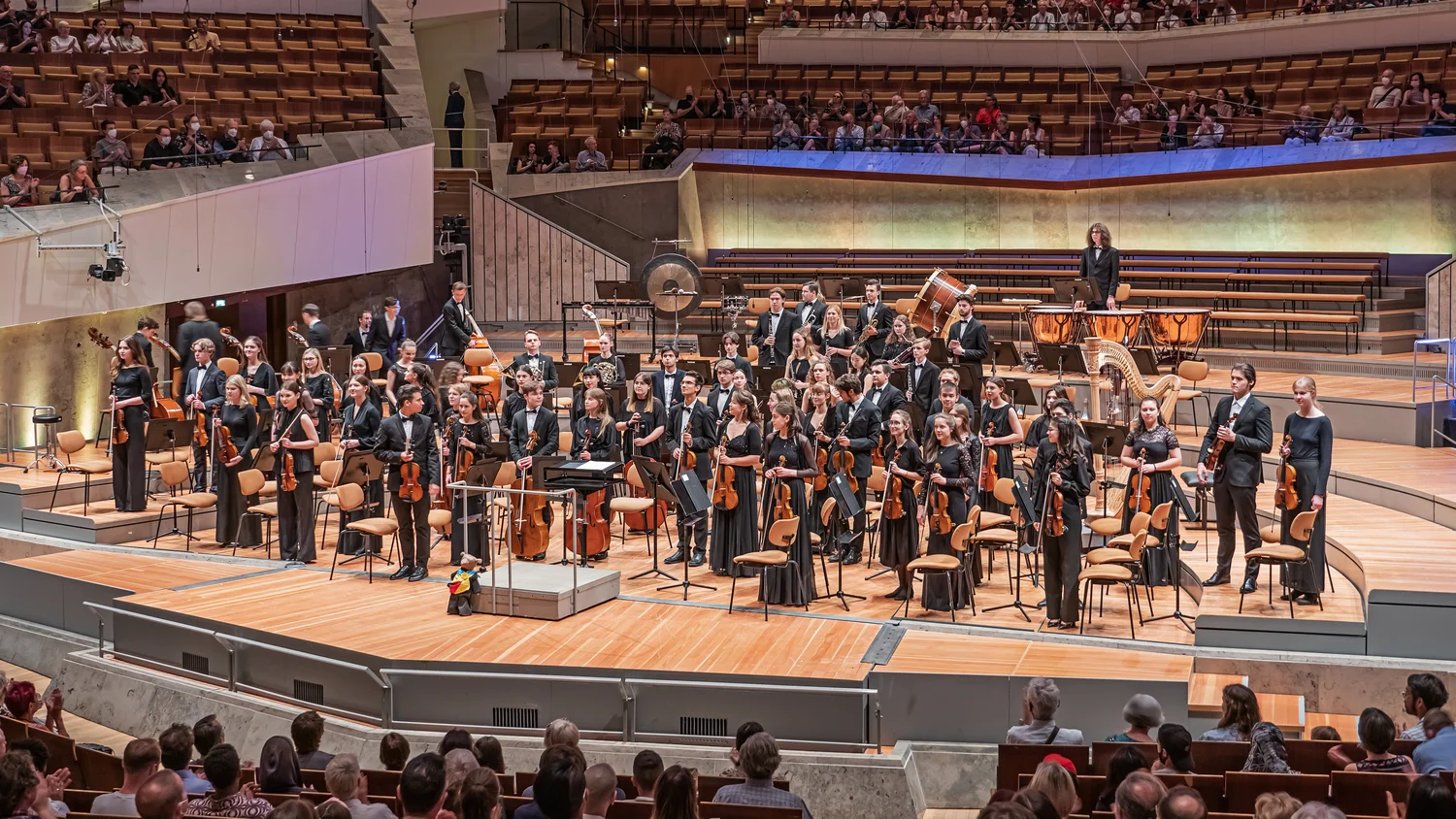
The Berlin Philharmonie’s main hall is a widely recognized example of putting the orchestra around the center of an audience rather than at one simple end of it. Architect Hans Scharoun arranged seating in rising sections around the platform. The Berlin Philharmonic describes the hall in relation to an idea of music at the center and to a landscape of terraces that has often been compared to a vineyard. The nickname is useful so long as it directs your attention upward as well as across the room. The seats are separated into blocks rising around a common area, and their heights affect what each place has in view.
A center changes the drawing
Take a blank sheet and draw the outline of a rectangular hall with one short end set apart for a stage. Everything else can reasonably be marked in one general direction. A seat close to the stage may lie far to the left, and one at the back could be in the middle, but any position can be described from a conventional front. If you turn the stage into a place surrounded by people, the direction from one audience member to the stage can oppose the direction from another audience member to it. They are still sharing a central field of attention.
In the Berlin plan, terraces make that attention possible from positions of different heights. Draw a section after you draw an overhead plan. If a person sits slightly higher than their neighbors, the difference can affect whether they can see over heads and how much of the platform they can see down onto. Two seats with similar distances on a flat plan can offer quite different views once you put them at their proper levels. In a photograph from one terrace, parts of the room are revealed and concealed by the edges of the other seating areas. The room is not simply a collection of seats arranged around a table.
As a viewer, try finding a broad horizontal feature that belongs to the platform and a vertical line that belongs to the edge of a seating block. The two give you a way to see how close a terrace appears to be without making a guess from the perceived size of a person. A wide-angle lens can pull distant things farther apart near its edges. Your sketch should keep an accessible plan or a second view in reserve. The first photo is a strong argument for the presence of several directions; it is a poor way to establish exact distances among them.
The orchestra keeps a front of its own
An audience distributed around a stage does not remove the need for musicians to see leaders, colleagues and music. A string player and a percussionist can face quite different ways and still take part in the same plan of performance. The people behind the platform may see the conductor’s face and find another part of the ensemble unexpectedly distant or partly hidden. These are offsets in the visual experience, not defects to be ignored. One seat can reveal a cue and another can reveal how it was answered.
Try following a single entrance in a video showing the platform from both sides if such coverage is available. Note where the camera was when the event became clear. The player first receiving a cue may be visible in one view, while the cue itself stands out in another. A view from the back does not have to supply all the information a view from the front provides. In a placement designed with both in mind, only some relationships need to remain equivalent; others make each seat’s account distinctive.
There is pleasure in comparing two quite local visual experiences. Watch a person starting a note at what appears a very small movement. Then look for a place where the same movement is hidden by a stand or another performer. Consider what you might still learn from the face or shoulders of a different player. The layout does not guarantee that each seat has the same access to these things. It gives an audience enough kinds of proximity that the work of attending can take on more than one legitimate visual shape.
Sound reaches the terraces by more routes
A seat’s ability to see a particular instrument does not immediately say how strongly that instrument arrives there in sound. Some of the sound travels directly. Other energy reaches listeners after reflecting from surfaces. Different instruments have their own directionality, and an ensemble’s balance can depend on performance, placement and room. The Philharmonic’s account of the building’s acoustics describes design work needed to serve its arrangement. A phrase such as “the stage is central” is far too short to explain why a sound field should feel any particular way wherever a listener sits.
Put yourself on an empty platform in an imaginary room. You can imagine where a wall that faces you would send back some of what you make. Insert a block of seating and another wall surface at a side angle. The new room offers other routes for sound, some reaching different parts of the audience at different times. That is the reason a section drawing belongs beside a floor plan when explaining a concert hall. Where the volume above the platform opens and how nearby surfaces are oriented can be relevant as well as the horizontal distances between people.
A phone recording is a weak tool for comparing these positions. Its microphones might point different ways, automatic adjustments can alter recorded level, and a clip carries little information about how a listener’s ears in the room received the sound. Even comparing two live memories needs care when the performers played with different dynamics. A good first comparison identifies what was observed: a visual cue, the apparent position of a melody or a change in the sense of closeness. These may occur together and need not have the same explanation.
A small platform makes the differences legible
If a single speaker stands near the middle of an empty stage, most listeners can see the person turn and can follow the direction of a voice. In a large ensemble the reference is more complicated. The conductor may face a row of players to one side, while players across the platform can continue providing the sound you are following. A listener in an unusual seat might observe where a cue goes without seeing its next recipient. A production photograph is often made precisely to favor one of these relationships.
The pattern of walls and seats can offer landmarks even if the location of a seat was not identified. Find stairs at the edge of a block and note the direction in which rows rise. It is often possible to tell which side of the action the photograph came from without relying on the instrument in the foreground. The appearance of nearness is more convincing after making that simple orientation check.
A hall knows where the audience is
One effect of the terraces is that people in the audience can be in one another’s sightlines. A person looking across the orchestra may see attentive faces beyond it. In a more familiar end-stage hall they may mostly see the backs of heads while facing the same direction. This is not just a distinction of seating plans. It can alter what a listener takes to be part of the room during a pause. A distant place at which one can see activity in people’s faces has a different role from a distant surface with no people attached to it.
The architectural description links the hall’s organization to an idea about gathering around music. The useful thing about looking at a particular terrace is that it makes this large idea testable at a small scale. Can you see where one group of listeners joins another around the platform? Does a place close to the center seem separate from people opposite? Can you read the conductor without also attending to the audience several steps higher? These are questions an ordinary image can help begin to answer even when the sound has been left entirely out.
A final comparison can be made without choosing a best seat. Trace the view from two seats to the same stand, one forward of the conductor and one behind. Add marks for a person’s view of the rest of the room. Then set the stand aside for a moment and consider the way the platform’s height separates the performers from the different levels of audience. The relationship between orchestra and listeners stays recognizable from both viewpoints. What changes is the particular part of it each person is put in a position to notice.