The Wall Around Ryōan-ji
It is easy to count stones in the famous Kyoto garden and overlook the boundary that gives them a setting. The wall, the viewing edge and the gravel all have something to say.
In this story 4 sections
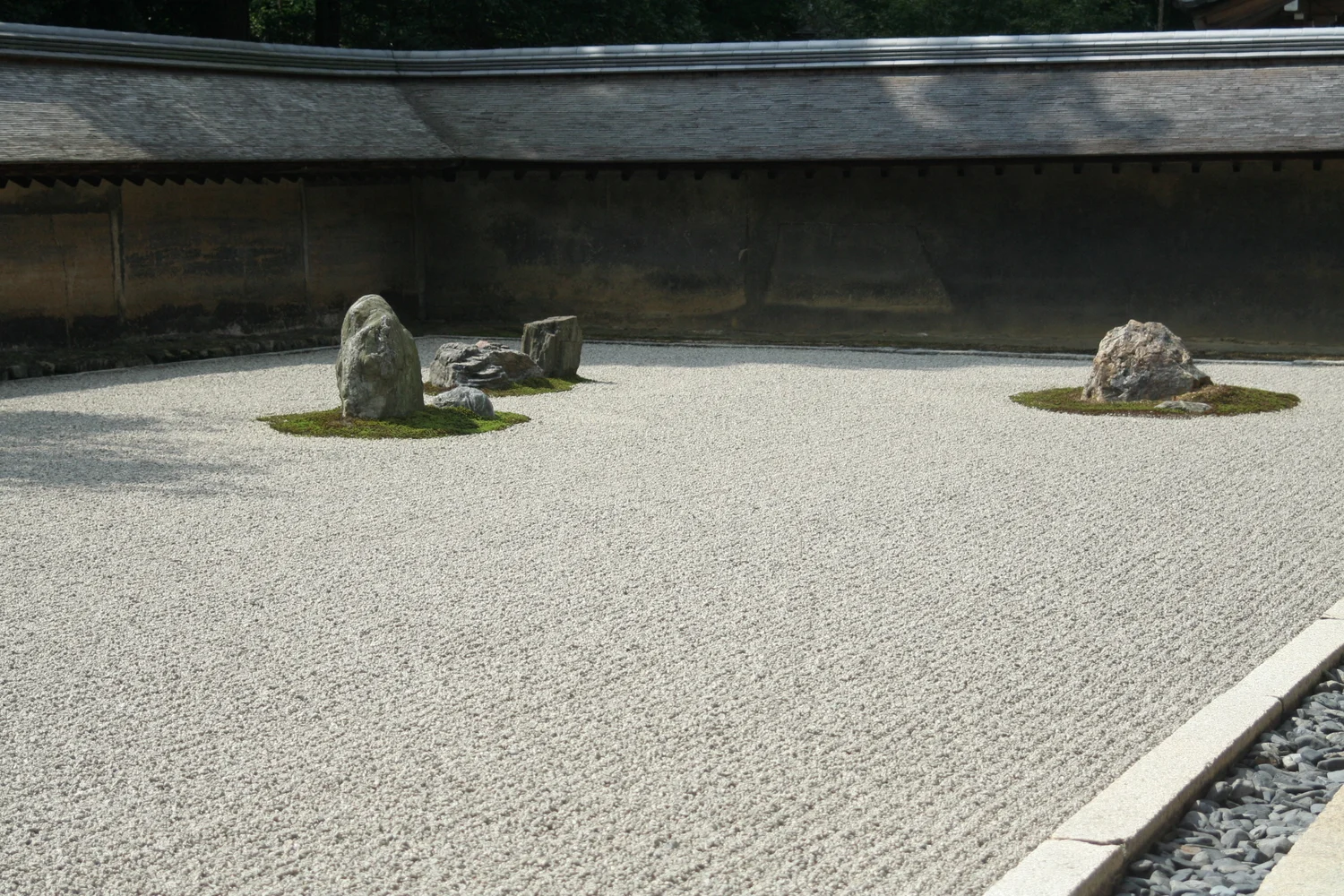
The line worth following in a photograph of the dry garden at Ryōan-ji is not necessarily one of the lines made with a rake. Start at the upper edge of its earthen wall. It travels behind the stones and takes a turn to enclose the ground. There may be a tree visible above it, or enough sky to establish a sense of space beyond it. The things beyond no longer compete with the little irregular silhouettes on the gravel. The wall has made it possible to look at a very small piece of the world for a fairly long time.
This garden at the abbot’s quarters in Kyoto is famous for its fifteen stones and their arrangement across pale gravel. Descriptions can turn the stones into a puzzle; if they are treated strictly as a puzzle, the first impulse is to count what is visible, compare it with what should be there and explain the difference. Try a second kind of looking first. The wall is high enough to limit what you see, open enough above to admit changes beyond it, and close enough for its surface to have texture of its own. Those things modify the view before you take up the question of what the stones might represent.
A yard can have a horizon
Put a sheet of paper on a desk to stand for the gravel. Set loosely matched objects on top, leaving some space between them. Photograph the result from just above the edge of the paper. Much of the back of the desk is likely to enter the frame. Add a long strip of card behind the objects. With a low enough camera the far edge of the paper appears to be attached to that strip. The same patch at the front of the desk now looks like a more self-contained place. The card did nothing to the shape or position of a single object. The difference lies in deciding where the field of view ends.
An earthen wall presents the garden at a very different scale from a piece of card. Yet in a view across the gravel from the building it can do overlapping jobs. Near the ground it stops more distant surfaces from continuing into the place where the stones are set. Behind the outlines it provides a broad background with few protrusions for the viewer to follow. A top edge allows something else to begin. Depending on the light, pale gravel occupies one part of the view, the wall stretches out through another, and leaves or sky give the composition another depth without turning the whole picture into an uninterrupted landscape.
Try cropping a public photograph of the garden in your mind. Keep the stones and the gravel but lose most of the wall. It is now harder to judge how quiet or busy the field beyond the stones is meant to be. Leave the wall and lose what is visible above it. The retained place can feel much more enclosed. These are different immediate readings of the same position. Visitors are not looking through the frame the photographer had to choose. In actual space they can raise their eyes after following a line in the gravel and see what he or she left off.
Sit where the room lets you sit
A view at a dry garden is not typically a walk among its stones. At Ryōan-ji the relationship between the veranda and this garden is part of what someone sees from the building. A low eye can catch very different gaps than a high eye. Shift sideways a little and a nearer outline moves against its background more than a distant one does. It is a routine perspective effect, but the relative simplicity of the garden makes it possible to follow. Instead of counting all the stones at once, notice first when neighboring forms begin to separate, and what in the background seems comparatively stable.
The garden therefore looks tidy from a distance without surrendering every detail to a single view. Some stones sit close together within groups. Moss breaks up parts of the plain gravel near them. A fairly small outline can be much more conspicuous against pale ground from one position than it is beside a darker shape from another. It is easy to assign such an effect to the individual rock, as though one were simply less prominent than another. What you are actually noticing can depend on what is behind it when you look. A sketch showing your own view can record this better than a diagram of the rock positions alone.
Let the space at the viewing edge be part of that sketch. Where does the field of gravel begin? How far below the eye is it? Which elements are physically in the space the visitor can use? A photo made from a low or cropped point may not answer every question, but you can still keep the gap at the bottom in mind. Something that seems to be right under your feet in an image may have a border, floor or roof edge giving it more distance in the place. Those understated features make it practical for many people to see the same garden without taking the same position.
Age is visible in more than one register
Stand back from an individual stone in the photograph and look at the varying color on the wall. A broad patch and a thin change near its base can have a texture that a reproduction flattens or makes brighter. It is unwise to assign dates to apparent bands with no further evidence. You can still see that the wall belongs to the garden in a way a neutral colored background would not. It has depth, weathering, a relationship to shade and a position in which it will not look exactly the same at any hour. The pale material of the garden has its own kind of weather and care.
To make this difference useful in notes, keep time and surface apart. Write down what indicates maintenance, what gives the material a sense of age, and what might have been made mainly by the light on the day. A pattern in raked gravel can be fresh. A dark region on a wall may change more slowly, or turn out to be a shadow that will be elsewhere soon. A record from a second visit or another photo with documentation can help. The apparent age of a single texture is not a date. A sketch can make that distinction easier by showing which surface you were talking about.
The atmosphere is changed by occupancy, too. A crowd looking quietly from the building becomes part of the viewing space even when a frame excludes it. A person’s ordinary opportunity to see a small change depends on the rhythm of people entering and leaving. A description that imagines one observer alone for an afternoon has set up particular conditions. It might illuminate part of the architecture and understate what people actually experience at the visitor’s edge. In making sense of the photograph, allow a moment to imagine not only the stones but how you arrived in front of them.
The wall’s corner can help locate the direction of a photograph if the stones are hard to place. A view that includes it preserves a relation of the building to the garden that a tighter crop might erase.
The temptation to interpret every shape
The official Kyoto visitor description identifies the number of stones and the surrounding wall without assigning them a single explanation. That is a useful distinction. The arrangement admits plenty of analogies. Someone may see shapes on an expanse of water. Another person might think about how intervals in the gravel make each cluster easier to notice. Neither initial impression tells us what someone intended at an earlier stage of the site or what a visitor has to think next. A specific historical argument deserves a source that addresses precisely that claim, not an analogy the garden makes easy to imagine.
One can test an interpretation of the present view without settling all of its history. If you think a largely empty strip of gravel is doing important work, see what happens when you cover it on a small print and leave the rocks visible. Which relation became harder to see? If the photograph’s strong diagonal wall was doing more for the composition than you originally thought, try a second view made from a position where the geometry of the corner looks different. This may reinforce something about the garden and undermine something about the first photograph. It is a small but pleasant difference to be able to recognize.
The wall also gives a way out of the desire to find a single code for the place. Watch where its line meets a group of stones, look across the empty distance between, and notice how the terrain beyond the enclosure keeps intruding at the top. This reading leaves room for imagination while keeping your eye on physical conditions. Turn to a view with more people or softer light and it will make its own account of what looked definitive in the first one. The garden does not have to settle down into a single answer to give an attentive visitor a very precise thing to notice.