A Cylinder Seal Has Two Images
One design is cut into a stone cylinder; the other appears as a raised strip in clay. Starting with a modern impression makes it easier to reason backward to the ancient object.
In this story 4 sections
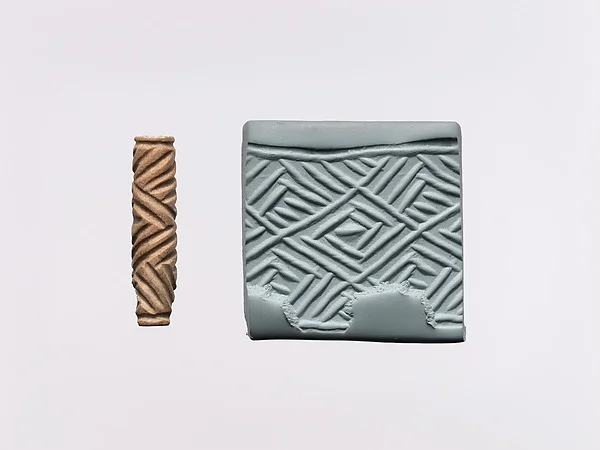
One object in a museum photograph seems able to explain itself; the small cylinder next to it refuses to do so. The cylinder is a stone object from the Early Dynastic period of Mesopotamia. The paler strip in the same view is a modern impression made to show the design that can be produced by rolling the cylinder on an appropriate surface. The strip is far easier for an unfamiliar eye to look at. It is also the part of that view that was not made by the ancient maker. Everything interesting about reading the little design begins with preserving both of these facts.
The Met’s collection record calls the particular example a geometric design. It is useful to start here rather than with a more complicated row of figures whose story or identities can attract the whole of a reader’s attention. A repeated geometric effect invites questions you can ask without settling an interpretation: where a line begins, whether the opposite material has changed relief, and where one turn of a small object gives way to another. As the little cylinder rolls, the image has to fit the motion that puts it down.
The stamp stays still in a different way
Imagine pressing an ordinary stamp into a compliant flat surface and lifting it straight away. Its design fits into the area it touched. It can be placed later in a separate area, or another stamp can take up a different part of the surface. The cylinder gives the person using it another motion. As it turns and advances in contact with the material, different parts of its curved face meet the surface in order. They open out into a strip. The effect can continue through the point where the first part of the surface comes around again.
This feature changes the work of the designer. Consider a long band intended to look continuous when taken through more than one turn. The join is the same place on the cylinder whenever it comes around, although it can occur several times in the impression. Imagine cutting out one representative length of the strip and wrapping that design back into a sleeve. The paper edges are now close neighbors. Anything awkward in their relationship can recur at the same point each time the strip continues. The design is both an image and an arrangement of marks around a closed path.
The freedom of making a long strip does not imply it will always be a smooth and complete one. The surface recording it needs to support a clear contact. The pressure can change, or one end of the cylinder can make a more distinct impression than the other. A view of a partial rolling can give valuable evidence without including the same full sequence as the cover photograph. Use the physical extent of the surviving surface when judging which parts of a design it could have carried.
The mark you can see may be the opposite of the one cut
Look closely at a groove in an object intended to mark clay. An impression can receive material into the recessed part and leave a raised version when the object is removed. An area left prominent on the cylinder can push into the clay. This is worth drawing as a pair of simple cross sections. In one sketch put a shallow dip in the source. In the other give it a corresponding ridge. From either view a shadow can make the effect harder to judge. The dark region at the edge of an angled photograph does not necessarily identify which surface is high without other clues.
Now take a mark with a distinctive direction. When a design is transferred in this kind of contact, its appearance should be read with orientation in mind. Viewing the cylinder from the outside and reading the facing impression are different relationships to a design. A photo of a curved surface also does not reveal everything on the side facing away from the lens. You might have to turn the object or inspect several views before making a comparison of exact orientation. Here a modern impression has a genuine evidentiary use. It makes available parts of the engraved arrangement that are not all easy to see in a front view.
If a particular detail seems missing in one image, try a small collection of possible explanations before deciding the maker omitted it. Perhaps it lies on the curve out of sight. Perhaps it did not transfer well during the documented roll. Perhaps the light in the photograph flattens an already shallow feature. A trained examination of both surfaces can separate those possibilities more securely. The interesting discrepancy can remain on the page while its cause remains under investigation.
Find the amount of pattern that repeats
Select an obvious feature in the impressed strip, such as a conspicuous short grouping of lines. Look for another occurrence and consider whether it belongs to a repetition within the design or to another turn of the whole cylinder. In a regular design there can be several short repeats in one revolution. The nearest repeated shape will not always be enough to identify the circumference. Pair it with a distinctive second feature farther along so that the combination has a clear form. A tiny difference in how two apparently matching groups are arranged can be more useful than a broad field of regular lines.
A repeated physical defect can prove particularly informative when a reader knows it comes from the source. An identical little interruption recurring at regular intervals gives a reason to ask whether it resides at one place on the cylinder. A rather different mark may have been left in the clay independently of the seal. The strip cannot make the distinction for you. Compare positions, direction and relative order, then say where the evidence comes from. The goal of counting the repeats is to make it easier to check a hypothesis, not to force the whole object into a regular rhythm.
The photograph supplies not only an image but a small statement about scale. If an enlargement makes the strip and the cylinder take up similar amounts of display space, consult the actual collection measurements before writing about the size of a movement. A pattern that looks dramatic when printed in a book could occupy little room on the real object. This gives an extra kind of respect to the cut surface. The work had to be controlled within a space that a camera now lets a viewer enlarge almost at will.
A cylinder can also have a surface that was never intended to carry the main image. Look at the ends before assuming the design extends across every part a photographer included. The ends are useful in showing the orientation of the object and the relation of one edge of the engraved band to the other. If a hole runs through a particular example, the way it might be handled or carried is a reasonable subject for the catalog. Its presence alone would not identify a particular owner.
The ancient impression and the recent one
Some collections contain clay with impressions that were made in antiquity. The Met records material of this kind in addition to examples of seals. The clay objects offer evidence of how impressions survived on things in use. That is a different source from a surface made now to show a cylinder’s design. An ancient example can leave parts missing or put the design in contact with other marks. It can still be remarkably informative about the relation of an impression to the original material, in a way a clear demonstration made for a modern object label cannot replicate.
Write down separate dates for the making of the object and the view of the design. If the latter comes from a recent demonstration, label it that way. If there is another photo of ancient clay, identify which object that is before making comparisons. A known context can affect what one says about the reason for an impression, but a pattern alone rarely supplies the complete history of a transaction or object on which it occurred. Attaching the right object number to the right surface is an important part of asking the question at all.
A person familiar with seals may have a rapid sense of where one part of the design gives way to the next. A novice can look very slowly and make much the same distinction by turning the problem around. Identify where details used to be next to one another on a curved object. Then see how they appeared on the strip. The examples in the collection provide two types of evidence that are unusually generous to compare. One preserves a hand’s work on the stone. Another shows the same geometry given room to extend on a different surface.
Return to the small cylinder after looking at the longer view. It may remain the quieter thing in the picture. Now, at least, the mark that disappears around its side has a possible destination you can point to. The image the hand made and the image a rolling hand could make from it are both present, each letting you see something the other leaves out.