The Turns on Sarah Hunter’s Basket
Figures travel around the shoulder of a willow and bulrush basket. Their outlines take shape within the same turns that give the jar its body.
In this story 5 sections
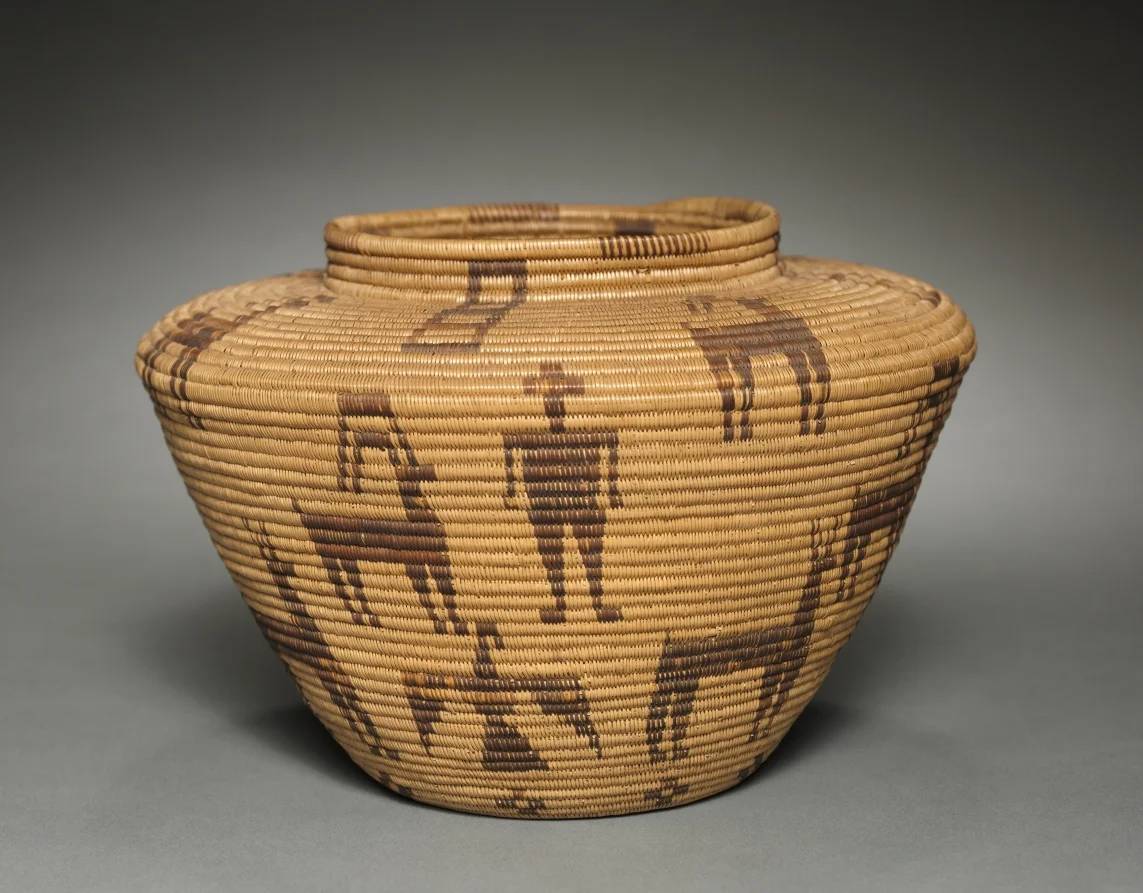
The figure facing the camera on Sarah Hunter’s basket is made of a small number of dark marks. Its arms stretch out and its feet stand apart. On each side a long-necked animal seems to turn in toward it. Move your attention from the figure to the lines running underneath. Ripples of pale material continue across the body of the jar, almost level in the middle and curving toward each side. The figure uses those lines. What looks like one solid stroke from some distance away breaks into short portions at close range. The basket’s surface tells you how to read the picture.
The Cleveland Museum of Art attributes the basket to Hunter, a Timbisha Shoshone basket maker, and dates it to 1910. Willow and bulrush supply its materials. Its narrow base widens into a rounded shoulder and contracts again before the mouth. Such a form is easy to recognize in silhouette. Its surface presents a harder question. How can a maker deciding where to place the next stitch also decide what the jar's edge will do several turns above it? The object answers in two ways at once, through the way it grows around a centre and the way figures take their positions as that growth goes on.
A line that can begin underneath
The museum calls the construction three-rod coiling. A coil in this kind of basket is a foundation that turns around the work, with stitches binding it to the previous course. The rods supply substance to the coil, rather than appearing as three separate bands of decoration stacked around the outside. Some of what holds the basket together is concealed by the material wrapped around it. On the surface the ridge of the coil remains visible. A photograph can show the ridges but give little sense of how the hidden material was prepared or how one section was joined to the next when more was needed.
There is a helpful difference between a series of separate rings and something laid down in turns like a spiral. The next part of the spiral has a previous part close by to which it can be attached. At first the turn can spread over a base. Beyond the base the placement of each course makes a difference to the outline. A course laid farther outside can make the body broader. One placed higher on the curve can make a more upright wall. On the shoulder the maker is drawing the outline inward, reducing the circumference as the turns rise toward the rim. Nothing requires the wall to be the diameter of the base or the mouth at all heights.
The rim is a useful place to see how the structure finishes. It goes nearly upright after the rounded shoulder. That short change of direction marks the mouth as a distinct part of the object. A basket with more of the broadest width carried all the way up could use the same general family of construction and look like a very different vessel. What sits inside or passes through an opening depends on that narrowest dimension. A viewer may notice the broad silhouette first, but the maker has defined several silhouettes, one at the height of each successive turn.
The figure moves across its foundation
Pick only one horizontal band and follow it through the visible figure. At one level the stitches might give a narrow dark segment for a leg, a pale space and another segment. Near an arm they might take up quite a different width. Across several courses the sequences begin to look like someone standing. The effect could not be achieved by repeating the identical distribution of dark material on every turn. What counts as a shift to the left or right depends in part on how the jar has changed shape since the last row. The darker stitch placed now has to relate to the dark ones already behind and below it.
Try another way of seeing the design. Imagine drawing the parts of a deer on a rectangle of paper, then wrapping the rectangle around a plain cylinder. A horizontal distance on the paper continues to represent the same length wherever the paper is placed up and down that cylinder. Now try to make the same drawing fit the shoulder of the basket in the photograph. A course low on the body and another close to the lip may measure quite differently around the jar. You cannot count on the rectangle to sit without folding or changing shape. The basket maker works on the shape itself, on a surface whose geometry was being decided as it was made.
Angular marks have a practical clarity on those lines. A diagonal can be produced by starting slightly farther across the next turn. A corner can take shape by changing how many stitches carry a dark tone. How sharp it appears depends on the scale of the photograph or on where a visitor stands. The outline of the figure is stepped when magnified, with the bite of each stitch contributing a small piece. At normal viewing distance the eye quickly puts those pieces together. The relief of the coils gives the figure an underlying texture even where the dark parts seem to flow seamlessly.
Colour arrives before the pattern is visible
The museum describes darker bulrush against a willow ground and identifies humans, birds and several animals in the decoration. That is evidence about this particular basket, more useful than guessing from colour alone about an unknown strand. The museum also points to the knowledge required to gather and prepare basket materials. Plant species are not interchangeable, and a material selected for one role need not have the same thickness, look or strength as material selected for another. Much of that work has already happened before a stitch appears on the outside.
A separate catalogued group of Cahuilla coiled baskets at the Smithsonian offers a helpful comparison. Its collections account associates those baskets with materials including a bunchgrass foundation and sewing materials such as rush and willow. The people represented and the objects are different from the Hunter basket. The comparison demonstrates how broadly the label coiled can operate, rather than supplying a missing list of details for Hunter's own work. Identifying a method does not tell you every plant used, every feature of the finished surface or every meaning a maker attached to a recurring form.
The materials in the photo have been lit so the warm ground and darker figures can be seen together. The exact difference in colour on a phone screen depends also on the way the photo was made and reproduced. But even with moderate differences in contrast, the distribution of stitches is still apparent. The dark lines have readable positions relative to the rim and the swell of the body. They are how the design enters the structure in this particular object, even if one cannot infer from them an exact process for collecting and preparing each strip.
A jar asks a viewer to turn
The front-facing museum photo provides a good view of some figures and a curved glimpse toward others. It leaves the back out of sight. A painting hung on a wall normally expects the front view to contain the whole surface offered to a viewer, even if details reward closer looks. The basket does not work that way. Its narrow base and rounded shoulder are still visible from the side, and the order in which the figures come into view changes with the position of the eye. A motif at the edge of one photo could be the centre of the next.
A museum description compares the stylized figures with animals on rock walls in the Death Valley region. That is an invitation to look at the shapes, rather than evidence that a specific petroglyph provided a specific design. The angle of a neck or the grouping of figures can recall a form encountered elsewhere without fixing a single story about what each one means. Caution makes the evidence more interesting. It permits a close look at Hunter's arrangement without asking the display label to supply intentions the photograph cannot confirm.
On this side of the object the figures sit near the widest region, where there is considerable room to place them at intervals. Look above them and the blank ground tightens around the upper shoulder like a short collar. Below, narrowing takes the line of sight toward the foot. A turn of the basket could reveal how the figures are spaced in relation to one another. It would not turn the decoration into a flat strip; each section would still occupy a changing distance from the eye and a different orientation to the light.
Begin again with an ordinary ridge
For a final look, put the human figure aside and follow one unmarked course close to it. The line does not stop because the figure is about to begin. Some stitches change colour as the ridge moves on. The structural decisions stay legible through a body and an arm and begin again in the pale space to the side. There is nothing especially conspicuous about the strip by itself. It matters because the surrounding turns show how it supports the edge that comes next.
Hunter’s jar gives prominence to both a curved vessel and a population of small moving forms. Neither can be removed on paper without making an interesting part of the object disappear. Study just the figures and the changes in their ground will seem arbitrary. Study just the silhouette and it will be easy to miss how each narrow band carries pieces of a much bigger design. Following the turns in the willow and bulrush makes it possible to see one handwork from two distances at once.