Three Marks Under a Celadon Bowl
A Goryeo bowl has a smooth green surface and an almost hidden record of how it was fired. The three marks beneath it tell a different story from the flower shape above.
In this story 5 sections
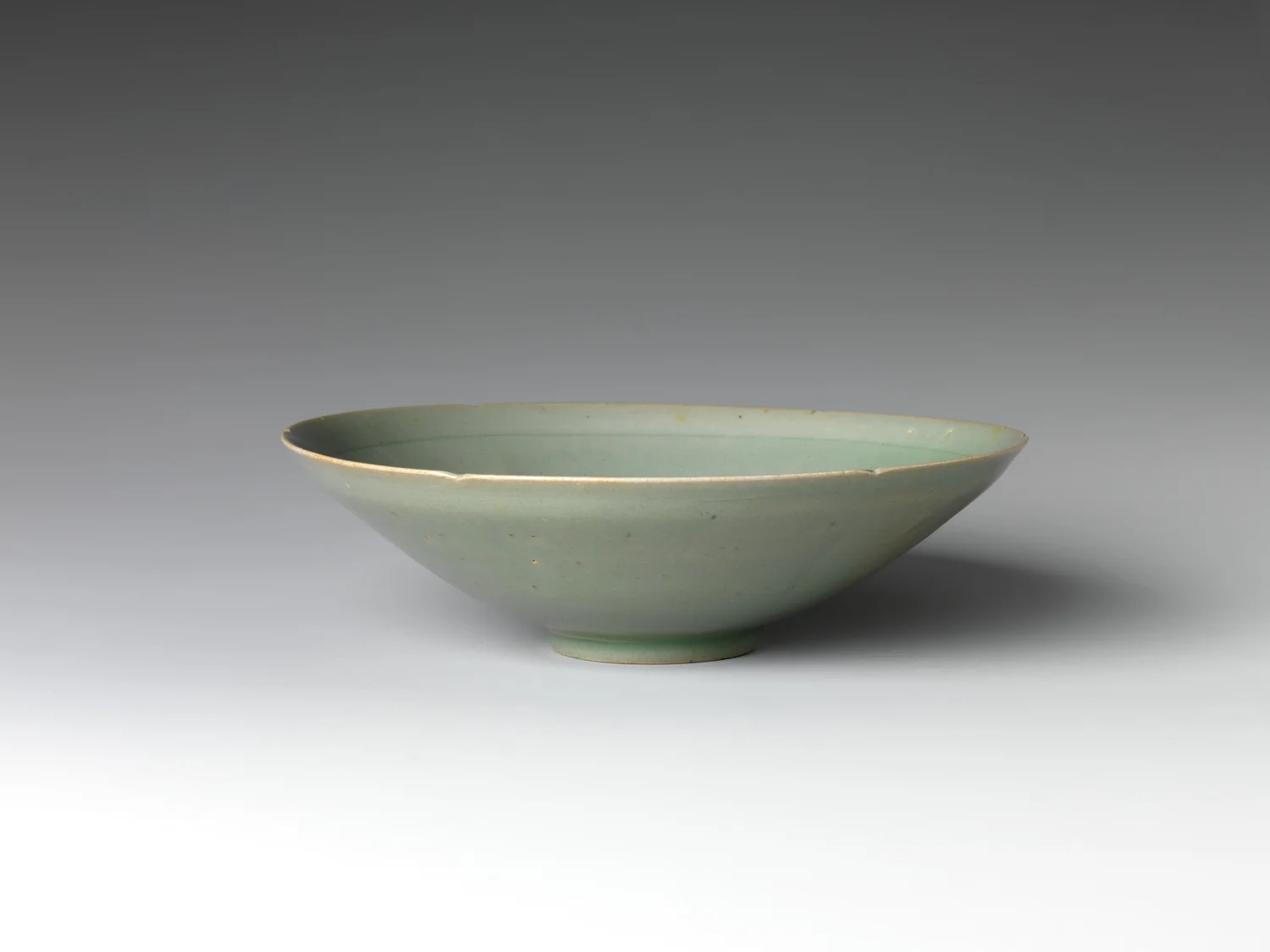
The Metropolitan Museum of Art's side view of a Goryeo bowl sets out a shallow band of gray-green glaze. Light catches the near rim almost as a continuous line. The bowl stands on a much smaller foot and flares toward the mouth. Seen from an angle above it, the outline would show more clearly why the museum calls it six-lobed. Seen very low, the small rise from the ground to the undersurface would attract more attention. Some of the most useful evidence for how this thing was made is on a face neither of those ordinary views shows well.
The Met catalogues the bowl as early twelfth-century Korean stoneware with celadon glaze. Its mouth is just under nineteen centimetres across. The catalogue calls attention to an incised line inside the rim, and to three small marks on the base. The line and the marks were made for different reasons. One is where a person looking into the bowl can see it. The three on the base are evidence that the bowl was supported as pottery was stacked for firing. They can be understood as places where the pot shared a little space with the kiln equipment that carried it through heat.
How to recognize a petal with no painted border
From the side this vessel has a spare outline. It does not have to be read as a picture of a flower. A visitor who has time to look into the bowl can notice changes in direction around the rim. The lobes make the overall form flower-like without requiring petals drawn on the surface. The thin line incised just inside the mouth offers another edge for the eye to follow. One detail belongs to the contour that meets the empty air; the other was placed on the wall where it catches light from a different angle.
A profile and a plan are useful alternatives here. Draw the bowl from the side and a viewer learns about the width of its foot, the flare and the modest depth. Draw it as seen from above and more of the organization around the rim can be seen. Neither drawing can carry the way the glaze changes appearance across the curved surface. One side of the museum photo sees stronger light than the other. Near the opening the curve turns into the light; close to the foot it turns away. A vessel with very little drawn ornament still has activity across its surface because the maker was shaping forms that meet light differently.
Comparing the two views also prevents a hasty conclusion about the foot. Its outside diameter in the museum record is a little over five centimetres, a small base under a much wider dish. Its role in use is easy to see: it brings the bowl up slightly and lets it rest on a relatively narrow ring. That ring belongs to the finished shape. It does not reveal all the places where the bowl was held in the much less ordinary circumstances of firing.
What touches the bowl while the glaze changes
A glaze that reaches the temperature it needs in a kiln is not just paint on a dry surface. At firing temperatures the surface materials can soften and flow enough to fuse with the body. This also creates a problem wherever the piece touches something else during firing. A patch of glaze that bonds well to the ceramic could bond to the surface supporting it. A kiln load has to leave enough space around glazed areas while keeping pieces upright. Different kinds of pottery and glazing create different approaches to that problem.
One way to minimize the meeting is to support much of the vessel clear of other solid surfaces and accept only a few small points of contact. Point supports can leave small interruptions in the glaze or other marks where something touched it. Exact supports and stacking methods vary. The Met identifies the three marks on this example as spurs and relates them to stacked firing. That is specific evidence from the museum's examination. The photograph above shows the bowl upright and does not show the shape of each contact at the base. A reader should give the catalogue credit for that observation.
Consider what the alternative might ask of a potter. Resting a glazed area broadly on another surface risks a broad bond. Exposing a large area of clay as a place to sit may be a reasonable choice for some bowls and inconsistent with the surface a maker wants for others. Small supports restrict contact at the cost of leaving evidence in a few places and requiring the weight to be carried safely on them. The important comparison is how much of the bowl is free to emerge smoothly from the fire, and which parts bear the evidence of having been held in place.
This green cannot be read from one ingredient
Soyoung Lee’s Met essay describes the materials of Goryeo celadon and the way firing conditions contribute to its colour. Iron-bearing materials take part in the result and the amount of oxygen inside the kiln affects how the glaze develops. This is why a patch of its finished colour is a poor guide to guessing the unfired appearance of the mix. The potter has to prepare ingredients and a body that work together in a suitable firing. Changes in atmosphere, materials or the way the coating lies on the surface can matter together. The common description gray-green leaves room for many actual appearances.
There is a second stage between the fired glaze and the viewer of an online photograph. The photograph may be made under controlled light to show the shape and colour clearly. A different light could bring out a slightly different cast or make a reflection sharper. Turn a curved surface until it reflects a broad light source and a streak can suddenly make one side look pale. One cannot work backward from that one streak to a story about an uneven kiln. It is safer to read the photograph for broad relationships and the museum's description for observations or identifications made with the vessel at hand.
The distinction matters with the marks, too. Altering a photo to make a muted variation at the foot easier to see can also make surface dirt or a shadow look like a deliberate feature. A closer image with even illumination would be useful. So would an account that distinguishes three supports from a single chip. A tiny irregularity becomes evidence of making through its position and relation to other traces, not simply because it is the first imperfection a photograph lets someone find.
The bowl belongs to a group wider than its silhouette
Lee puts Goryeo celadons in a history that includes technical exchanges with ceramics made in China and distinct developments by makers in Korea. A single early bowl can be a reason to see what such developments involved without making that one piece representative of the whole tradition. Some related vessels carry incised, impressed or inlaid designs. Others allow more room for shapes, lines and colour fields of the kind visible here. A visitor can compare a boldly decorated surface with this one and see that judging skill by the number of visible marks would not carry very far.
The same care helps in placing the shape in time. A label saying Goryeo describes a period spanning centuries. The catalogue's closer dating of this bowl narrows the comparison. Find another cup with a foliage motif formed in the body, for example, and there may be a useful question about how potters treated curved surfaces in the two pieces. It would not make the cup and bowl the work of the same hand. The museum does not give the bowl a named individual maker in its record. Attention to the way it was made can be specific even without that other kind of identification.
The three points underneath supply a different group to think about: other vessels or pieces of equipment sharing a firing. The surviving bowl arrives alone in the display. Part of its preparation was aimed at how it would sit in company with other things, in a hotter and tighter setting than the space around it today. A gallery has room to give one vessel quiet attention. The marks ask viewers to imagine the practical arrangements before a gallery object could be removed from the kiln on its own.
Follow the two most unlikely neighbors
Imagine turning the bowl over, without asking to handle it. The incised circle near the rim disappears from view and the support marks become the details to seek. Turn it back. Now the things described in the catalogue can occupy their separate positions in one mental image. The marks are near the foot, where their smallness helped limit visible interference with a broad glaze. The line near the mouth helps articulate the inside, where a viewer can see the bowl's thin and shallow form.
One kind of mark makes a line easy to follow. The other has to be followed backward from a finished surface to the moment of contact during the firing. Studying both lets a person look at the spare green bowl again with two different interests. It is a flower-like shape someone chose to make. It is also an object that had to be held somewhere while that shape and colour were made durable.