The Drawer Under Riesener’s Writing Table
A surface that looks ready for a letter can become a bookstand or reveal a mirror. Jean Henri Riesener’s table turns a small piece of furniture into a sequence of positions.
In this story 5 sections
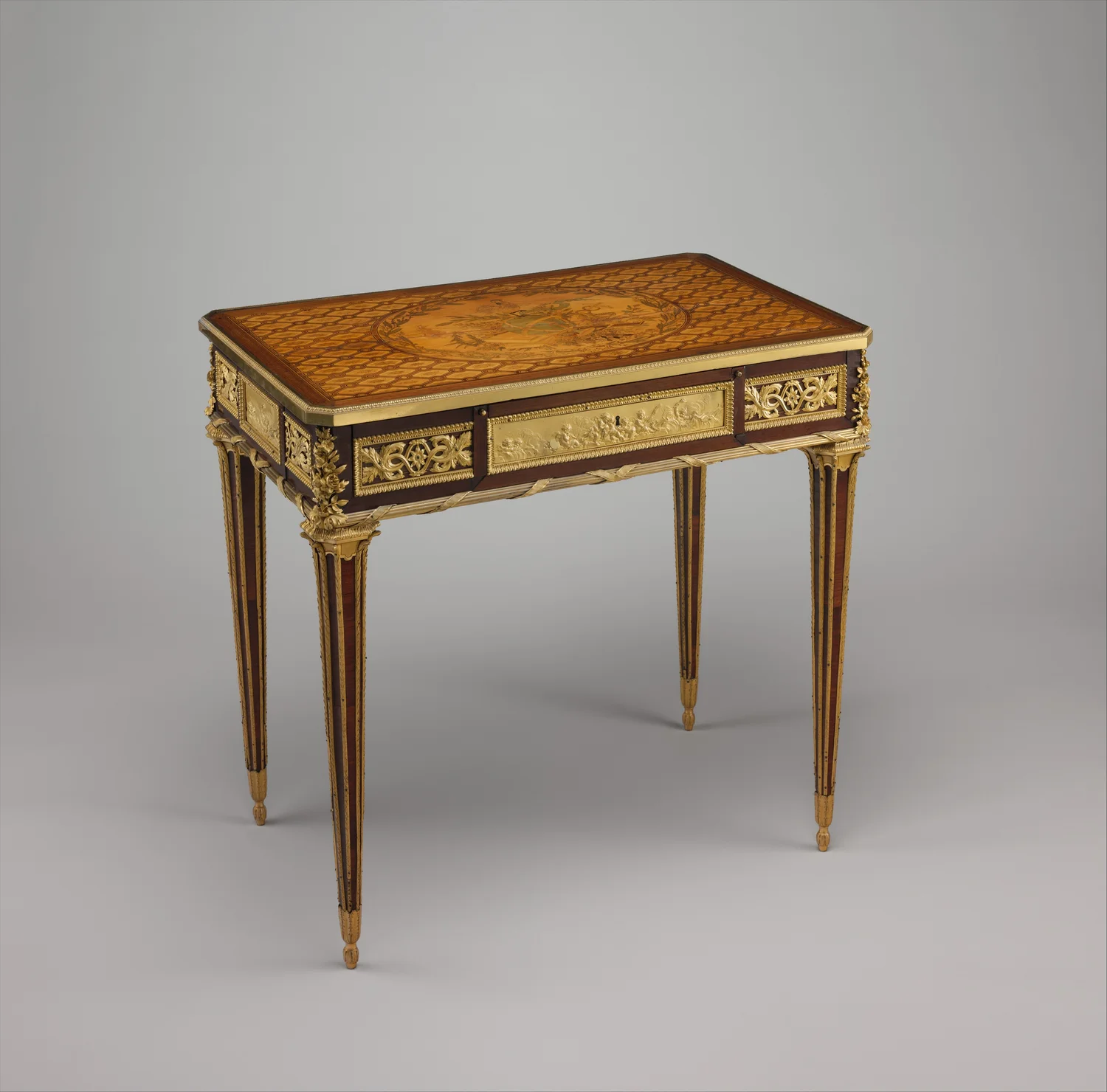
The most generous answer to the question where is the writing table? would be to point at the whole piece of furniture. That is how an inventory of 1789 described the table by Jean Henri Riesener now held by the Metropolitan Museum of Art. The term is also remarkably economical. To find the writing surface a user could put the furniture in a different position. Further changes made a bookstand or exposed a mirror. All those things occupied one table's worth of space, though they were not all available in quite the same way at once.
Riesener made the table in 1781 for Marie-Antoinette's rooms at Versailles. The museum also connects it with her later dressing room at Saint-Cloud. Those are statements about the object and its documented placement rather than evidence of what a person did with it on one given morning. They do help explain why a piece that offered several uses was named by one of them. Furniture can be useful in a room because it is ready to become something that does not need to be visible the rest of the time.
The top and drawer go in opposite directions
The Met records that the top can slide backward as the main drawer moves forward. This is the first movement worth considering. In many tables a drawer can be pulled out under a fixed surface. In this one the relative movement changes access above as well as below. The closed top with its decoration is one arrangement of parts. The open drawer brings surfaces into reach and reveals features that the ornament outside does not advertise in detail.
Try sketching a side view with the extended and closed positions marked. The open table takes up a longer space in the direction in which the user is standing or sitting. The top shifts in a different direction. A picture of an object on display can show where those parts are, but an imagined room has to accommodate both movements. To understand the use, give the furniture room where its surfaces travel. The footprint of four legs is not a full account of the space the object needs when operated.
A side view also makes one of the design's tradeoffs clear. The user controls something near the front, yet the result must be coordinated with part of the table farther back. Opening the drawer in isolation would be relatively ordinary. Making both the drawer and the top change their positions in relation to one another gives the first gesture a wider effect. The museum's account establishes what the joined movements do. Identifying a particular hidden gear or connection would need closer evidence of the mechanism than the facade gives.
One piece provides three viewing positions
The central compartment contains a writing surface covered in velvet. The museum describes that surface as adjustable to act as a bookstand and reversible to reveal a mirror. Those are not three names for what a person does at a fixed height. Writing makes sense with paper supported in one position. Reading a propped object brings the eye to a surface at a different angle. A mirror makes the direction of the view part of its operation. The useful result changes because a surface changes relation to the user.
This is a better way to describe the furniture than adding up its possible uses and calling it versatile. It explains which surface is available and how it helps. A bookstand is helpful when it stays at a suitable angle and gives the material something to rest against. A mirror is helpful when the person can see themselves from a position they can actually occupy. A single drawer can contain both possibilities. Its construction still has to provide the necessary positions and clearances.
The museum's material list identifies the green velvet as a replacement rather than original fabric. That is a small detail with a large consequence for interpretation. An image of the writing surface can show colour and how the furniture is arranged today without providing evidence for the precise texture or colour used by Riesener. The replacement can help present the function while preservation records keep the current state distinct from the original one. A well documented object does not need to hide one date to be useful evidence about another.
Decoration follows pieces that can disappear
The top is decorated with marquetry, including patterned compartments and a central composition associated with literary and poetic pursuits in the museum's description. Other decoration appears on interior surfaces. There is a change in what the viewer sees when the drawer opens. The decoration normally in full view belongs to the closed table. Further work becomes visible on parts whose role is more intimate and intermittent. The object does not tell the same visual story at every stage.
Marquetry makes a picture or pattern from fitted pieces of veneer. A record of which woods were used can make an attractive surface more specific. The Met also connects differences in preservation to exposure: some decoration protected inside the furniture is better preserved than the work on top. Two areas on the same piece can therefore repay comparison better than attempting to guess the intensity of original colours from one faded view. The comparison does not remove the possibility of earlier repairs, but it gives the question actual surfaces to work with.
The outside and inside need different kinds of looking. From across a room, the top can make the furniture read as an object with a coherent field of decoration. Close to the drawer, the observer can see edges and smaller panels previously hidden by the arrangement. Seeing both is a reason to keep several documentary views. The elegant top is an important part of Riesener's work. It is not the entire evidence of where he put its ornament.
An inventory and a photograph describe at different speeds
The older inventory name helps establish how furniture was identified among other possessions. It was not meant to give a mechanical demonstration. A modern collection record can afford to name the changing positions and show views of the table. Even that record may not capture the timing of a typical use. A static image of a drawer partly out could be interpreted as a final position or merely a moment in the process. A good caption can settle which state the photograph is intended to document.
Consider what a small museum label would have to choose. It could show the table closed to emphasise the pattern of the wood. It could open the table to explain the changing surfaces, if the object's condition and display arrangements allow. It could provide a separate illustration of a position that cannot be displayed continuously. The useful choice depends on whether visitors need to recognise the object, understand its movement or compare details of the decoration. No state has to stand for every possible question.
The object number helps a reader who sees only one such view. It links that view to the same table after a different configuration or place of display has been documented. Without the link, the open and closed versions might look like two closely related objects. With it, an apparent difference between two pieces becomes evidence of what one piece can do. The identifier has a practical use beyond helping a store room find a location.
What a table keeps ready
A revealing comparison is the architect's table by David Roentgen also described by the Met. Its top can rise, and a support emerges to hold reading or drawing materials. The similar idea is that presenting a surface involves making it stay in a position and allowing an object to rest on it. The different idea is where the action happens. In the Roentgen design, lifting the visible top announces part of the function plainly. In the Riesener table, moving the top and drawer brings a separate piece within the drawer into use. The same word table encompasses two ways of making a different working angle available.
The comparison does not require supposing that one maker copied the other. It brings attention to the problem represented in each surface. To hold a book, provide a plane that faces the user and a lower edge that arrests movement. For writing, provide a place where the hand can travel over paper. Describing the actual supports makes the small change of angle easier to appreciate than a list of the furniture's possible labels.
The change from writing surface to mirror is easy to describe in a sentence. It could still have mattered to someone using one room for a succession of ordinary activities. A smaller surface concealed in the furniture makes it possible to keep a material ready without leaving it in view. Setting it at the appropriate angle changes what the body and eye can do next. These are about the arrangement of a room and the position of a person as much as the ingenious construction inside a drawer.
Look at the table as if it were about to stop being what it first seems. Think about where the top has to pass and how a drawer below brings other surfaces closer. Then ask what the closed table hides well enough that a simple inventory can name it for one purpose. The old account need not have been mistaken. With a piece like Riesener's, writing is one state among several that can be fitted into the same object, ready when somebody needs it.