The Cord That Closes an Inrō
The lacquer case, sliding bead and sash toggle have separate shapes, but one cord makes them a wearable container. A nineteenth-century example shows how the mechanism shares room with the decoration.
In this story 5 sections
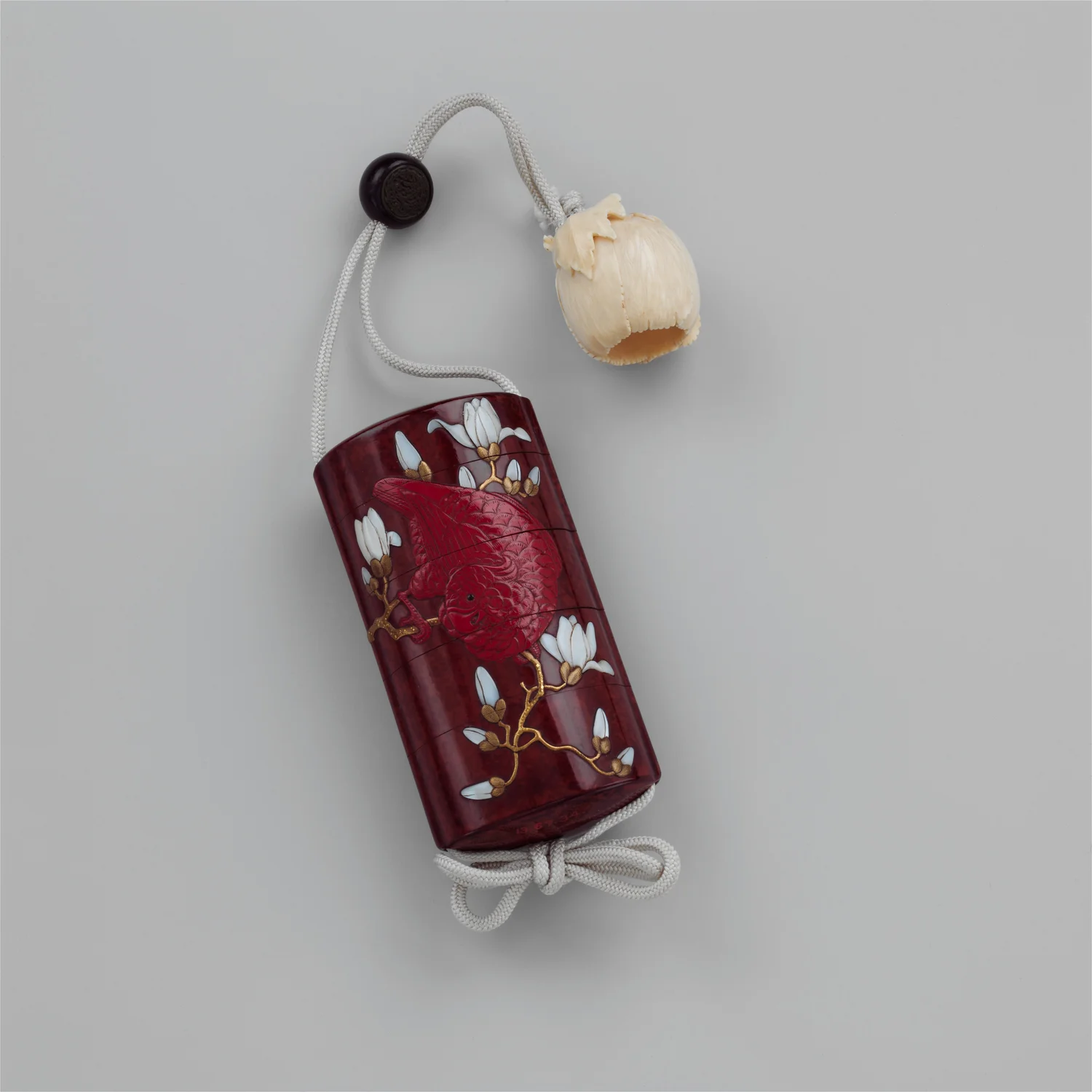
A cockatoo and a magnolia decorate the Metropolitan Museum of Art's red lacquer case. A slender cord enters at the sides. The three things are easy to distinguish at a distance, but you have to look more closely to make out the horizontal joins in the lacquer. The case is divided into levels. The pieces can be separated to reveal the hollows within them, then nested together again. There is no prominent metal clasp. The cord is already where the maker needs a closure to be.
The museum names the object Inrō with Cockatoo and Magnolia. It dates the Japanese piece to the nineteenth century, gives it a height of a little over nine centimetres and associates it with Yamada Jōkasai. The catalogue records gold decoration against red lacquer and identifies a poppy-shaped netsuke and a smaller bead. These details help a viewer read it as something assembled rather than as a single sculptural block. The inrō itself is the container, the netsuke catches at the sash and the bead travels between them. Each part can be admired alone. In use, the functional shape of the object runs all the way from the knot underneath to the toggle where it meets the wearer.
Allow a little slack
The museum's curatorial essay describes how one cord can do more than suspend a case. One end passes along a channel on one side of the body and the cord is also passed through the toggle and around to the other side. Its ends are secured below the container. Between the toggle and the case sits the bead known as an ojime. Where the cord passes through that bead, the two lengths are drawn together. Push it down toward the top of the container and there is very little room for the stacked pieces to move apart. Slide it away and there is slack on both sides. The sections can open while remaining threaded onto the cord, rather than becoming pieces that must be set down one by one.
The order matters. A closure meant to travel on a thread has to sit between things that stop its movement. At one end there is the case. At the other there is the toggle, set where the cord changes direction. A knot in the wrong place could make the bead ineffective by using up the same spare length needed to uncover a space inside. A tight fit between sections alone would demand that the sides be pulled in opposite directions. Here the sections have a physical fit, and the position of the bead also governs how fully a hand can separate them.
Think about the moment after retrieving something. The owner can draw the pieces together with the same cord that keeps them in sequence. Once nested, the container presents much the same decorated face as it did a moment before. Lowering the bead is a movement over a short distance, performed on a part of the object that is already under the fingers. A convenient-sized handle on the outside of each tray might have made it easier to identify in isolation. The complete case has little need for several projecting parts because they have another way to stay together.
A toggle does its work against cloth
The vessels and pouches that hung from sashes belonged to a broader group of suspended objects. A sash secured the garment and supplied a place for a cord to pass. At its upper end something broader than the thin cord could keep the assembly from slipping away. This is the everyday work of the netsuke. With the sash between the hanging case and the toggle, the shape at the top bears against cloth as the case draws down at the end of the cord. The same part can be unseated deliberately when it is time to handle the case.
The result cannot be judged by weight alone. The place where the cord enters and leaves the netsuke influences how that little sculpture sits. Rounded shapes and the placement of the cord holes matter near fabric, where a catch at the wrong time would work against the convenience of suspension. A viewer seeing a detached toggle in a cabinet can look for two openings that belong to one threading path. If one is on a surface that would have been close to the sash, the least immediately visible face of the carving may have held the clearest evidence of use.
The full ensemble also makes it possible to see different occasions of visibility. The case hangs where a person moving beside the wearer might see it. The toggle is at the sash. The bead moves but stays between those two. Three ornamental objects placed very close together in a photograph can once have been spaced over more of the clothing. The finished pieces also need not look alike to belong to an ensemble. On the Met example the bright material and bird decoration of the case are distinct from the carved poppy. Each was fitted to a separate task.
A plant painted over a join
On the museum's case, the decoration is not confined to a square in the middle as it would be in a framed picture. The viewer follows the shape of the object, its edges and differences in illumination. Red lacquer, gold and lustrous shell do different things as the viewing angle changes. Behind that first impression is the small puzzle of a design distributed over parts that can move. An edge may read as a drawn line from one direction and as a working join from another. Opening the container interrupts a view that the assembled object seems to offer all at once.
The visual interruption is a useful check on the idea that a decorated exterior comes after the actual purpose of a thing has been solved. In a case this small, there are few surfaces to spare. The joints and cord paths must have a place among the decorated fields. A leaf or feather near those boundaries will be seen along with them, whether the marker of a seam is pronounced or barely detectable. A case that will be held and tilted has to carry the ornament around surfaces that the eye reaches in sequence. Even in the museum photograph there is a strong distinction between the face in full view and the narrow side that turns away.
One can approach the design through those narrow strips rather than counting all the motifs first. Look for where the repeating edges of the compartments establish a rhythm across the face. Then attend to how a form such as a petal or the outline of a bird draws the eye in a different direction. The closure need not be invisible for the decoration to work. The very limited space shared by fit, suspension and imagery is one source of interest.
What comes apart in a museum?
A catalogue can keep the relationship of the parts visible even when the case is photographed at rest. It names the bead, tells the reader which materials belong to the body and distinguishes the carving on the netsuke. It can also name what cannot easily be seen from that angle. The Met reports a signature on the underside referring to Jōkasai and explains that artists in the Yamada family used the name. A label therefore has room to record an attribution without inferring an entire biography from a mark. An image of the closed exterior would be a poor basis for deciding by itself who made every removable part.
One can learn something by comparing that description with the general account of suspended objects, without assuming that every piece of the surviving ensemble looks as it did at a particular moment of wear. A cord can be replaced. A collector might value a good carving separately from the article it once helped to suspend. Different materials age differently, and pieces displayed in museums have their own acquisition histories. The key question for a viewer becomes which connections are visible in this object and which come from evidence of how other examples were worn. The image and the written history can answer different halves of it.
Understanding the threading also gives a detached piece some context. A person might recognize it as small enough to carry and even guess the subject of the carving correctly. What brings it into relation with the rest of the ensemble is a cord running through it. Through that cord the netsuke takes the weight of something staged lower on the garment. Knowing that changes which face of the object is the front in use; the carving can be turned by a hand and then fall into a habitual position on the sash.
Study the small movement
There is a useful last comparison between the knot and the bead. The knot is meant to stay where it is for as long as the case is in service. A loose knot underneath would allow the rest of the arrangement to come out of its channels. The bead is meant to change position frequently. Its movement is as essential to the inrō as the fact that the knot holds. Both constraints lie on the same short length of cord. A viewer can identify them without trying to open the museum piece.
The little distance between the lowered and raised positions of the bead offers one way to read the entire object. Closing and carrying, two jobs that could call for separate fittings, draw on the same material here. The decoration on the case remains legible throughout and gives no special prominence to the mechanism. Once you know how the cord runs, there is always another thing to see alongside the cockatoo and magnolia: the hand that could release the compartments and carry them away again with a single movement at the top.