A Stage That Fits on a Table
The sheets sold for a paper theater were not a finished show. A surviving Pollock print helps explain what had to happen between choosing a scene and raising the curtain.
In this story 5 sections
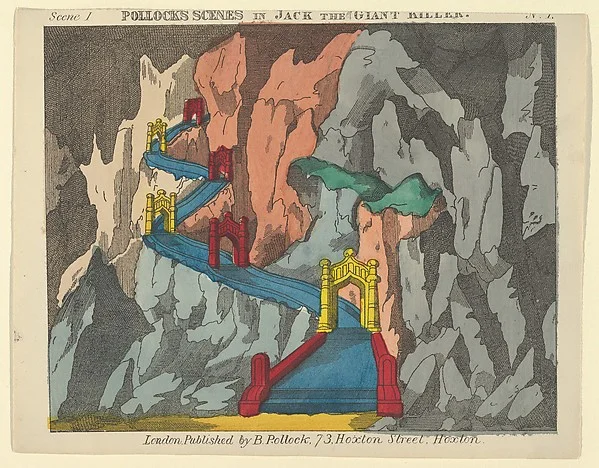
The paper shows a route through rocks. Coloured steps and little bridges wind across the scene, changing direction each time they meet a face of stone. Overhead, the frame of the print leaves enough room for a short printed title. A viewer can admire the picture as a landscape, but its label in the Met's collection makes a better question possible. The museum calls it Scene 1 from Jack and the Giant Killer, part of a set of scenes for a toy theater. Somewhere off the edge of this print there is a performance to arrange.
The museum dates the lithographed sheet to 1870–90 and names Benjamin Pollock as its publisher. It measures about seventeen by twenty one centimetres. Those are the dimensions of the piece of paper, not necessarily of a finished stage. The paper has a title and edges that can belong to a print in a folder. A tabletop version of the scene has to fit behind an opening, with room in front for figures to pass. That distinction between the printed work and its eventual use is where the little theater starts to feel less like an illustration and more like a room.
The thing you buy has work left in it
Toy theaters in nineteenth-century Britain took designs and stories from contemporary stage productions and brought them home in sheets. The University of Kent's Pollock collection describes the form, known as Juvenile Drama, as a souvenir of live theater. A souvenir might be a picture of something already finished. In this case the purchaser could become the person responsible for setting the next scene. The choice to buy paper, rather than preparing one more pair of seats in a real auditorium, changes the whole audience.
Miami University's collection gives a useful inventory of what could survive: character plates, settings, wings and scripts, in both colour and black and white, alongside theater accessories. That list is a better guide to how the theaters worked than a single picture of an assembled model. A scene on paper is one thing to place. A figure is another. A script can tell the handler when a figure enters. Each survives perfectly well alone as a collectible, but the show asks all three to refer to something that happens at the same moment.
The price formula often associated with the form distinguishes plain sheets from coloured ones. As Miami University's collection notes, purchasers could pay for printed pieces in either state. A plain sheet offered a home colourist more decisions about appearance. A coloured sheet did not remove the need to decide how the piece should stand, which surface belongs to the auditorium side and what order the pieces should enter. The completed performance was not included in either price.
One picture occupies several spaces
Look again at the winding route on the Pollock sheet. Width and colour give the eye reasons to think that different parts of the printed landscape sit at different distances. But the narrow coloured path cannot actually carry a character into the distance. It belongs to a flat view behind the playing space. Bringing a figure in front of that view can suggest a great change in distance without moving the paper far from the spectator. The image and the construction each have a part in the effect.
Physical wings can add a second kind of depth. A strip of scenery near the side of an opening can partly cover a figure or hide the edge of a backdrop. Layer one wing behind another and even a shallow stage gains a few places to put an entrance. A National Trust collection record for a toy theatre describes a wooden base and grooves for fitting scenery; the surviving arrangement makes plain that the designer of the frame had to leave space for pieces to sit at more than one distance from the front. The viewer can experience a single place while the person setting it has to handle several slots.
One way to understand the difference is to draw the arrangement from above rather than from the audience. From above, painted rocks need little detail. Lines can stand for scenery and a strip for the opening. The useful information is which piece sits in front of which, whether the figure can fit between them, and where a hand can reach without showing. An audience view might be beautifully finished and never answer those questions. A plan of the model might be barely more than pencil marks and allow somebody to run the scene.
The opening guides the eye
A proscenium gives the small stage another job: it tells someone looking where the performance begins and ends. Behind the frame a handler can move a piece towards the middle. In front of it a viewer might see only a character arriving. Too tall a setting may disappear behind the top of the arch. A figure with small features can look surprisingly articulate close up and blank a little farther back. An arrangement made from accurate scale measurements still has to be checked from the seats available in the room.
The miniature can show one of the full sized theater's problems in a particularly plain way. Try imagining a spectator much to one side. A near wing can cover a piece that looks clear from the middle. The opening can expose a fold or support it was meant to hide. Moving the chairs changes that view quicker than painting a new scene. To learn what an apparatus was meant to do, it helps to think where it put the person watching.
Scale affects the sound as well. A figure has no separate voice. It may need a reader who can maintain a line of speech while bringing the next person into position. A long pause spent finding a misplaced cutout lands differently when the audience is within speaking distance. The familiar size of the living room makes the timing of the performance feel more intimate. It takes surprisingly little space to make a mistake visible to everyone.
A script doubles as a set of instructions
The words spoken in a toy theater can be read as miniature dialogue. Another reader has to use the script to prepare changes. Suppose the first scene needs a backdrop, a figure already in view and a second figure that arrives after a line. Storing those objects in that order beside the stage is more useful than putting the paper figures away alphabetically. A later scene may need the first figure in a different position. A short mark in the margin, or a small pile of pieces within reach, can tell the next handler more than a polished speech.
Imagine replacing the whole stack of scenery during an interval. Removing the backdrop first could expose the edge of the stage. Moving the figures before the curtain closes could look like a hurried exit. The operator may discover that a change must be read backward: start from the first image the audience should see after the break and work out what can be prepared before that. The print does not show the pause. The assembled performance has to make space for it.
A missing script does not make a printed setting empty. The sheet can show the name of a play, scene number, printed colours, unused borders and the publisher's details. But it will be poor evidence for how one particular family read the speeches. Those words might have been shortened or spoken by several people. A collected copy that bears no cut marks cannot tell us whether a second copy of the scene was used somewhere else. Curatorial care keeps evidence of the intended possibilities distinct from a record of any particular evening.
A complete sheet and a used theater
A sheet that has not been cut keeps information an assembled frame can lose. It can preserve the relation among printed pieces, the caption and the margins untouched by a blade. A figure with visible supports or an edge worn by the handler gives evidence of different work. It may preserve how somebody used it even after the name printed near it has gone. Museums have reasons to care about both states. Neither needs to be made to look like the other.
That is a useful reminder before inferring a stage from the sheet pictured here. Its irregular rocks and strong steps are evidence of a design. The opening that once framed them in a particular home, the time spent colouring another copy, the placement of a small lamp and the moment a figure moved are separate questions. They would need an assembled theater, another document or a surviving account. You can appreciate the planning that went into a paper scene without claiming the picture records a rehearsal.
A tabletop theater also invites a modern reader to define what counts as a work. If the answer is only the adventure in the script, there is too little room for the sheets. If it is only the physical sheet, the little grooves at the back of the stage cease to make sense. Imagine putting Pollock's Scene 1 in a frame at home. Behind the opening there would still be the rocks and the path. In the hand there would be another piece of paper, due to enter after a line. The print gets its dimensions from the sheet. The theater gets its life from that interval.