The Wood Under an Mbira’s Keys
Metal tongues vibrate against a shared wooden support. The details of that connection, and the choices performers make around it, matter more than the familiar label of thumb piano suggests.
In this story 5 sections
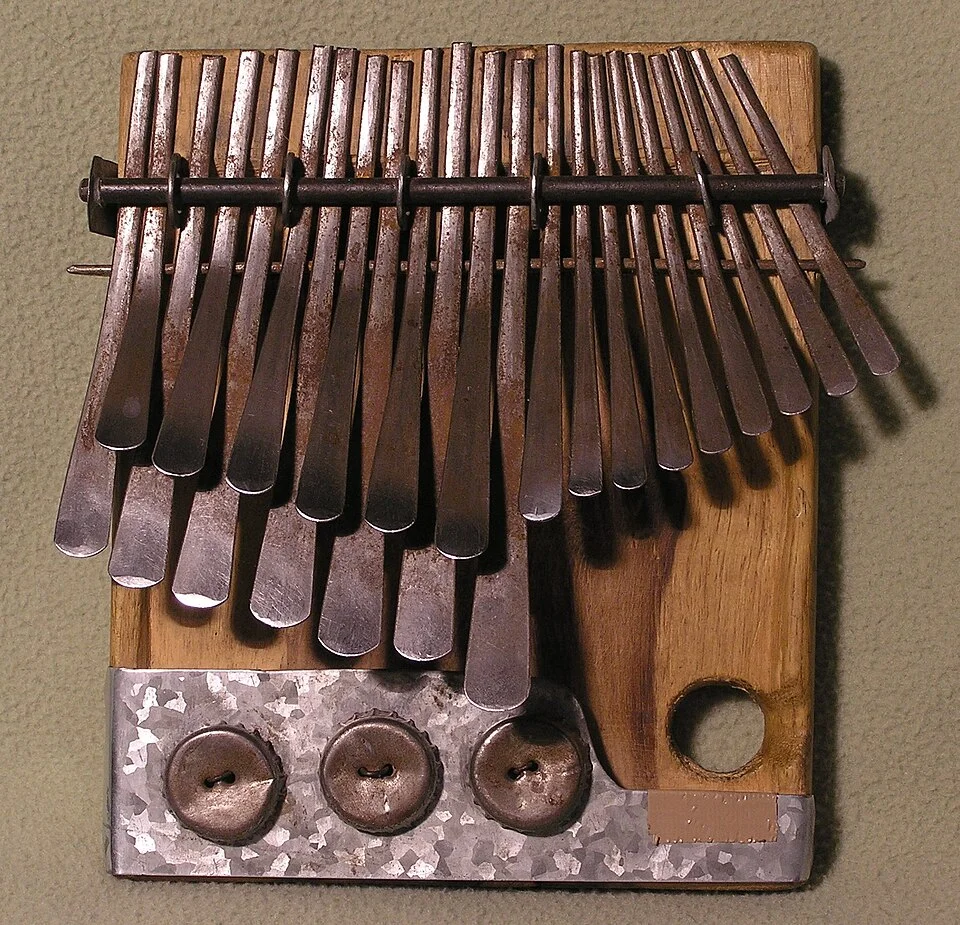
The keys in Alex Weeks's photograph are not waiting to disappear into a wooden case. Much of their length is visible against a board. The free ends spread beyond the narrow area through which rows of metal are held in place. Rings or other small pieces of metal near the lower edge draw the eye after the main keys. A viewer could stop at describing it as a compact keyboard. Its outline has another advantage: it allows the things that make sound and the things that support them to be seen together.
The photograph is identified as an mbira dzavadzimu. UNESCO describes the art of crafting and playing Mbira/Sansi in Malawi and Zimbabwe through a joint inscription, which includes traditions of mounting metal keys on a wooden board and using the thumbs or a combination of fingers and thumbs. Such a description does not make all instruments with plucked metal tongues interchangeable. It introduces a family of ways to use materials and play, while leaving the name of a particular form and the history of a particular object worth keeping.
A key makes sound as it moves back
A plucked tongue bends and returns. Part of it is held, and part can move. Press it lightly and release it, and the metal springs back and vibrates. The disposition of the fixed and freely vibrating lengths helps decide how that action behaves. A painted key in a photograph does not show that movement. A view in which the tongue's edge and support are clear can make what will move easier to imagine.
This is one reason the familiar phrase thumb piano is of limited use. It can suggest the small field of positions offered to the hands. It does not describe how the sound starts. The player releases the spring of a short metal tongue. A piano's mechanism sets a string sounding with a hammer. Both can organise notes through repeated finger gestures while having quite different ways of transferring that motion into sound. The word key is helpful when it names the position a player addresses; it needs an additional description to explain the process.
From the photographed surface, the different outlines give a clue that the tongues need not share all their dimensions. Length, shape, thickness and the way a tongue is held can affect how it vibrates. A picture does not give the exact pitch of every key. A note describing the tuning of one instrument should be tied to the example, maker or recording where possible. Treat the shape as a way to ask how the pitch was produced, not as sufficient proof of the whole tuning system.
The board is more than a convenient handle
The wooden board is a support for a set of vibrating parts. It is also part of the way the instrument passes vibration to the surrounding air and to any additional resonating structure. UNESCO mentions that some examples are mounted with a calabash or a wooden resonator. A performer holding the instrument at the surface of a larger resonator can be making use of something a frontal photograph of the board alone does not show. The arrangement matters when a reader tries to account for a particular recorded sound.
Consider two pictures. One shows a board with keys clearly, so it is good for locating the fixture that holds each one. Another shows the same size of playing surface in a gourd, making it easier to see how a broader form sits around it. The second picture is not necessarily the better illustration of the keys. An audience listening to a performance might hear an effect of the larger arrangement that the first picture cannot make visible. Keeping both types of evidence can help show that a movement of the thumb is only the first stage.
The position of the instrument in the hands also affects what a person can reach. A crowded field of metal from above becomes a set of possible choices from the player's point of view. Some notes can be approached with different fingers under particular playing techniques. A labelled graphic can leave space for one person's convention without turning it into a rule for every tradition included under the broad name. The UNESCO entry's recognition of several ways of plucking is a useful reason to take that variation seriously.
Listen for more than a clean pitch
Small additions to a board or resonator can sound along with a plucked note. Smithsonian Folkways' notes for a Botswana recording, for example, identify small rings on an instrument described as a setinkane. They add their own sound. That is a comparison with a documented different example, rather than a description of every object called an mbira. It makes sense to notice the additional metal visible in the cover photograph and to ask what it might do. The still image does not establish that the filmed or recorded result of a performance will match the Botswana example.
A buzz can be meaningful to a player even if somebody accustomed to other instruments first hears it as stray noise. A description that gives only a measured pitch would not include it. The effect need not have the same significance in every setting. Listen to a documented performance and name what its record says about the instrument, setting and musicians. Learn where the added sounds come from on that occasion if the evidence is available.
The differences among use, construction and recording become clearer if a listener attends to the initial pluck and what remains just after it. One sound can be bright and brief. Another can be heard alongside it or persist when the movement of a hand is no longer visible. Room, resonator, instrument and recording equipment affect what reaches the listener. The version of the instrument named in a caption is an important starting detail. It does not make all sound experiences of it identical.
A performance is also a learned way to use the instrument
UNESCO's entry describes transmission of skills, including how crafting and playing knowledge are shared. That steers the story away from being merely a list of materials. A visitor can recognise the wooden board and count pieces of metal without understanding how a performer organises time, learns patterns or plays with other people. Those abilities belong to people and practices. They do not become available just because someone has acquired a similar looking instrument.
The same distinction helps with community names. In one region or context, a particular name can refer to a recognisable instrument and associated traditions. Another name in an international listing can keep neighbouring traditions visible. An article can use those names carefully and retain the scope used by its sources. It should not take a selection of photographic or catalogue examples and infer that every community has the same reason for playing, the same method of construction or the same repertoire.
Sight offers one more point of entry. Turn an image of a keyboard instrument so the lowest notes are at the left and someone accustomed to it can predict roughly where the hands will move for a rising line. It is tempting to demand the same result from the mbira because of a familiar English nickname. Before drawing a diagram from an isolated photograph, look at how the instrument is held and which part of each key lies within reach. A long tongue and a short one can sit near one another. Height in a photograph may tell you more about where a finger can comfortably land than about what note it will produce. In a recorded example the two hands can supply sounds close together in time. An account of the pitches in the order they appear does not necessarily show the sequence experienced by either hand. This is part of the learning a still photograph leaves out: the player connects the shape within reach and the sounds already in mind.
A small documentary exercise makes the order of the evidence plain. Start with the source identifying the photo and the material parts it shows. Then consult a record concerned with actual playing and transmission. If an individual performance is discussed, keep the person, place and recording together. The record of an object and the record of a player can then complement each other without picking an anonymous performance to represent all the places in which similar instruments appear.
The useful view is made of parts you can see and things you can hear
Return to the ends of the keys. In this photograph they can be followed to a region where they are held against the board. Imagine each location as a place from which a small vibration can begin. Now put the picture beside an account of a resonator and a performer using it. The relation of hand, metal, wood and the surrounding air becomes one intelligible chain rather than four separate facts about an instrument.
No picture has to sound for this comparison to be useful. It can show an arrangement that a recording alone would leave invisible. The music can show learning and choices the metal itself does not contain. The small piece of wood brings those accounts close enough to see why they belong to the same subject. It holds the keys in position until a human gesture takes over.