What a Magic Lantern Operator Moved
The lamp could stay still while a wheel turned in its picture. An early lantern and a set of surviving slides show the difference between projecting an image and performing one.
In this story 4 sections
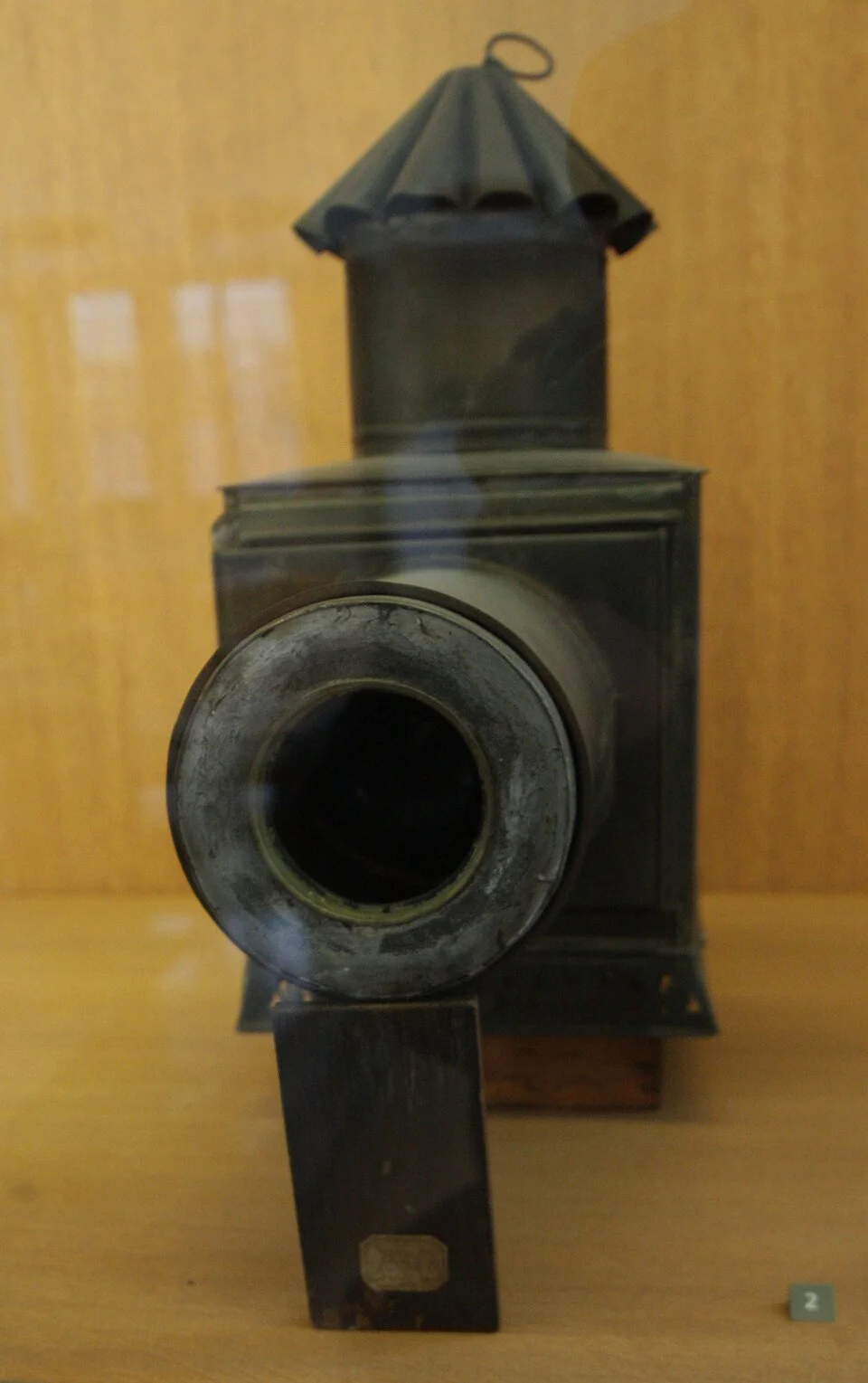
There are two objects to look for in a magic lantern show. One is the lantern, with a body to contain light and a lens pointed toward a surface. The other may be out of sight as soon as the image appears: a piece of glass bearing the picture. A nineteenth-century lantern can look surprisingly complete on a museum shelf without its slides. For a person waiting for the demonstration to start, the empty projector would be a promise that had yet to show anything.
The lantern photographed for this page is from the Musée des Arts et Métiers and is identified as an example from 1818. The museum describes magic lanterns projecting images painted on glass with the help of a light source and a lens. Another collection, held by the Science Museum Group in Britain, preserves slides with parts that move. The photographed French lantern and the British examples are separate objects. They are useful together because they put the image and its operation back into a story that can otherwise stop at the machine.
The picture was small until it met a room
A transparent slide offers a way to put the same composition on a much larger surface. A mark on the glass can become more conspicuous by being enlarged, though any flaw can grow along with it. The size of the audience and the placement of the screen are therefore part of the picture's success. Something that can be inspected comfortably in the hand may require a darker room or more careful focus to be legible to people farther from the screen.
Compare what is visible in a display case with what a person would have seen during use. In the case, the brasswork and housing may be the brightest things. On a wall, the shapes transmitted through the glass are the point. The audience can see part of the effect without knowing where in the apparatus the thin rectangle of glass sits. The photographer of a lantern has good reason to put the object in view. The operator has good reason to direct attention elsewhere.
Still pictures deserve to be included in that account. The Cleveland Museum of Art describes using slides for presentations and education, including lectures alongside gallery visits. A projected image could make a work or detail available to a group without a mechanical transformation inside the slide. The speaker's words, the selection of pictures and changes from one image to another give a sequence its own timing. The ability to move part of an image was a different possibility, not a necessary feature of a lantern.
A little displacement can become an event
The Science Museum Group's catalogue describes slipping slides in which one piece of glass moves in front of another. A worker can place two images very close to alignment and shift one while the lantern stays in place. The result depends on what was put on each piece. A still area can provide context while the moving area adds or removes something the audience can see. The mechanism does not have to move a large distance merely because the projected event looks large.
A lever slide offers a different action. The same collection describes examples with glass mounted to turn partway through a limited arc. One could watch a printed arm swing without seeing the small movement that guided it there. The movement is bounded by the apparatus, and the bounds may suit a particular picture. A short turn is enough to suggest a repeated action. A longer rotation would serve another kind of scene. Calling both of them movement leaves out the careful choice of how something had to move.
Consider the collection's water mill effect. A slide is catalogued for superimposing window light and a water effect on a mill scene. A viewer does not have to see each layer as a separate surface. A still building and the active details can appear as parts of one view. In a storeroom, the fixed setting and effect slide are different pieces to find and identify. Matching the intended parts makes the difference between a convincing small performance and two pictures with unrelated light passing through them.
It takes a person to choose the moment
The mechanism can establish how far a moving part travels. It does not determine exactly when a presenter should use it. Picture a hypothetical lecturer describing a building, then advancing the slide before the audience has identified the feature just named. Nothing about the glass is defective. The transition happened before the arrangement of speech and picture was useful. A presenter keeping a picture on the wall long enough for people at the back to locate a detail is doing another kind of work with the lantern.
For a moving scene, the first and last positions matter too. An effect performed repeatedly can be comic or distracting depending on how long it goes on. An operator preparing the next slide may need to establish where the previous scene should appear to end. The mechanics offer options with a particular feel. They do not preserve a recording of how one show used them. An account by a spectator could supply an impression of timing that even a complete box of slides cannot.
A rehearsal might note something as simple as which side of the screen faces the audience or whether a slide is in the correct orientation in the apparatus. Those details become obvious only when the whole setup is tried. A card with a sequence printed on it could make the show easier for a second person to prepare. A collection of surviving slides can reveal the available material without answering whether it was shown in the order in which it was found.
What the slide and lantern each leave behind
The fixed and moving portions of an effect can be usefully listed as separate items even when they are present in one wooden frame. A new catalogue entry might give the scene, the material carrying it, the thing a hand moves and the direction in which it is permitted to travel. A conservator then has evidence about what ought to move before meeting a handle that seems to be stuck. A reader can use the same description to work out which parts of a picture were designed to remain aligned. Naming what moves is often more specific than rating the slide as merely mechanical.
A change from one piece of glass to the next can work at a larger scale than the turn of a lever. The lecturer or show operator has to decide whether darkness between views is a pause, an interruption or a time to let an audience recover from the last image. A drawn line on a slide does not prescribe that interval. If somebody is researching one occasion rather than the projector's capacity, an accompanying lecture text, programme or notes on the slides themselves may be more useful than a second photograph of the apparatus.
The historic museum uses show why those kinds of records matter. Presenting a work with slides can place two objects in relation at a scale impossible in the storage room, while still leaving the place of the pictures in a particular talk to be recovered. A numbered slide can be a cue for the person operating the lantern and a reference for a researcher long afterwards.
A photograph of the lantern provides surfaces and proportions. A photograph of a slide might preserve the image on its glass, and a second view can record the frame or handle. Neither tells a viewer all that could be projected in a particular room. Notice which element actually survives before treating a modern reproduction as an old screen view. One may document material, one possible motion and another a reconstructed optical result. The three can work together if the evidence for each is named.
Mechanical slides are particularly easy to misunderstand in a still photograph. One position can show the pieces neatly aligned. A second can expose the overlap. Catalogue language about what moves gives the reader an intermediate link. It can describe a mechanism without requiring a curator to operate it repeatedly for the thumbnail. When a new demonstration is possible, it should name the example being used so the audience does not confuse an original glass painting with a performance reconstructed from it.
The same care applies to galleries showing a surviving projector beside unrelated slides. Interpretive displays can sensibly use objects from more than one collection to explain how a class of instruments worked. The fact that an object could have projected painted glass is different from evidence that it once projected a particular wizard, ship or mill. An object number and a clear caption protect a rich comparison from becoming an unsupported account of a showing.
The lantern in the cover image looks solid enough to command attention all by itself. The thing that would once have caught an audience's attention was lighter, larger and temporary. It waited on a prepared slide, a suitable wall and an operator ready to put it there. Attention to that chain makes a small object of glass remarkably expressive. Turn it slightly at the right instant and a still scene gains an event; take it out and the handsome lantern is quiet again.