The Smaller Keyboard Inside the Virginal
Hans Ruckers’s rectangular case held two complete keyboard instruments. Open the lid and the painted garden, the two keyboards and the movement between their playing positions become part of the same story.
In this story 5 sections
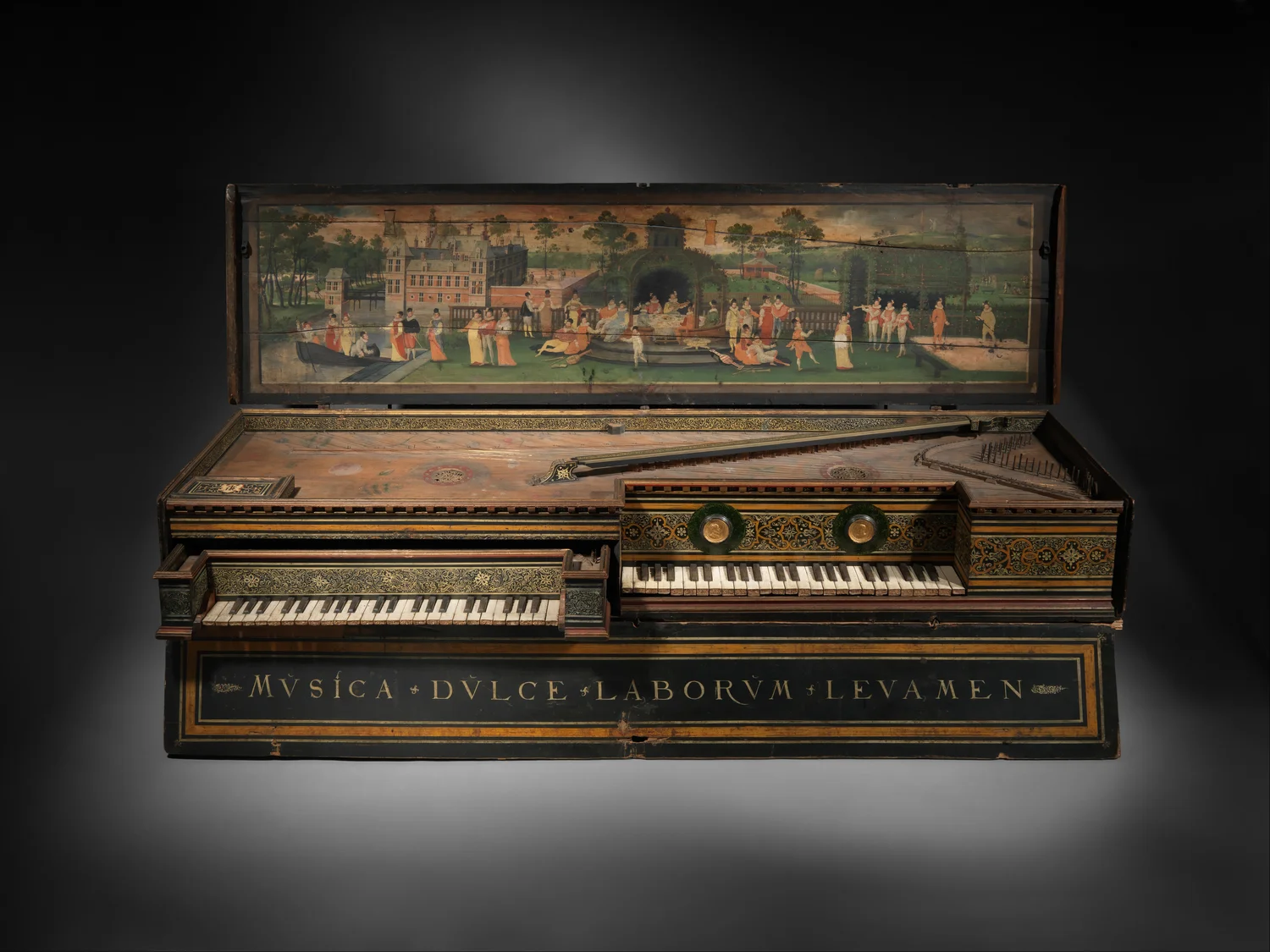
Two keyboards can be seen across the front of the open case, with a painted garden behind them. The smaller one seems to belong in the box in almost the same way a drawer might belong in a desk. It can come out. What it takes away is a playable instrument, not just a row of keys. What it leaves behind is another instrument, which may still be played on its own.
The Metropolitan Museum of Art dates this double virginal by Hans Ruckers the Elder to 1581. In the arrangement its catalogue describes, the larger instrument's keyboard is set to one side and a smaller instrument fits in the remaining space. The smaller one is tuned an octave higher. It can be used separately, or placed so it sounds with the larger instrument. The case has to organise all of those possibilities before the music begins. In ordinary view it may look like one rather elaborate piece of furniture.
The two instruments can live in the same box without being one
A keyboard can give a listener an idea of which fingers are moving. It gives less immediate information about how the sounds behind it are set up. In a virginal, a key operates a mechanism that plucks a string. The box holds strings and parts that have to be placed in relation to the keys. The small instrument is therefore more than an attachment that changes the large one's appearance. As the Met explains, either part can be played on its own. The arrangement stores one complete set of musical possibilities inside a second object's outline.
The names traditionally given to the larger and smaller parts, mother and child, help describe their proportions and relationship. They should not be taken to mean the smaller part cannot work anywhere else. The museum journal's study of Flemish instruments discusses the use of those terms and physical evidence for early arrangements and alterations. A paired instrument gives researchers several things to inspect: the case, each action and the points at which the two fit together. Confirmation of one does not answer every question about the others.
It is useful to sketch the stored position from above. The small instrument takes up space alongside the larger keyboard that could otherwise have been closed or assigned to another part. On a second sketch move it out of the case without changing the location of the larger object's keyboard. The sketches will produce different outlines while preserving the fact that the large instrument belongs to the same case. This is a clearer way to show the storage relationship than counting every visible key on the front and calling the result one keyboard.
Placing the smaller instrument changes the sound
The collection record describes a third arrangement: the smaller virginal can be taken out and placed above the larger one so its keys are actuated when the large one is played. Both instruments can then sound at an octave apart. The crucial distinction is between holding an instrument in an available place and putting it where another keyboard can operate it. A visible shelf or stand might explain one part of the arrangement and leave the transmission of motion to be explained separately.
An octave is an interval a listener can recognise as versions of the same note name at different pitches. In the coupled arrangement, one gesture produces those two pitches through two sets of strings. The result is not simply turning up the volume of one sounding string. Two instruments are contributing. To understand how that happens, follow the motion from a key to the corresponding actions and ask when each of the two is meant to respond. A still photograph gives a good starting place and no sound to settle the effect.
A museum display could show three views: stored side by side, separated and coupled. The person looking would benefit from captions that name what each position makes possible. In a single view the small case can seem to be standing in the only place it belongs. The ability to move it is what makes the object partly a story about performance. Position decides which person or keyboard can set something sounding.
Open the instrument and a garden appears
The Met identifies the inside lid as a painted scene of a pleasure garden with figures engaged in several activities. It sees ties to a genre of painted outdoor gatherings. Some depicted people make music; others join different kinds of leisure. The painted activity matters because it appears where a musician prepares to play rather than on an independent panel elsewhere in the room. The instrument can bring a picture of social life into view at the same moment its strings become available.
The effect depends on which surface is seen. With the lid closed, the painted interior is protected and largely absent from the view. Open it and a vertical surface rises beyond the flat area where the strings sit. That surface has consequences for the appearance of the room. It gives somebody across from the player something quite different to see from the keys nearest the player's hand. An image fitted to the underside of a lid is an image that needs a particular action before it can be looked at as intended.
This makes it worthwhile to separate the identity of the instrument from the identity of the painter. The museum names Ruckers as the maker of the instrument and records that the painter of the garden is unknown. Those statements can coexist. The signature and other identifying marks supply information about the instrument; an attribution of the picture would need evidence of its own. Rich surroundings do not let a viewer assign every part of the object to the name written nearest a keyboard.
The closed case protects things the photograph makes easy to see
The front panel can swing up over the keyboards, and the lid can be lowered over the strings. The Met describes that as a protective arrangement. Its effect is to turn a visibly active object into one that can have an ordinary outline when not used. For the modern viewer, the opposite action makes some of the more vulnerable and interesting parts available at once. A cover photograph with the instrument open resolves the question of what lies within but gives different evidence from a view of the outer surfaces.
Alterations complicate what it means to say the object has been returned to a position. The museum journal considers changes and restoration across several instruments, a subject distinct from how surviving eighteenth or later listeners might have heard a particular piece. A conservator can draw conclusions about what a joint or later modification reveals. A modern demonstration can show an arrangement under described conditions. Neither should be passed off as a recording of what was heard by the original owners.
There is a further distinction between a famous instrument's travels and its original purpose. The Met reports the later discovery of this one in Cuzco and discusses a possible royal connection, while acknowledging uncertainty about who owned and played it. That history is a reason to retain the uncertainty rather than fill it with an attractive story about a particular performance. We can follow the whereabouts that the record describes and keep the question of earlier ownership open.
Learn to read the case in positions
The records of the keys and the decoration can also be kept on different scales. A close image of the smaller instrument's jackrail can help show where the maker is named. It may be too small a view to show how the smaller instrument is supported by the case. A broad view can make the relationship of the two clear while losing the legibility of the inscription. When those views accompany one another, the reader can place a mark where it actually sits rather than imagine it written along the whole instrument.
Objects with movable parts are especially prone to misleading identification from an isolated picture. A stand carrying the smaller instrument could look like an ordinary stand for a separate keyboard if nothing linked it to the whole. A good catalogue entry keeps both the position in the photograph and the numbering of the object visible in the same account. The comparison of positions remains useful when the instrument cannot be operated or removed from its display.
Begin with the view on this page and mark which parts are visible because the lid is open. Next give the smaller instrument a route to its independent and coupled positions, using the object record to decide which arrangements are documented. Only then ask what sounds those positions were intended to permit. A physical display, a written description and a sound demonstration can answer different parts of that question. Grouping them is more useful than expecting one picture to serve equally as a plan and a performance.
The painted garden is likely to receive the first glance. The next may find the strings or the smaller keyboard where it is stored. That is a perfectly sensible order for looking, provided the little box is not left as a decorative detail. It is the part of the case with another place to go. Understanding the instrument means being able to picture that movement before pressing the large keyboard's keys in an imagined room.