What Changes When You Go Behind a Wayang Screen
A wayang kulit performance offers different evidence on each side of its screen. Light, leather, rods and the dalang’s voice meet in an image the audience can follow.
In this story 5 sections
A shadow on a white screen can give a person a surprisingly definite impression of a character. At the next moment a moving edge can make the character seem to lean, turn or leave the ground. Go around the screen in a performance where both views are available, and the apparent movement has another description. Light reaches a flat figure held and moved by a person. Rods make several of its parts available to a hand. The shadow is easy to see from one side. The conditions that brought it about are easier to see from the other.
Wayang names several Indonesian traditions of puppet theatre. Here the focus is on wayang kulit, in which flat leather figures can be used to cast shadows. UNESCO’s description distinguishes these from wooden puppet types and explains the role of the dalang, the performer who brings figures to life, voices characters and directs much of the performance. Traditions vary in Java, Bali and elsewhere. A photograph of a particular set offers a specific view rather than a complete model of all its uses. That is part of the pleasure of looking. You can ask which relationship is visible in the particular scene instead of searching for every element at once.
The visible edge has several causes
Take an opaque piece of card, a pale wall and a small lamp. Bring one edge of the card close to the wall. Then move it slowly toward the lamp while keeping the wall and lamp where they are. The shadow can grow and its edge may become less distinct, depending on the character and distance of the light. Turn the card a little and a different shape becomes visible. The experiment shows why turning and moving through depth can be expressive even with a flat material. A hand hardly needs to compose a long realistic gesture to change what a spectator sees.
In a performance the effect has to be brought back under control. If the figure becomes broad and diffuse the audience may lose the line it was using to identify a pose. Near the screen, the same carved figure can offer finer edges. Punched or cut areas can allow spots of light through. To somebody looking directly at the object those areas are features of its workmanship. To someone following the shadow they give the body gaps that can remain legible at a distance. The position relative to the screen and lamp determines how much of this detail is available in any moment.
Watch the position of one figure in relation to another rather than trying to name its every movement. A character might seem to change size because of movement within the light, while a figure entering at another distance from the screen can have a different apparent scale. This gives the performer a way to change the effect of approach. It also gives the spectator a reason to notice where the outline regains its definition. The figure can be recognizable before every opening in the leather becomes visible. Several kinds of information arrive at once, at different levels of detail.
Behind the screen is a working view
The painted side of a puppet can become visible from a position near the performer. Rods, the hand holding them and the orientation of the puppet make the same episode look different. A gesture that seemed spontaneous on the screen can be seen as a series of precise movements. One rod may support the figure and others make it possible to move arms independently. The joints limit some motion and enable other kinds. Before you look for realism in the result, look at how the performer keeps the whole figure available while making one small part move.
The different view can also reveal the work that happens before a figure comes into the picture. The next puppet has to be within reach. A person can move the visible character while preparing the conditions under which the next character will appear. Performers can arrange implements and waiting figures to make a transition possible at the speed they need. What seems like empty time on a screen can be time occupied by work just beyond it. That fact becomes easier to hear or see once you have watched one change from the performer’s side.
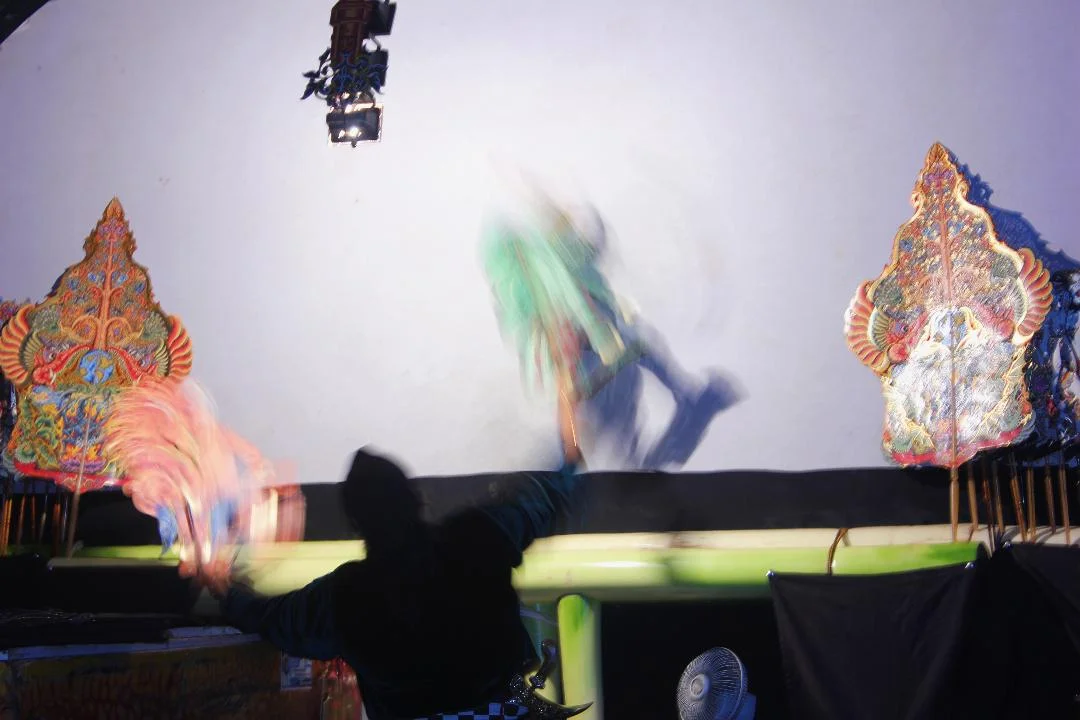
Learn to distinguish a view taken from close to the work from a view meant to accompany a whole narrative. The cover photograph is useful for considering a dalang at work. It supplies a particular person in a particular arrangement of materials. A still image cannot preserve the response from the room or the relation of an action to the previous line in a story. A video, where available with the context of the performance, can give the transition time to run. A view from the other side of the screen can then complement that evidence rather than merely repeat it.
Listen before deciding what the figure did
A figure on a screen presents one channel of information. A change in voice, pace or sound can arrive while the figure appears fairly still. Turn your attention to a passage that seems visually simple and listen for what makes it a transition. A new register of speech can identify an exchange without requiring two equally prominent figures to be moving all the time. The voice can make a distinction at a speed the visible action would take longer to establish. Knowing some context for the story helps you recognize when a visual change is doing the work and when another element has already made it clear.
The music also deserves its place beside the moving figures. The Smithsonian discussion of Balinese wayang describes relations between musicians and the dalang that vary through practical knowledge and performance. A sound can be part of what gives a movement its timing. An illustrative workshop photograph gives plenty of information about spatial arrangement and misses that close interaction in time. Try watching a brief passage once, then listening to it separately. If a striking visual action still seems to have a recognizable moment in the audio, see what cue made it possible to locate it. Keep the example attached to the performance it came from.
A recording can itself alter what you hear. The nearest sound to the microphone can become more prominent than it would have been from an ordinary place to sit. A voice and an instrument located quite apart can also seem to occupy the same position in a small speaker. That is a reason to keep notes about which recording you use and what its view includes. You can make a useful comparison across two parts of it without assuming that it reproduces every position available to the people present.
Record which side your description belongs to
When telling somebody what you saw, name the position first. “From the audience side I saw the silhouette reach across the screen, and the voice changed before the figure disappeared” gives a different account from “the performer turned the puppet while bringing the next one into reach.” Both can be useful descriptions of the same interval. Putting them side by side can help somebody understand how little material is required for an action to become clear and how much skill may go into bringing that action about.
It is possible to spend a whole performance attending to one side and have a substantial experience of the work. If an opportunity to see both arises, let each view make the other more interesting. The screen gives the audience a place to see the silhouette resolve into a legible event. The other side gives the light, puppets and hands a physical location. Alongside speech and sound, those same objects produce an episode that stays intelligible as it moves from moment to moment. That is exactly the detail a glance at a mounted puppet is most likely to leave out.
A museum puppet and a performance can answer different questions
Look at a single collection object after seeing a scene in motion. The catalogue can give you dimensions, materials or a place associated with the figure. A good photograph can reveal a seam, the edge of a cut or a detail painted on the leather. Those details can be difficult to see at the moment an audience needs to recognise a character. Keep a note of which ones become clear in silhouette and which are chiefly available in a view of the object. A drawing of the outline can be helpful if you want to remember what information survived the reduction from coloured object to shadow.
The comparison also explains why a puppet in good condition can look strangely motionless in a display. An arm sitting at a certain angle in the catalogue can simply be a part that had to rest somewhere when photographed. In use it may have a range and an occasional striking position. A spectator can recognise the range without thinking about the joint. A researcher looking at the joint can learn what makes the variety physically possible. Bring those descriptions together before assigning a fixed mood to the posture in which a figure was displayed.
If you have access to a film of a performance, choose a manageable event, such as a character entering, then note the sequence in ordinary words. Keep one description of the shape, one of the motion and one of the change in sound. The three usually need different vocabulary. That small record gets closer to what the theatre is doing than a caption that describes the appearance of the puppet alone.