Reading the Edges of the Luttrell Psalter
A medieval book of psalms makes room for ploughs, household heraldry and impossible creatures. The catalogue helps separate what can be seen from what can only be guessed.
In this story 5 sections
A modern reader can crop a medieval manuscript down to a single creature, send it to a friend, and see nothing wrong with the result. The creature is still odd and the joke still works. A crop does, however, remove an essential thing: an explanation of where in the experience of reading the creature appeared. In the Luttrell Psalter the page has a centre made for lines of text, and spaces supplied by the shape of those lines and by the area around them. Some of the most memorable images arrive in those spaces. Their company keeps changing as the reader turns the pages.
The British Library’s shelfmark is Add MS 42130. A psalter is a book of psalms, and the catalogue is the place to begin if you are trying to identify one particular image in it. An isolated browser image entitled “Medieval knight” can refer to hundreds of things. A shelfmark and a folio number can tell you which physical leaf you are looking at and sometimes help you find the view immediately before or after it. The two sides of a leaf are usually called recto and verso, written as r and v. The difference matters in a book whose pictures work in concert with the space available on a page.
The order in which you look matters
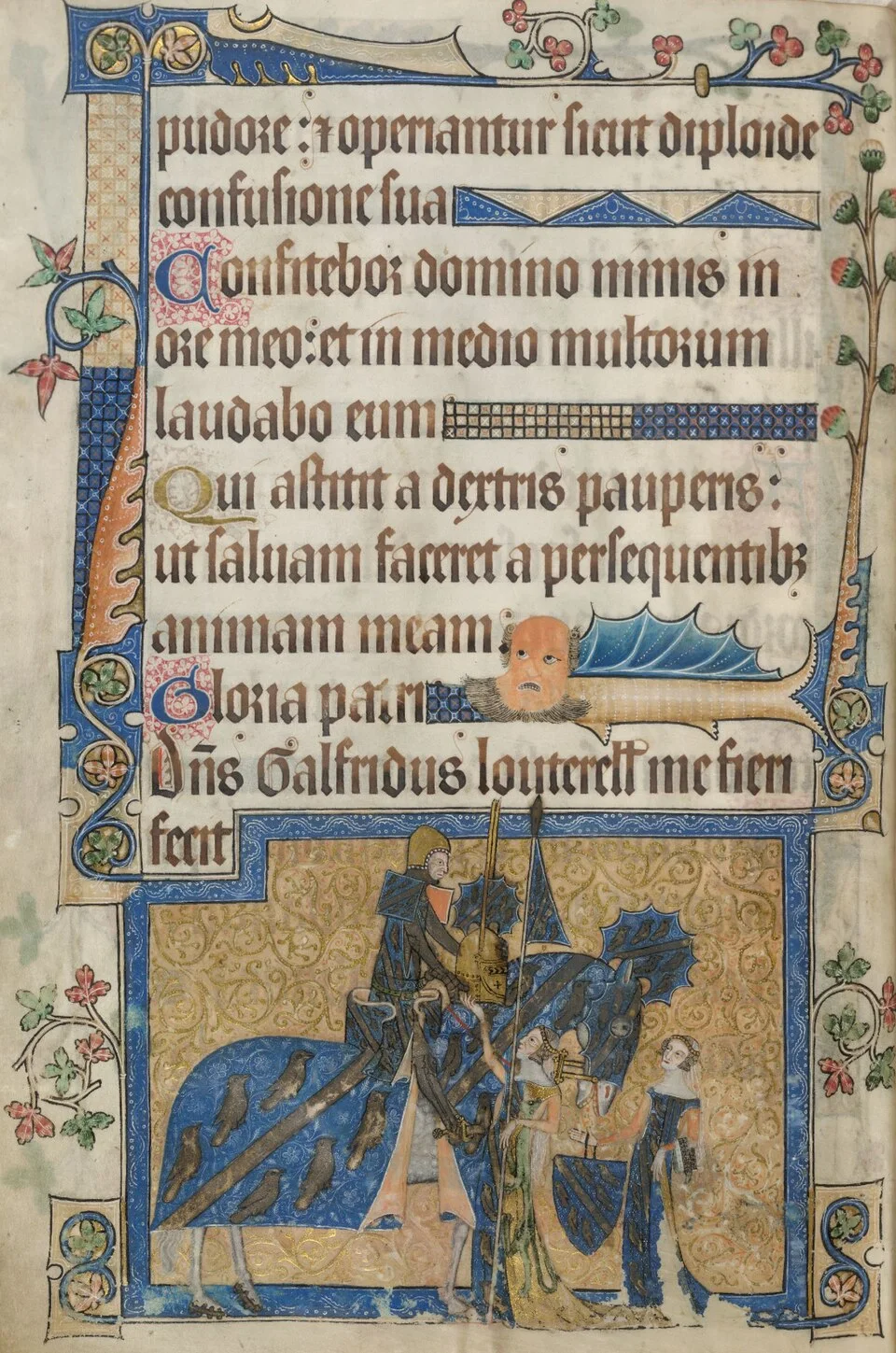
Before zooming in, set the image small enough that the whole page fits on the screen. You want an idea of what a reader could see before deciding where to focus. A little figure below the text feels larger when shown alone; on the whole page you can tell whether it commands attention from the beginning or waits near the bottom of a long block of writing. A painted initial within the line does another job. It both interrupts the rhythm of the text and helps a reader recognise a beginning. Make a rough copy of the page using rectangles for text, border and image. In a good sketch, the difference in their sizes will still be clear when you cover up the details.
The cover image for this article shows a conspicuous picture on folio 202v. The catalogue identifies the mounted man as Sir Geoffrey Luttrell and names his wife Agnes and daughter-in-law Beatrice among the attendants. It identifies coats of arms, too. An inscription associated with the image says Geoffrey had the work made. The Latin inscription and the presence of identifiable arms make this a different sort of problem from naming a creature with a human head and an improbable set of feet. For one picture there is a record of identity in and around the picture. For another there may be little reason to hope for answers beyond what can be seen.
Take the tools seriously
The manuscript’s scenes of rural life have circulated widely because they offer things that other kinds of medieval records often omit. A tool can be identifiable in a picture even if nobody included a drawing of it in a description of farm work. An arrangement of hands and feet can suggest how a piece of work was physically done. If you are interested in a scene of ploughing, it helps to make a two-column list. On the left put things visible in the image: the placement of the worker, the animal or animals, the handles, and the relationships indicated by lines. On the right put proposed interpretations. Do the hands seem to be guiding, pulling or holding the implement steady? How certain are you that the artist saw the work being done?
That separation keeps a small picture useful without making it bear the weight of a survey. A wealthy patron’s book selects a view of rural labour. What made an image appropriate for the book was not necessarily what would make it representative of a village or even of a season. A labourer’s posture may tell a viewer something about a plough, while the finished selection tells the viewer something quite different about the people who commissioned or made the book. Those two sources of information can coexist. A picture is more interesting for being capable of telling different stories about its subject and its makers.
The distinction also protects the people depicted from a little imaginative shortcut. A figure that seems relaxed can be painted that way for reasons having very little to do with how such a job felt. The artist may have had room for a curve but not a fully articulated body. A figure with raised arms might describe a gesture or solve a problem of balancing empty space. The same observation holds in modern nonfiction illustrations. Sometimes the long leg is there because there was room to draw a long leg.
Be careful with the copy you are looking at
A digital facsimile is a partial view of a physical object, even when almost every available leaf has been photographed. The binding can be hard to understand from individual images. Stretching two screenshots edge to edge does not reproduce how far a reader could open the book or which part of a leaf disappears into the gutter. A scan made under steady light can flatten the effect of shiny material. A display setting can change what a reader remembers about the blue or red. These are not reasons to doubt everything; they tell you which questions a digital image is in a position to answer.
Likewise, two cropped files of the same illustration can suggest different readings. One might show how a painted branch touches a line of text. Another may be cropped to make the creature look free floating. If you are comparing two images, record the folio and the picture’s place on the leaf before taking a screenshot. A note such as “below the last line, across the width of the writing” will be much more useful later than the image’s filename. If the catalogue gives access or digitization constraints, take note of them and resist the temptation to fill in a missing view with a similar picture from a different manuscript.
There is more than one date in the object
The catalogue gives the work a medieval identity, but it also makes room for the history of the binding. The British Library describes a later binding of brown calf with tooling, as well as remnants of older cords and sewing kept separately. That information changes what it means to look at the book as a whole. The way a text stands on one leaf is a fairly local observation. The way the leaves sit together and the materials a reader would have handled belong to a longer history, during which people intervened to keep the book in usable condition or make it suit another purpose.
This is a useful distinction if you notice wear in a digitized image. A rubbed patch might have followed generations of use, a period when the corner was exposed, or an event a photograph cannot identify. Look at other leaves before promoting an observation into a story. Repeated traces in the same place may suggest a shared condition. A single torn shape can be compelling to look at without giving you enough evidence to explain how it formed. A missing fragment gives no answer about the text or image it once carried unless there is an independent record.
A record can also help you notice the work modern viewers do to reunite what a library keeps separately. The description of cords and binding, an image of a loose group of leaves and a reference to the finished book can concern related physical things without presenting them as one object in a single photograph. There is a satisfaction in keeping these different pieces on a small timeline. It tells you which claims belong to the making of the psalter and which belong to later work that helped it survive. The margin is part of a leaf that has been handled for centuries; its present condition did not stop changing when its maker put down a brush.
Turn the page in your head
The best use of a spectacular detail can be to send someone back to a whole manuscript. Start with the figure that made you laugh or the implement you can identify. Then ask how quickly you would have met it had you started at the beginning of its leaf. Is it near a decorated initial? Does it stand below ruled lines of text or reach alongside them? Would the viewer meet a similar gesture just before or just after it? The sequence changes the question from “What does this picture mean?” to “What was it like to encounter this picture here?”
Some answers will remain open. It is easy to become so fond of a theory about the margins that every creature starts to serve it. Try choosing two leaves that do different things, and looking for an interpretation modest enough to accommodate both. The catalogue supports a solid identification for the mounted patron. It does not turn every figure in the margins into a portrait with a known intention. A reader who keeps a few certainties separate from a pleasant set of guesses is doing the book a good turn. More of its strangeness stays available that way, and so do the practical details that make it an unusually rewarding historical record.