The Two Views in a Stereocard
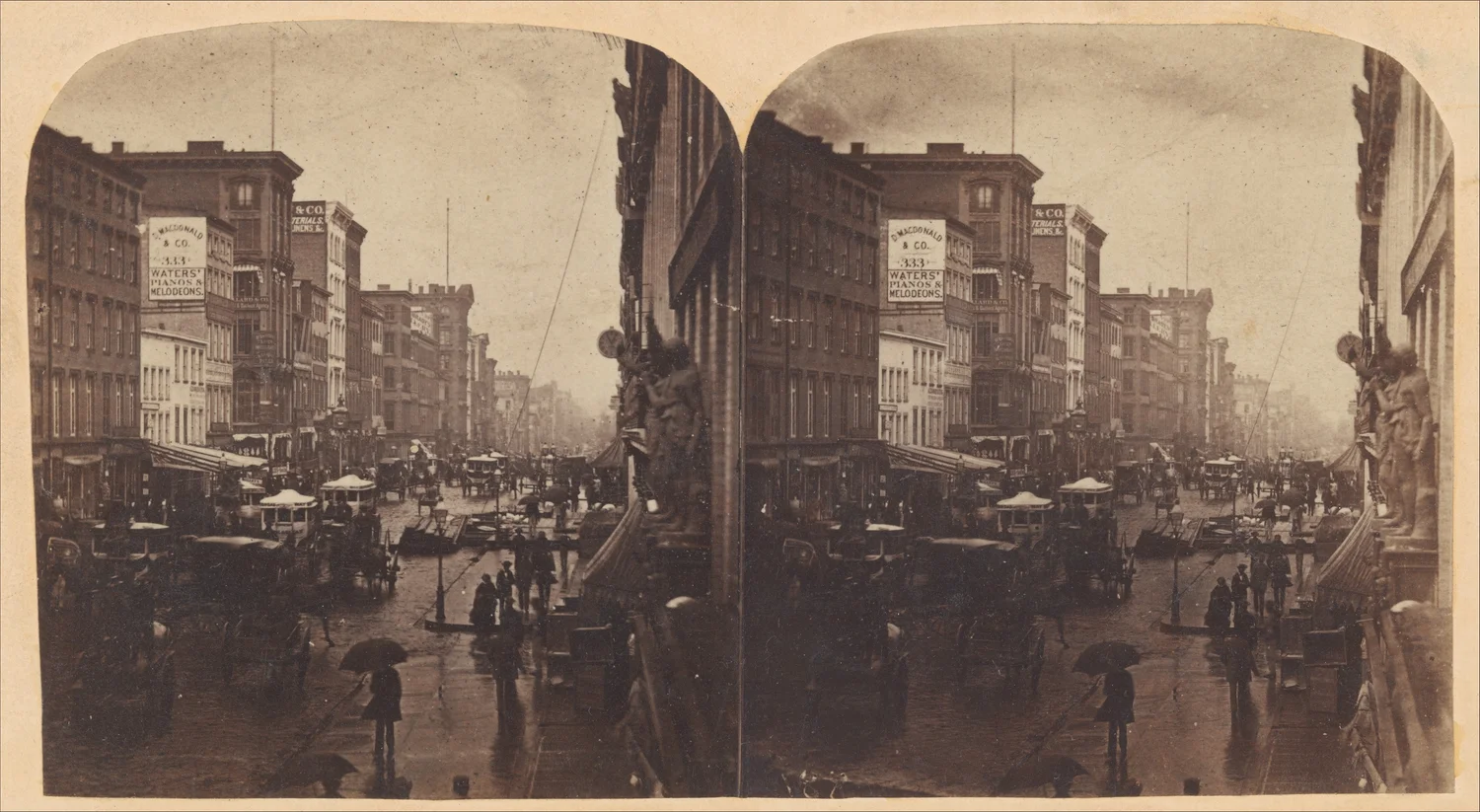
Edward Anthony sold two closely matched views of a rainy New York street on one card. Seen through a stereoscope, their small differences give the foreground and the distant buildings different depths.
In this story 5 sections
The rain is easy to miss if you look only at the big buildings in Edward Anthony’s picture of Broadway. On the street the dark points of umbrellas are easier to find. There are figures moving among the vehicles, with the wet roadway extending away from the camera. Something about the scene looks unfamiliar even before you identify when it was taken: there are two versions of it on the card, edged and sized to sit next to each other. Your eye comes back to the broad building on the left in each one. Matching it point for point, however, is harder than matching two ordinary copies.
The Metropolitan Museum of Art places this albumen silver print in the 1860s. It names Broadway in the rain and gives a likely camera position rather than a completely certain one. A history that starts with the view as a record of New York will ask which street is visible and what has since been built there. A history that starts with the object has an equally useful puzzle. It asks why a maker would put nearly the same view on a card twice and let the viewer attend to only one resulting image. The difference between the pair is the thing Anthony needed to preserve.
A little displacement makes a large difference
Hold one finger at a comfortable distance in front of a wall. Close one eye and notice where the finger lines up with a feature on the wall. Now open that eye and close the other without moving your head. The finger may appear to change its position dramatically. A boundary much farther away changes position by less. Neither the finger nor the wall has moved. The direction to the finger is simply quite different from two positions on a face because the finger is close to both. The direction to a distant wall is nearly the same from the same two positions.
The card offers a similar comparison in photographic form. Each view records what was visible from a slightly different position. A distant corner may land very nearly at the same place relative to its frame in both. The projected positions of foreground objects have changed more. This relative displacement is one of the clues human vision uses in judging depth. Seen as ordinary adjacent illustrations, the prints present two rainy streets. Set up so that each eye receives its corresponding view, the useful parts of those differences can register inside one perceived scene.
For that reason, aligning two identical copies of a single photograph would not do the same thing. You could see plenty of depth clues that were already there: the small size of people in the distance, objects partly hiding one another, converging lines. Those would still work if only one eye were open. The stereocard adds controlled differences the eyes can compare at the same time. It supplies a kind of depth information that an ordinary two-dimensional copy of either view will not bring back.
A street whose near and far objects have something to do
Broadway is especially useful as a subject for this format because it has details at many distances. There are surfaces with repeated elements: windows above one another, broad edges narrowing along the street and lit patches in the open space between buildings. There are also separate forms away from the broad façades. Someone standing in the road does not occupy the same plane as a wall farther away. When the near and far details are distinct enough to match from one view to the next, the image gives the viewer plenty of evidence to sort.
Take care with a large landmark such as the building at left. It offers a secure starting point when you're looking back and forth by eye. But the shifts are always being compared with other features. If you attend to only one edge and forget the street beside it, you may miss the relationship that the pair was made to deliver. Read at least three distances. Find something low in the frame, something along the buildings and something far toward the centre. The difference between how much those features shift matters more than finding one absolute measurement on a web page.
Above all, a printed end to a photograph is not a physical boundary of the street. Some details are cut by the frame and not as easy to follow into the neighbouring image. Two views of a place naturally offer slightly different slices around objects and at the outer edges. A card chooses and holds those slices within separate rounded fields. The frame makes the two prints a recognizable pair while deciding how much of each individual view survives to be compared.
A viewer intervenes between the eyes and the paper
The Library of Congress describes stereographs as deliberately paired images, usually viewed through a stereoscope. The viewer's contribution is practical. It helps each eye see the right print at a manageable apparent size and makes it easier to combine the views. Surviving cards can be studied without a viewer, but it is then easier to see the printing and paper than to experience the intended depth. Both are informative activities. A large screen that spreads the images wide can be good for examining small details and inconvenient for viewing them as a stereo pair.
Even with two views, orientation and order matter. If you swap which eye gets which, the differences that once suggested an object standing in front can suggest the reverse. Ordinary perspective from the same picture may resist that reversal, making the effect awkward. If one view is enlarged slightly or turned a little with respect to the other, features that belong to the same vertical level can become hard to align. A plain reproducer who trims pictures for design convenience might preserve the scene as illustration but make the combined result less convincing.
People also vary in how easily they can combine the images. One person's clear view does not mean that someone else must see the same effect through the same equipment. Near and far comparisons are still available on the flat reproduction: nothing prevents a reader following the umbrellas, the blocks of windows and the pavement in one view before comparing them to the other. The paired prints are still a document of a choice about how a photograph should be read.
Selling a scene twice on one piece of card
The museum describes Anthony's series as instantaneous views and notes that the Broadway subject sold many copies. There are two scale changes in that history. A view of a wide city street was brought down to a surface that someone could hold. Then a small artifact could circulate far from the street. A person in another city did not have to buy a large framed image or visit New York to have the same subject in front of them. The stereo format also asked the person to slow down, set the card in a viewer or otherwise give the two prints equal attention. Quick production of the scene and prolonged viewing of it could both be part of the attraction.
A person examining the surviving albumen print can ask which changes belong to that object and which to its presentation online. The aging of the paper, the tones of the print and the spacing of the pair are properties of the card as preserved. The compression of an image for display, the width available on a phone and the bright light of a modern display are properties of the reproduction. Neither will reveal the experience of a nineteenth-century owner completely. The online image provides a very useful first impression when it keeps the mount and both photographs in view. It lets people see why the repetition was worth the space.
The street itself supplies a fine third comparison: its pictured scale and its historical scale. An umbrella near the camera may catch more attention than a building that was much larger in reality. That is partly ordinary perspective, and part of the experience comes from seeing the umbrella placed among more distant things as the pictures come together. The foreground object earns its prominence through where it happened to be when the image was made, rather than through a caption telling viewers it matters.
Leave room for both photographs
An editor choosing an illustration can easily mistake one half of a stereo card for a spare copy and crop it out. A reader would still have a historic street view. The relationship through which the maker asked the eyes to experience it would be gone. Keep the full width and even a very small reproduction retains the first clue. The matched arches above the two scenes and the gap between the views show that the repeat was intentional. Detailed comparisons can wait for a larger view of the same image.
Anthony’s card rewards an easy initial misreading. Find the building on the left twice. Follow the street into the distance in both panels. Let the eyes pick out what they know belongs to the same place. Then look for a near form whose position does not quite agree with the position it occupies next door. That modest disagreement is why this rain-soaked section of Broadway was printed in a pair. Far from being a flaw that a printer had to hide, it was an important part of the scene a customer paid to see.