The Song on One Side of a Sheet
A broadside could carry a title, several narrow columns and a picture but leave its melody to the reader. A photograph of The Carpenter preserves what that inexpensive format could do.
In this story 5 sections
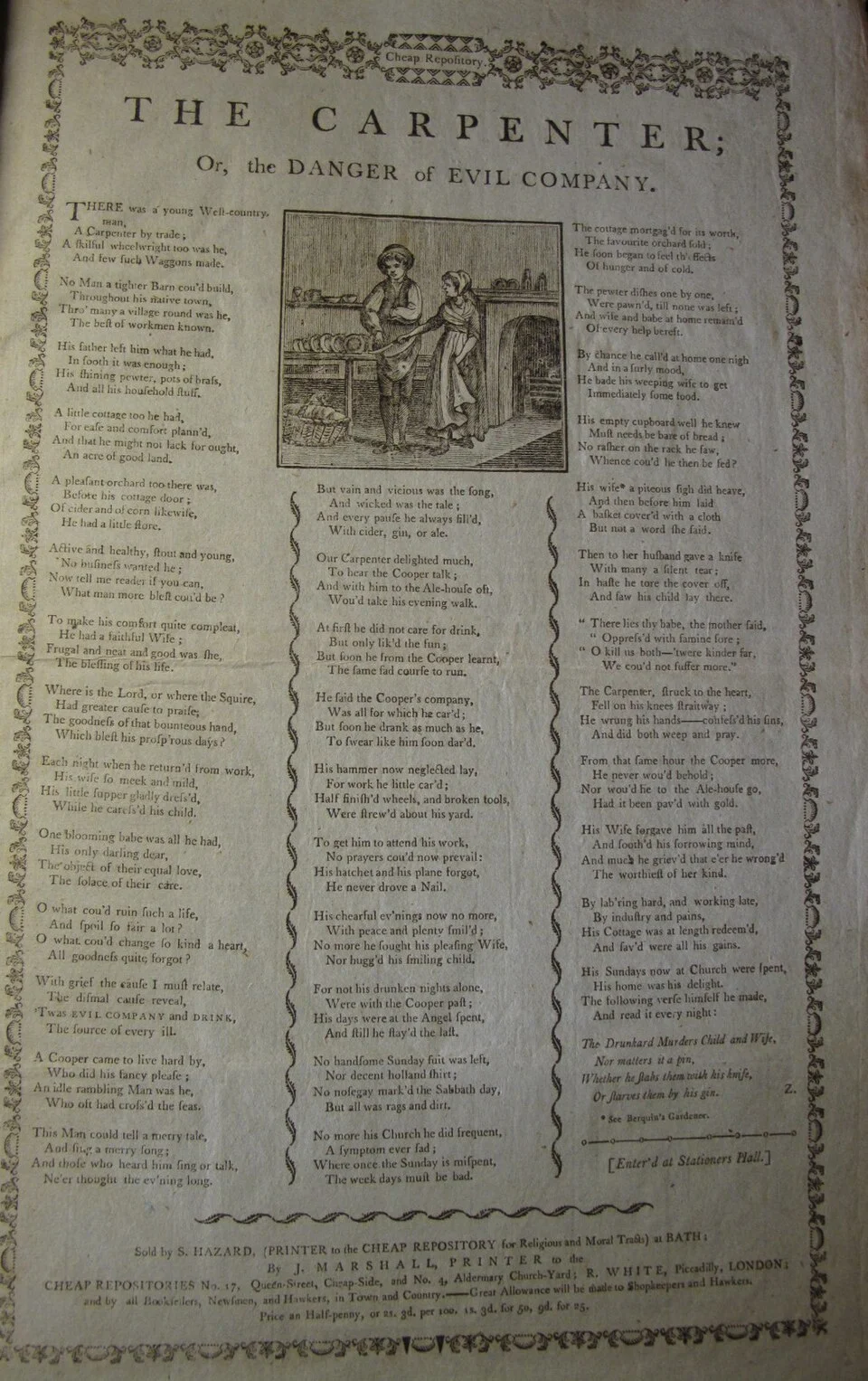
The picture at the top of the printed sheet is small enough to be taken in at a glance. The words present a different kind of work. They are gathered into narrow columns, set beneath a title that can be read from farther away. The sheet is a broadside of The Carpenter, dated 1795 in the photograph's record and associated with Hannah More's Cheap Repository Tracts. Turning to a second page is not required to see the main arrangement. Everything the printer set for this side has to announce itself in the space that was available.
The Bodleian's exhibition catalogue identifies The Carpenter: or, The Danger of Evil Company as one of More's tracts and describes how the imprint helps date a particular copy. The Bodleian copy and the photograph used here should not be treated as the same piece of paper without evidence of identity. Together they make it possible to ask how a single sheet could bear the title, image, story and evidence of publication. Reading the item as a set of words alone misses how those kinds of information are distributed.
A broadside uses space that a book can postpone
An ordinary book can put its publisher and title on another leaf and give its words long lines on following pages. A single-sided broadside needs to arrange what is visible in one field. A title can make the sheet recognisable at the point of sale or among other papers. Columns can keep a great many short lines legible while using the width of the sheet. The little image can be found immediately and then left behind as the eye travels through the words.
None of this requires the sheet to be read in one breath. The broad arrangement and the pace of individual lines are distinct. A person reading aloud can pause or repeat a passage without needing to follow the shape in which a modern viewer discovers the page. A photograph makes the whole sheet available in a moment. The work of reading it still happens in sequence. It is worth noting where the end of one column leads, just as one would notice where a page was turned in a book.
The upper and lower edges do different work too. A heading can identify what a purchaser is looking at. Lower printing and imprints can tell a later reader where the item came from or which organisations were associated with issuing it. A reproduction cropped tight around the words may save the verses and remove the information needed to identify that edition. An archive can be interested in both. The printed text can be searched, while the photographed sheet keeps visible boundaries between one part of the publication and another.
A familiar tune is a kind of missing part
The Library of Congress explains that broadside and song sheets often printed lyrics without musical notation. Some named an existing tune and depended on people recognising it. A buyer might have heard a seller sing, brought knowledge of another version or fitted words to a tune already known. The description is general. It would be a mistake to infer from the history of the form that any one purchaser sang the photographed text in a particular way. The point is that an object can be designed to rely on knowledge outside its own surface.
Imagine learning a present-day song from words on a page, without having heard it. The way lines are grouped can offer hints about phrasing. It may not tell you what the first note is, whether a line takes longer than another or where a singer ornaments it. Somebody learning by ear starts from a different source and might need the page later to recover a verse. Each route provides information the other route did not preserve especially well.
This is why a title from a broadside and an audio recording of a ballad can be interesting together without being identical evidence. A recording gives phrasing, timing and voicing at a particular occasion. A paper copy gives an arrangement of words in print at another point in circulation. Repeated text might move between different tunes or oral versions. A catalogue can identify relationships among them while keeping uncertainty about exact use visible. Matching a title alone is not enough to recover the performance of the person who held the sheet.
The imprint is small because its task is different
For a reader following the story, the text at the bottom may be a brief distraction. For the Bodleian catalogue, imprints and other physical traces help distinguish issues and narrow dates. Its description of a copy of The Carpenter discusses where its printing falls within an interval in 1795. That is a different claim from the year assigned to the work as a whole. An edition of a cheap sheet can change a piece of surrounding information without making the plot unrecognisable.
A careful note about a broadside thus distinguishes title, printing, individual copy and reproduction. The first may be shared. The second can refer to a particular issue. The third can carry handwriting or damage that no other copy has. The fourth provides its own date and framing. A reader comparing two digital images should be able to tell whether they show two different sheets or two images of the same object. That question can matter long after nobody is trying to read the text as a current publication.
The cover photo has its own identifying record on Wikimedia Commons. It is useful for seeing the position of the title and woodcut-like illustration alongside the printed columns. The Bodleian description remains useful for what it establishes about the version in its collection. An honest comparison can leave the relationship among those individual paper copies open and still learn a great deal from the shared form.
Paper can join a programme without carrying its whole purpose
The title's reference to a danger makes it clear that the printed story was not labelled merely as a series of events. The Bodleian groups it with More's Cheap Repository Tracts and documents the form of the series and its imprints. A story printed for wide circulation can be made attractive to look at, manageable to read and useful to the aims of a publisher at the same time. Understanding the organisation of the sheet does not require agreeing with its judgments. The title and picture are good places to see how a publication proposed a way to enter its subject.
A period title also helps explain why people might remember the story differently from an archive. A reader might remember a character or a verse, while a catalogue needs the words printed at the top. A singer may remember the tune or first line. These are several routes back to a work and not all equally helpful for locating a particular edition. Saving a reproduction with title and publisher visible allows more than one future inquiry to begin.
Another trace can sit on the unprinted side. The Bodleian catalogue describes an annotation on the back of its copy. Without the rest of the collection record it would be easy to treat a number written there as part of the original printed edition. It could instead belong to the way an individual copy was kept, ordered or collected. The front of a photographed broadside tells us very little about handwritten material on its reverse. For questions about how a copy was used, recording the back even when most of it is blank can save future work. A printed convention and a mark added to one sheet are different evidence.
The image in the top area also asks for its own note. If a similar small picture appears on another sheet, that could be evidence of related production practices and is a reason to compare the details. Looking alike is not enough to prove the same block was used. Repeatable evidence would include the dimensions, small marks and details of surviving impressions. The point of recording the image separately is to let a question about it be asked without making the printed plot or title do all the identifying work.
Keep the sheet and the missing music in view
Put the whole photograph beside a plain transcription, if an authenticated one is available. The transcription helps when a word is small or the paper is uneven. The photograph keeps the word attached to a column, heading or space. Neither source gives a particular melody merely by being legible. A documented tune or historical account would be another piece of evidence, with its own history to preserve.
When the text moves to a searchable edition, preserve the reading order as well as the spelling. A scan can put two adjacent columns on one visual line even though the words in them belong to different parts of the story.
The broadside gives a person something to take away that is complete in one important sense. Its picture and printed words fit within the edges of the object. In another sense it can be deliberately incomplete. It can depend on a voice, a memory, a tune or knowledge of what the publisher was doing around it. Those things need not be imagined away to appreciate the craft of arranging the page. The sheet tells us which parts of a song or story were put into print. The space beyond it is where a great deal of reading and performance still had to happen.