The Picture Hidden in a Book’s Edge
Fan the leaves of a closed volume and narrow strips join into a scene. The book’s spine, paper and painted edge meet in a form of illustration that depends on how the object is held.
In this story 5 sections
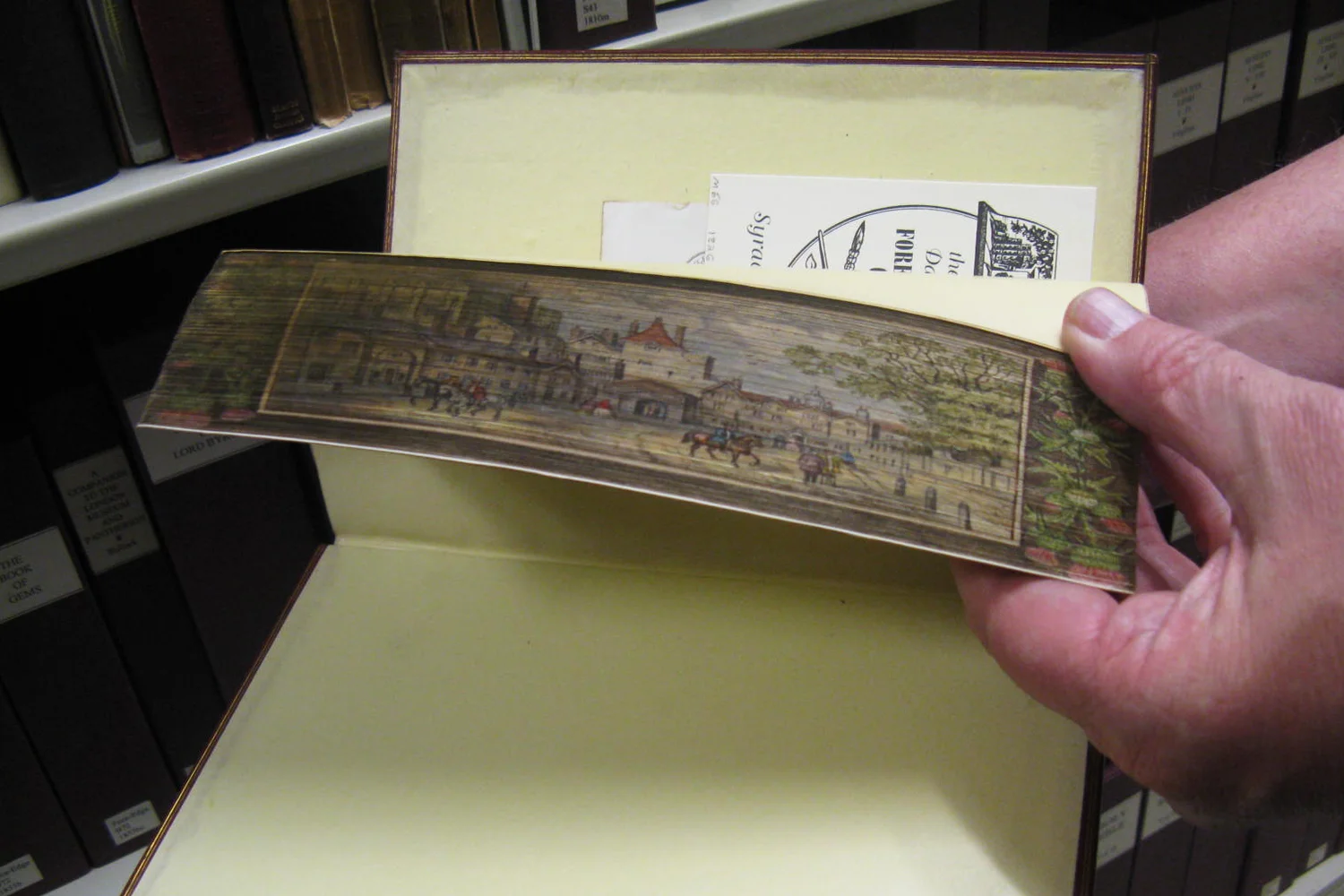
A thumb appears near the right edge of Laura HB’s photograph. It is keeping a book open in a rather particular way. Long strips that might be mistaken for the outer edge of one thick piece of paper form a painted view. A stretch of buildings and ground can be followed across them. The printed leaves are not opened at one specific page so a reader can see the picture. Their alignment as a group is the important thing. The picture depends on a small assembly of lines that will no longer meet in the same way once the pages are completely closed.
The fore edge of a book is the side of the text block opposite the spine. In an ordinary closed book you can see the very cut edges of the pages there. Fore-edge decoration can be visible on that surface. There is also a kind of painting meant to disappear when the pages settle into alignment. Brandeis University’s Special Collections distinguishes the two, pointing out that the hiding version occupies narrow areas just inside the edge. It takes both an arrangement of the paper and an image adapted to that arrangement to make the result. One can see how it works without treating every decorated edge as a picture in hiding.
The difference between a stack and a step
Picture a stack of plain index cards on a desk. Along one edge you can see a broad horizontal face made of the cards' thin edges. Every card ends directly above the one below. Now imagine the stack shifted in increments so each card shows a narrow strip of its face, and the one above begins a short distance farther back. A facing view of the stack can include those thin strips together. They could each carry a fragment of a mark. Bring the cards back into alignment and the strips would be covered by the neighbouring faces. Something could still be visible at the edges themselves, if it had been placed there. It would not be the image made along the strips.
A bound book offers a curved version of this relation. The spine keeps the leaves together at one side while a gentle fanning of the outer portion can bring many thin strips into view. Differences in the readiness of the paper to bend and in the binding can affect how that view is achieved. The fore-edge picture sits in a field of steps, even if it looks quite continuous from the intended angle. Far enough back, the eye follows a line crossing many increments much as it follows a printed outline on a solid page. Closer in, the leaves reassert themselves.
The book also reverses an expectation about opening. An illustration on an inside page is accessible because one or a few leaves have been moved out of their usual position. A disappearing fore-edge image asks for many leaves to remain in relationship to one another. Open too far to examine a particular strip and it won't give you the whole view. Study the photograph and look for where a line such as a roof or a ridge has to cross the separation between pages. The image is usually much easier to recognize when the separations don't hold the entire attention.
A closed edge can still have its own appearance
A feature such as gilding gives a closed volume an appearance of its own. At the ends of the leaves, the visible edge can look gold while the areas hidden just inside it carry the painted view. When the book is fanned, relief and light change and the picture gets the surface it needs. The plain or gilt closed edge does not have to be an imitation surface that covers a separate insert. It is part of the same pieces of paper, seen in their other relation. This makes the transition slightly more interesting than lifting a lid to uncover a picture already complete beneath it.
Brandeis describes several variations, including double paintings where fanning in opposite directions reveals different pictures. Think back to the shifted stack. A strip revealed on one side of a leaf in one position is not necessarily the strip revealed on the other side when the shift is reversed. This gives the maker more than one possible field. No single photograph of a fanned book can establish that both views are present. A reliable record can note whether the cataloguers examined each position or whether the photo only documents one image.
How something disappears also affects how it is displayed. The light against an aligned edge can be easy to show on a standing volume. Spreading the painted strips can require a different support and a different camera angle. What makes a good photograph of the painted view need not show the book as a reader would ordinarily store it. A pair of images, one closed and one arranged to show the painting, can be especially informative because each supplies the other's missing state. They document the mechanism without requiring a viewer to handle the object.
The date on the title page is one date among several
Books are often identified by a title, printer or publication date. A private owner might take a printed book to be bound or have it decorated much later. A binder or painter can change the appearance of physical copies without changing their printed words. The copy that survives with the painting therefore carries more than one kind of history. It belongs to an edition that other copies can represent, and to a chain of owners and workshops that may be unique to that volume. A generic picture attached to a description of the edition would not establish any of those later particulars.
Michael Carter’s account of a painted book at The Cloisters Library supplies an example distinct from the book in the photograph. The library has a late eighteenth-century English edition of French tales with a concealed scene featuring a knight on horseback and a woman. Carter traces one clue from an armorial mark on the cover to an earlier owner and suggests that the decoration could have been commissioned after printing, without claiming the case is settled. These are separate observations: the date of the edition, the scene under the gilding, the stamp and what can reasonably be inferred from them. The separation leaves room for evidence that has not survived.
A scene can relate closely to the book's text or operate more independently. The Brandeis examples include a variety of subjects and note this difference. A reader recognizing the shape of a familiar building in a painting can ask when the image was added and why someone chose it for this book. The title page might point toward an answer, or it might leave the question entirely open. Either way, one of the subjects of study is the relationship of this object to an individual reader or owner, not merely the relationship of a picture to the sentences around it.
A photograph borrows the right moment
Look at Laura HB’s photograph again and pay attention to where the hand is. It gives a hint about why the painted area cannot be described as an ordinary thin line along the margins of one printed page. The pages are held in a revealing position and in a useful relation to the camera. The picture in the book depends on that relation even though the photograph has turned it into one flat image that can be viewed forever afterward. That is a special value of documentary photographs; it is also a limit. A crop made so tight that only the landscape remained would show the depicted subject and conceal how the photographer made it available.
There is a practical courtesy to that observation. An old volume should not be assumed to open freely simply because someone wants to see whether it has an image hidden in the edge. Spotting a binding or edge that might reward investigation is a different matter from knowing whether the paper and sewing can tolerate movement. A library can arrange a suitable view or point to a photograph. The evidence supplied by a record of this kind often saves repeated handling and can give several people a better look than trying to see the same narrow place over one shoulder.
The place where pages agree to end
Most of the time the fore edge is a familiar point of entry to the pages. From it a reader can turn toward a chapter, a plate or a section they marked earlier. In the case of a disappearing painting, the pages supply a surface while their individual texts stay out of the way. A sliver of work on one page is less revealing than the agreement among many. It is possible to appreciate the painted subject separately, but only this way of presenting it asks a book to keep its picture when composed and to hide it by closing as usual.
The hand in the photo will eventually let go. The book will take on the appearance of an object someone can put back on a shelf. No framed landscape will need to be removed first. The picture stays where it was painted, and the next reader who sees it will have used the book itself to bring the separate lines back together.