The Angle of a Noh Mask
The slight lift or lowering of a painted wooden face can alter what a viewer sees. A Noh mask has a physical construction and a role that depend on movement.
In this story 4 sections
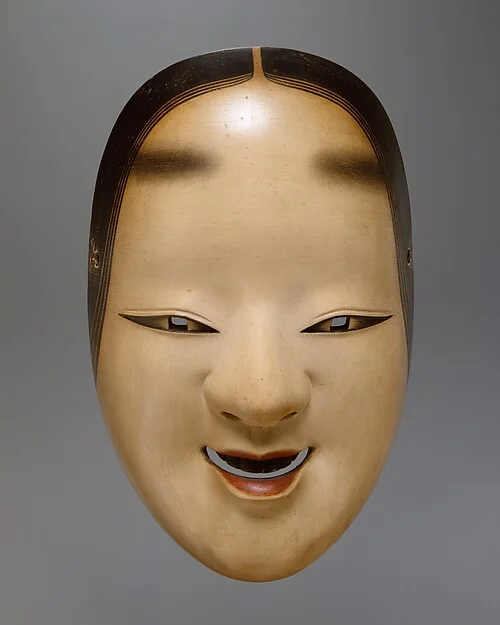
In a catalog photograph, a Noh mask seems to keep exactly the expression it was given. The photographer may place the lens in the middle, with the carved face square to it. The forehead curves away. The nostrils sit low in their shadow. The painted mouth is slightly open and, in the next minute and the minute after that, it stays that way. A spectator in a theater sees something less dependable. An actor need only alter the angle of the head for a face that seemed composed a few moments ago to take on a different air.
Regard the cover photograph for a moment without assigning it an emotion. Notice first where the planes of the face meet, especially beneath the lower lip and below the eyes. Try to imagine where the existing pools of shadow would go if the face tipped back a little into the light. The exercise is not a substitute for seeing a performance. It gives you a reason to doubt how much of the face belonged to paint and how much was produced for the photographer by the arrangement of object, light and lens.
The mask offers a role
The Japan Arts Council describes wooden painted masks as familiar equipment for performers of the main role in Noh. Masks are made in different kinds. Which one appears can matter to the age, character or other identity being presented and depends on the play and the way it is performed. A simple exhibition case may place forms beside each other that would have quite separate jobs onstage. Identifying one of them as a mask for a young figure says something about what an actor can do with it. It tells us much less about the expression they will give it for any particular line.
The Met’s example is a Ko-omote mask, a type whose name refers to a small face. The museum describes the medium as cypress wood with white, black and red pigments. The carving, painting and holes are part of the same functioning thing. A shallow difference in relief at the corner of a mouth can help establish an expression from across a room. A difference painted onto that same mouth can remain fairly constant when regard for the relief alters with the light. Those are powers of quite different kinds in the hands of a skilled actor.
If you have only seen an isolated museum photograph, it helps to remember the field the mask will be working in. The hands, sleeve, costume, actor’s pace and other people onstage give the audience more than one place to look. A mask that appears small on a body can be quite emphatic when the head turns at a particular point in a sequence. It need not contain everything the audience will be asked to recognize. The story, words and the path of the body around the stage will have brought some of that material to the turn already.
What the light stops touching
Try a deliberately ordinary experiment away from the museum case. Find a small rigid object that has a few appropriately visible recesses. A little face molded into the side of a mug is ideal; the raised edge of a decorative box is enough. Put it under a steady lamp and give it a very small tilt. If the lamp is overhead and slightly to one side, a recess may receive more light when the object turns toward the lamp while another becomes harder to see. Hold the viewer’s position constant. It is usually easier to follow what changed in the relief when you have not leaned over to meet it.
Now return your imaginary mask to a theater. The actor’s movement changes both the way the form is lit and the way the viewer sees it. You may see more under the leading plane of the brow from one position and less from another. The mouth is still cut in wood, but the ratio of dark to light in its curves changes. An observer who says the fixed mouth has moved can be giving you a very accurate idea of the effect while misdescribing the physical event.
The Noh resource on mask expressions discusses the familiar effects of lifting and lowering the face. An upward inclination can lighten the expression, while bringing the mask down can darken it. What a viewer makes of a particular turn also depends on what has just happened. A lowered face can be given time in the movement of the play. If the same shape appears in the last still frame of a demonstration, the camera may keep the shadow and lose the approach that gave it an emotional force. The known relation between tilt and light is a useful first observation, not an exhaustive dictionary of gestures.
Watch where the face is going
To notice the difference, keep your view fairly wide when watching a performance recording. Follow the shoulders as the actor crosses a portion of the stage, and then look carefully at the relation of the mask to the torso when they stop. A close photograph of a single upward angle flattens the two tasks into one; a moving view can show that the head altered position relative to the rest of the body. It can also show that the body took another step after the head found its angle. The face is only one of the things the viewer has to place in time.
The other thing a wide view preserves is relative stillness. If a change happens after a long pause, it can be more noticeable than a larger movement during a busy part of the action. As an observer, put a mark in your notes where you first stopped making the old assumption about the face. You might discover that you noticed the pivot a little after the actor began it. A second viewing, now with foreknowledge, can persuade you that the signal was obvious from the first frame. Both reactions can be informative if you remember which one came first.
Seats can make that response vary. From the side you judge depth against a different outline. The person opposite you may get a view of more of the painted face just when you see more of its edge. A single photograph cannot sample that audience. You can understand the object better by seeing images straight on and from a shallow side angle. Use the two images for different questions: shape and placement from the front, projection and thickness from the side. Choose photos of the same mask if you want the comparison to constrain anything about the particular carving.
The small limits of a picture
With a painted wood mask in a museum, study what appears quite fixed. A mark dark enough to read in several views gives you a different kind of evidence from a line barely visible in one. See where the carver appears to have shaped a contour and where the painter has supplied a line that carries its own weight. If an image has been lit to illuminate all parts evenly, the outline can look gentler than it does in a spot-lit space. That is an advantage when you are trying to identify marks; it has less to offer if you want to understand the changing contrast of an actor’s face.
Make one note about the object and one about the way the object is shown. The note on the object might identify the chevron beneath the nose or the depth at the side of the lips. The note about the showing might mention a highlight that reveals the upper cheek or an angle from which the opening of the mouth is briefly lost. With these two entries you can repeat the comparison under another presentation. It saves you from having to redraw the mask in your head every time a new image contradicts your first impression.
A mask also changes the actor’s view. The small openings that carry an appearance toward the audience constrain what the performer can see from inside. A viewer with complete quiet photographic access to the surface has quite a different experience of the carved face from a person keeping it in place while moving. A position on the floor or in relation to the stage has to be learned as part of using the thing. If the mask looks serene in a photograph, it does not follow that wearing it asks little of the performer. The same small object can offer an audience a changing expression and offer the person who wears it a restricted view.
Return to the front of the Ko-omote example after looking at other views. The photograph may still feel as though it was taken at a rest, between movements. That is a good position from which to imagine what could happen next. A little more light reaches the lower curve. A spectator catches a difference before they see a change in position. The mouth remains where the carver set it. There is a remarkable distance between moving that small piece of wood and deciding what the face now seems to know.