The Audience in Daumier’s Fourth Act
Honoré Daumier leaves the performance outside the print. The people who came to watch it become the only people whose timing and gestures we can read.
In this story 5 sections
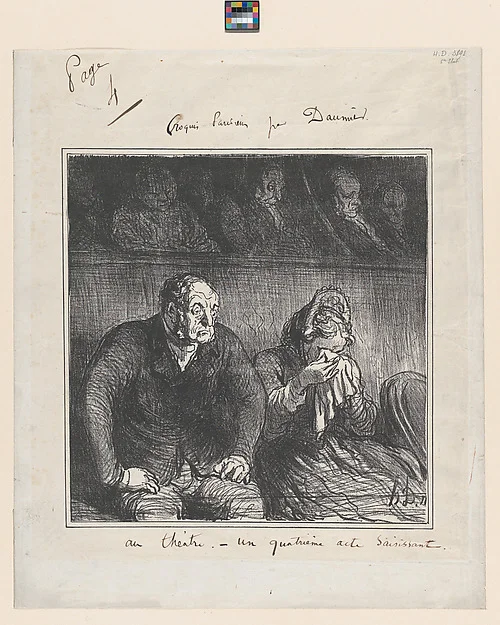
The thing Honoré Daumier leaves out of In the theater: a gripping fourth act is the fourth act. At least, the part we ordinarily mean by that phrase is unavailable: the action giving other people a reason to sit in their seats and look toward a stage. Instead there are spectators. Their faces and postures are drawings in their own right, and although you cannot turn to see what prompted them, the little space they occupy already has much of the timing of theater in it. This is a fine excuse to let your view of a printed scene stop where the people charged with watching it are sitting.
Read the title from the Met’s record and then set it aside. The word gripping seems to make a promise about what is happening somewhere else. On the page there is a record of which bodies support which heads, who occupies the same horizontal stretch of space, and where faces are directed. The spectator looking at the lithograph has been given unusually limited privileges. There is no way to inspect the production first and decide whether a response was warranted. You have to do some of the interpreting from the people in front of you.
How many things can an audience do at once?
Take two heads next to each other in the print. Do they look as if they are directing the same amount of effort toward the same place? Which one seems to lean into another part of the rectangle? Make the observations without naming a mood on your first pass. A closed-looking eye and a tilted neck can give a viewer reason to make a judgment. The same features are available to the artist who wanted those people to communicate something quite sharply in a small amount of space. The picture is a good place to separate how someone looks from the state of mind you are ready to assign them.
In an actual theater, an audience member can listen with considerably less conspicuous movement than a person playing a role on the stage. From a few seats away, somebody who shifts in a chair could be straining to find an angle or easing a sore back. Another may give impressive attention to a spot that contains nothing you recognize. In Daumier’s drawing such things can become available as deliberate choices. The characters do not distract from the production from your point of view, because the work has made them the production. What was normally a collection of interruptions can serve as a sequence of observations.
A theater audience does not have to appear in agreement. A person can be still and markedly attentive next to somebody very expressive. A change in position somewhere else can redirect attention inside the row. The print lets a reader look at a succession of bodies without finding an authoritative observer to identify with first. Try starting on the left and moving across. Then reverse the order. A strongly shaped head in the second pass may give a different account of the place than the one that introduced it the first time.
The stage is a direction before it is an object
An artist can leave the stage out and retain one of its effects. There is somewhere out of the pictured group where much of the people’s attention likely belongs. A few eyes, shoulders or angles of sitting can give it an approximate position for the reader without including it in the scene. This is an old joke about spectators and a powerful construction of pictorial space. It also makes room for the person who does not appear to be responding to the same thing. That contrast would be less forceful if no common direction had been proposed at all.
Use a rough sketch to test the placement. Draw a line from the edge of one eye to where you suppose the person might be looking. Then do the same for a second figure. Do not expect such an exercise to recover a detailed room plan. Eyes can be indicated with a few marks, and the picture does not promise precise lines of sight. It helps to see which figures were given an obvious association with something off the page and which ones let the view remain in their company. In a small scene those two directions can carry much of the movement a theater audience ordinarily feels from the music or speech.
There is a second audience beyond the work. You, the viewer, can take time to look at the way two people sit that an actual actor may not have. The people on the page are located openly enough to be scrutinized, and the question of what they are watching stays unresolved. This arrangement turns theater’s ordinary distinction between looking and being looked at into the actual material of the work. A reader need not ever have seen the play in order to recognize the change.
A reproduced proof belongs to a particular object
The Met identifies this work as a lithograph, with a proof in a specified state. A state is a way of identifying the form the print took at a particular point in its making; different states can preserve changes to the printed image. If another copy has a visibly different space below the figures, first check what it is and what part of the sheet was photographed. A broader view of the proof can give margins around the image. A reproduction meant to emphasize one character can remove them. Such differences should be checked before assigning a change to the artist’s work itself.
The quality of a printed shadow is part of how an expression comes across. A close image may allow you to distinguish dark lines and softer surrounding marks. Reduced to a small size, their differences can contribute to a single tone. A little head that looked very sharply outlined may turn into an area that stays close to the marks behind it. The image provides a choice: inspect what was physically drawn and repeated in an impression, or observe what the same marks do to the whole group from farther away. Neither choice requires a second print if the digital view preserves the detail needed for it.
It is particularly valuable to keep the sheet’s typography in view when available. A title, number or caption can be part of how a print was put before readers. A word such as gripping, read in one context, can make the spectator in the image seem to confirm the action going on somewhere else. Read with attention to the contrast in posture, it can seem meant for a joke someone knowledgeable about audiences would recognize. If the exact wording or placement matters, distinguish the catalog’s supplied title and any text actually on the page. The source of that little piece of information changes the comparison a reader can make.
Notice the people who take a higher place in the frame
The brightest faces near the foreground are not the only spectators available in the print. Look into the darker band beyond them. Other people are kept there in less detail. This is an economical way to make the strongly drawn row belong to a larger audience: not every face needs enough marks to give a separate account of the evening. A viewer can often recognize the division between nearer and farther rows much sooner than they can say which person occupies a particular spot there.
Now compare the dark field with the light margin around the image. They are both broad, relatively quiet areas in the reproduction, but only one belongs to the crowded theater. Bringing the sheet close lets a few bits of the darker area become legible as people. The surrounding margin behaves differently. Daumier can keep part of the implied room in view while placing the joke almost entirely in the lighter faces below.
Notice also the gap between those levels. In that interval the rows nearly blend together, giving the lower figures a little more room on the page.
Imagine the time between two gestures
A lithograph does not give Daumier a way to show the group changing minute after minute. It can place figures at different apparent points in what seems like a succession. One can look as if something is immediate and another as if they are waiting through a very long interval. A single frame can supply both impressions. Rather than writing a little narrative and pretending it is in the picture, state the clues that encouraged you to imagine the timing. The direction of a neck and the amount of room someone leaves around a face have more of a lasting existence on the sheet than any story about the performance that makes someone act that way.
Try one last reading at a distance too far to pick out particular eyes. The crowd remains legible as a few people occupying a common stretch. Come close and see how rarely they look like copies. A performance that could have been grand enough to make the fourth act interesting is beyond your view. The piece of theater you can inspect remains intimate. Several people have been put in the same place at one time, and you are given just enough of their separate ways of sitting to wonder which event each of them is actually attending.