The Cords on an Inka Khipu
A khipu preserves relationships between cords as well as marks on individual ones. The way a record is attached can be as significant as the knots it contains.
In this story 4 sections
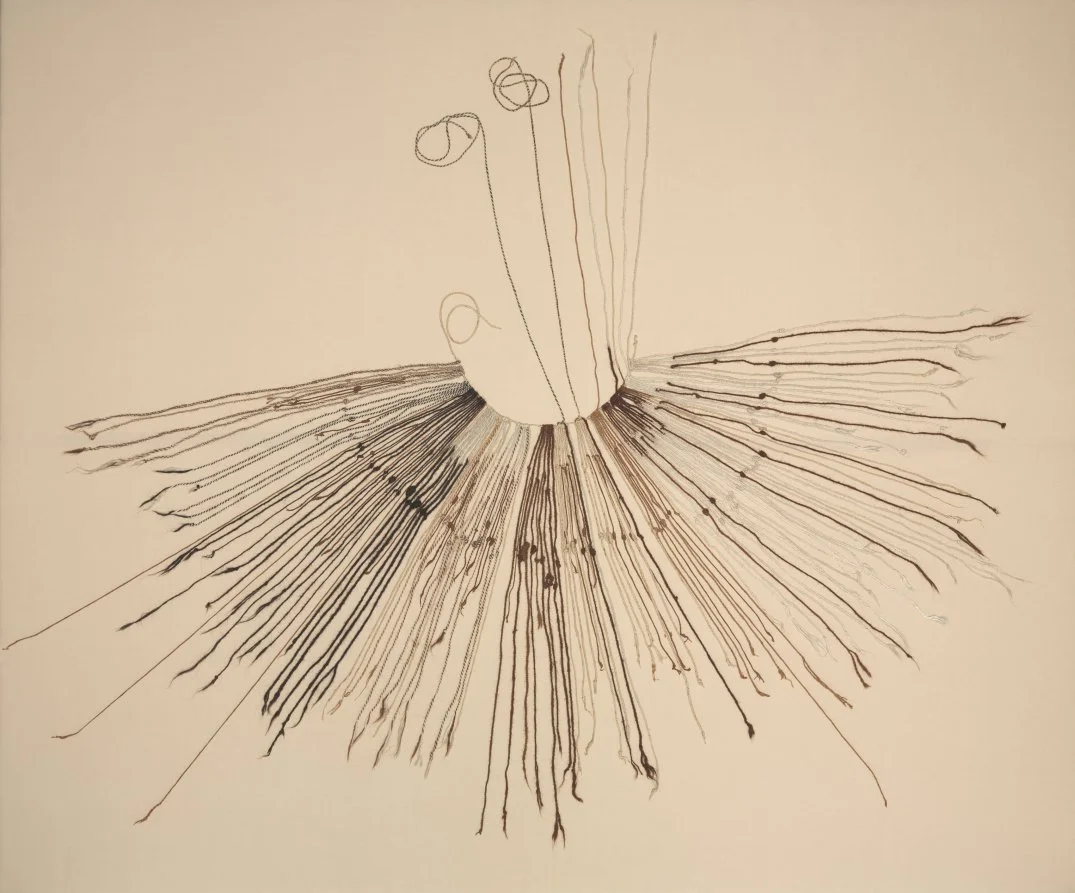
Find the curving cord near the center of the Cleveland Museum of Art’s Inka khipu and follow it across the mounted object. At first it may look like a means of holding the more interesting things below it. It makes an appropriate beginning to the record. The small lengths hooked onto it do not all simply hang next to one another. Some cords are attached to other attached cords. Others occur in groups that have particular relationships to what hangs to their left or right. A photograph opens the whole thing in front of you. To make sense of it, you still have to decide which path you are following through the fiber.
Khipus, also spelled quipus, served as recording devices in the Andes. Some numerical Inka khipus are legible through a system of knots and place values; the larger range of meanings of these objects is a subject of ongoing study. A careful description should resist simultaneously making two mistakes: treating a complicated organization as pretty material alone and assuming every bit of it can be read as one familiar kind of number. The record can be examined piece by piece. The attachment of a cord is a good place to start because it is part of the object you can actually see.
Identify which cord the knot belongs to
The Cleveland museum describes its example as twisted and knotted fiber, made of cotton and wool. Find the longer cord that carries a section of pendant strings. Trace one pendant from where it attaches until the photograph no longer lets you follow it. It may change color, emerge from a cluster or cross something else. A line that appears to intersect another one in a photograph need not have been tied to it. Take as separate observations what you can see crossing, what you can see attached, and where you lose track of the cord.
A branch attached to a pendant can matter as much to the arrangement as the folds of a page do to a manuscript. It introduces the possibility of recording a relationship without forcing everything into one sequence of strings on the primary cord. But it does not come with a modern legend telling you that the branch is a note, a subcategory or a separate count. Draw the connection itself before giving it a name that presumes a particular meaning. A material relationship is sometimes more securely available to the observer than the administrative use that relationship once had.
An easy way to understand this is to draw a copy of a short segment using line and dots. Draw only one edge for each cord and number the attachments in the order that makes sense from your chosen end. If you draw overlaps as attachments by mistake, your diagram will contain branches that another researcher cannot find on the object. A good sketch leaves a small mark where something is uncertain. A diagram with reassuring straight lines can otherwise seem more certain than the close view from which it was made.
The reverse view of a cord is worth keeping if the collection provides it. The way a loop embraces the main cord may be harder to distinguish from the front than the fact of the attachment itself. Cataloging these features separately makes room for the possibility that the method of attachment carries information of its own.
The position of a knot can be part of its value
Some Inka numerical khipus use a decimal place-value system. The position of a knot along a pendant is significant to reading it. In general the units area occurs farther from the primary cord, with positions for larger powers of ten nearer the attachment. Different kinds of knots also do specific work in such records. A loop at the end of a line and an ordinary single knot higher up need not be read as interchangeable bits of decoration. As in a written decimal number, recognizing a sign and knowing the position in which it appears are different tasks.
Take an invented three-digit number, 241. Writing it in ordinary numerals puts the largest place at one end of a short written line. Schematically identifying its hundreds, tens and units on a pendant means moving along a length of fiber rather than from one written column to the next. For a decimal Inka configuration you would expect two single knots in the hundreds group, four in the tens group and a form for one at the units end. If you find only the four knots in a close crop, you cannot tell what part of a larger value they express. The broader record should let you place them on the cord.
There is another reason not to count every lump in one go. A single long knot can carry a value greater than one in the units position, expressed through its turns. A different type marks a value of one there. The reader needs a definition of which type is present before counting. Researchers can also distinguish gaps from unclear or damaged areas. Contrast a cord whose unused position appears empty with one whose end seems lost. Both can produce a picture with no readable knot in that location. Only one may give sound evidence of a value at that position.
A number is not a complete entry
Imagine someone discovering a piece of paper on which a column adds correctly. If the names of the columns and the circumstances are missing, you do not yet know what was added. The objects might have been baskets, people, days or amounts of something else entirely. It would be reckless to take the accuracy of the arithmetic as proof of a specific commodity. Numerical khipus can face the same interpretive problem. The numerical organization, attachment pattern and associated evidence can help the inquiry in different ways. There is no reason to replace those differences with one confident translation.
Research on the khipus of the Inkawasi storehouse offers an instructive case of what other evidence can do. Urton and Chu report cords discovered in an archaeological setting associated with storage. Relations between records and their locations provide tools for thinking about what was recorded, in addition to the numbers. A cord bought or collected elsewhere without a known context can have quite different evidentiary possibilities. Comparing two examples in a museum photograph is useful; it cannot supply a deposit or a documented place of recovery that was never recorded for one of them.
Related cords sometimes lend themselves to questions about totals or other kinds of organization. Begin by marking where a formal comparison is possible. If a value appears to agree with a sum nearby, another set of relationships in the same record may reduce the chance that the agreement was accidental. It still does not tell you the word an original user applied to either group. This distinction explains much of the attraction of the research. A visible agreement between values can be real evidence, while the account of what those values describe is still an argument that can change.
Keep the signal and its carrier together in the notes
A mounted museum khipu allows access to the general spread of its cords. Some details become visible because the object will not fold on itself while you are watching. Other details, such as a short twist on the side turned toward the backing or the disposition of cords when the thing was in use, may be harder to examine in that view. A close view of one part and a wider one of the arrangement answer different questions. Remember the accession number and view before assuming a piece of color in a reproduction is comparable to a named position in a scholar’s diagram.
Make three levels of notes if you want to spend an hour with one record. In the first, keep the material observations: the cord’s location, color where it is apparent, attachments you can see, and features that would need another view. In the second, write the numerical reading if you have enough evidence and can say how you got it. In the third, put any proposed interpretation of what the value was for. When you read the notes later, you will know which entry would change if it transpired that a strand passed behind its apparent neighbor rather than joining it.
An object of fiber can have marks put into it and show marks left by its survival. Wear, a repair or the way it has been mounted may attract the eye as strongly as a complicated knot. Neither view of the object needs to be discarded. It is helpful when only one of them is treated as a report of the original record. An accession description establishes an institution and object. It does not make every visible feature equally legible or assign it to the same moment in the object’s history.
Return to the long cord that appeared simple at first. It now makes visible a set of distinctions across the width of the object. Descend along one strand again and follow its different positions. The record depends on both directions: where a piece belongs in the system and what happens along the piece itself. A knot is an event you can see. The khipu makes the connection to other events part of the thing that survives.