Reading the Horse Between Muybridge’s Frames
A grid of photographs makes a gallop available to the eye one pose at a time. Its frame numbers, ground lines and final standing picture tell you how to use the print.
In this story 4 sections
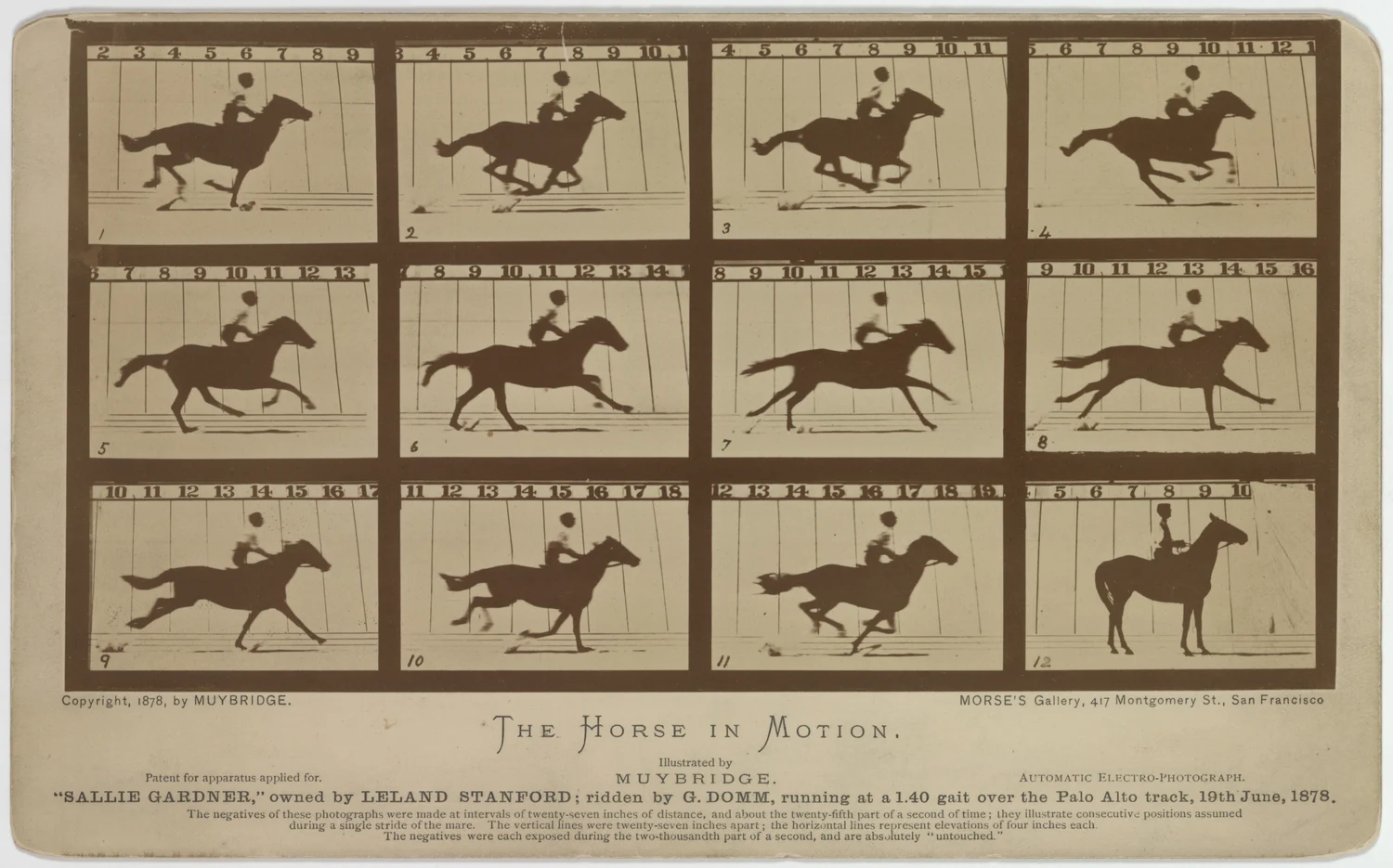
In the first rows of Eadweard Muybridge’s 1878 card of the mare Sallie Gardner, the horse seems ready to go on as long as there are frames in front of her. Each image presents a recognizable horse, even when the position of the legs looks unfamiliar. When the viewer reaches the last panel the rider is upright and the horse is standing. That change deserves attention. It shows that the print has an order chosen by people. A person supplied boundaries, arranged separate pictures and presented them beside explanatory text. The subject really moved, and the card makes the movement available through a deliberate arrangement.
The small numbers at the foot of the images help organize the trip. The numbers along the top of the pictures have another job. They belong to the markings visible in the photographed setting. Quite a lot of the card can be understood by keeping these two groups of numbers apart. One is a way to refer to the separate pictures. The other helps a viewer follow location. A gallery label may send attention directly to the question of whether all four feet ever left the ground. Before settling that question, it is worth spending a little time with the things that make it possible to ask.
Use the ground as a reference
Start with a frame in which two feet seem to approach the same part of the horse’s shadow. Follow the horizontal markings carefully. A compact overlap can seem to turn two legs into one. Another frame makes their positions easier to separate, as the body moves and the legs enter a different relation to one another. A clean view of a foot near the ground offers evidence. A dark shape that could be foot or shadow supplies less. The effect is similar to watching a dancer from a place in the audience where one performer sometimes blocks the view of another.
The background offers help because the bodies and gear are changing position while the marks in the setting stay in order. Compare the horse’s shoulder to a mark in two adjacent frames. If you follow only the centre of the visible rectangles, you can miss some motion because the framing changes what part of the background each rectangle contains. Identify a specific background feature that appears in adjacent views. Then use it to reason about where the horse was. The exercise turns out to be more useful than drawing an arrow from the centre of one picture to the centre of the next.
A photograph also has an exposure time. A fast exposure can record an interval short enough that a shape is far clearer than it appears while the horse runs past a spectator. The time between two exposures answers a different question. The poses available for inspection still depend on when the next image was made. A short exposure can leave one sharp record of a lifted foot while quite a lot of the foot’s movement happens outside that record. Read the printed statements about intervals as part of the historical object. They are clues to the procedure and claims about its performance that could themselves be compared with other evidence.
Find the collected part of a gallop
Imagine drawing a running horse from memory. Many people will extend the legs to make the whole outline say “fast.” A broad gesture is easy to read in a still picture and useful for some kinds of art. In the views captured on the card, a viewer can find frames in which the feet gather beneath the body. The useful point is the difference between a pose chosen to make movement unmistakable and evidence of what had happened at a particular instant. The image of tucked legs can initially feel awkward because it gives up the outline the viewer has learned to read as speed.
The striking part of the print is how quickly that unfamiliar pose becomes one recognizable part of a stride. Find the frame in which the body seems especially compact, then look again at the preceding and following images. Change the order in which you look, too. Reading backward helps make visible the inferences the forward sequence normally supplies without effort. A viewer can describe a foot as approaching the ground only by bringing time back into the description. That time may be inferred convincingly from other images. In a single photograph the foot occupies one position and the direction of travel takes more interpretation.
It is also possible to learn something from the rider. The upper body changes its relationship to the horse in small ways while the limbs below offer the most obvious action. Look at the relative heights of the rider’s head and the horse’s back. Take care about the printed frame because a cropped image can make an unchanged level look altered. There is a second performance here, consisting of the adjustments that keep a person with the motion of the animal. The pictures supply moments from their interaction without making every gesture equally easy to identify.
A card lets you hold time still
A grid presents several moments at once, even though the events that produced them occurred in succession. The viewer is free to go back to an interesting moment, skip one or put two neighboring frames side by side. Reassembling the images in rapid succession gives a different experience. An apparent movement can carry a person through an interval too quickly for particular details to be compared. An image sequence used for projection or animation therefore requires decisions about which poses appear, in what order and for how long. The arrangement of the printed card is one possible way to present material made with successive exposures.
For a small experiment, pick three panels and look at each for the same short count. Then look again, giving the middle one twice as long. The scene appears to contain a hesitation only because of the change in your viewing. A playback device changes the same sort of relationship in a measurable way. Timing supplied by a viewer or a projection mechanism does not automatically reproduce the timing of the event recorded. Anyone comparing an animated version with the printed card should check for repeated frames, omitted frames or a loop that begins earlier than expected.
Now consider the standing panel in the lower right. You can understand it as another view of the animal and rider. If you put it at the end of a fast playback without making a distinction, it can look as though a gallop ended in an extraordinary instant. The newspaper-like arrangement of rectangles is surprisingly persuasive. It tells the eye which way to go and encourages it to put neighboring things in one continuous time line. Looking at the marked image before playing it forward can make that implicit argument clear.
The print also provides a little lesson in where a caption belongs. Its identifying text sits below all the panels, giving the card a common subject and naming the place and occasion. A close-up extracted from the sequence readily loses those details. If you are keeping a particular frame for comparison, save the card’s identifier and the frame number together. Add a note describing what you can actually see in the frame, such as the gap between a forefoot and a marked line. The note stays useful after you forget the argument you were trying to make. It also gives another reader a fair chance to arrive at that spot and see it differently.
Compare a second angle for a specific reason
A later Muybridge print catalogued by the Library of Congress presents side and rear views of a galloping horse. The anatomy that is easiest to separate in profile can be harder to read from behind. Conversely, a rear view helps with questions about where the hooves fall to the left or right of the body. A different angle can be a way to ask a different question about the event. When comparing reproductions, use each object’s catalogue record to establish the study, time and arrangement. A picture made later may show how the method was used without supplying a missing view of the particular horse on the earlier card.
The same attention is useful when watching a modern rehearsal video. Put a fixed object in the setting in mind before trying to interpret the movement. Follow a hand or foot for several frames. Then decide whether the original speed, a slowed version or a pair of still frames will best answer your question. The evidence changes shape when you change the presentation. A pause can bring a gesture to attention that would pass before you were able to name it in continuous motion.
Return to the mare and look down at the ground marks one last time. They sit quietly beside a subject whose movements produced the whole project. A great deal of what a spectator can learn from the print depends on those quiet marks and on the space left between panels. The animal supplied the motion, photography supplied separable moments, and the published card made the moments available in an order a reader could use. Paying attention to that order is one way of seeing the running horse more clearly.