The Paper Between a Piano and a Performance
A player-piano roll stores instructions in holes and their positions. Preserving the paper and letting someone hear a performance made from it are separate achievements.
In this story 4 sections
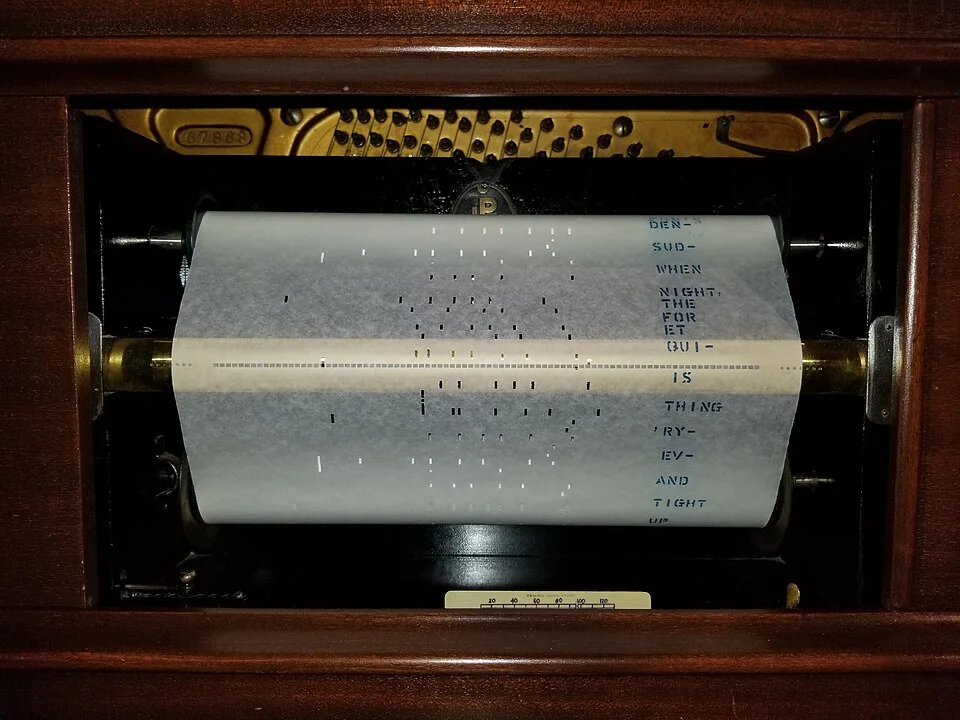
The holes in a player-piano roll do not look like music in the habitual way. There is no staff to measure a note against. Long vacant sections can lie alongside scattered little cuts. A person with enough information about the type of roll can read quite a lot from those shapes. For most visitors an easier way in is to see the paper moving toward the little row of ports that reads it. A hole comes past, opens a path in a system and then passes on. The material goes from looking like a long arrangement of empty places to a series of events someone has gone to a great deal of trouble to store.
Stanford’s libraries preserve historical rolls and describe methods for digitizing them. Mechanical playback can give a listener something rather special: air and moving parts act on a real piano in response to paper. Running a delicate old roll through a machine, though, is not the only way to learn from it. The images, measurements and audible realization of a roll can each be retained. The former two can show what was preserved on a particular strip of paper; the latter lets a person hear one way the instructions could turn into music. Good preservation can make each of them available without calling them the same record.
The page has one direction that means later
The roll has an axis along which the paper travels. When one opening in a given position comes past before another, that gives them an order of events across the playing of the roll. Positions across the paper can identify channels in the system the roll was made for. A particular channel might correspond to a note or have a different job depending on the format. In a schematic picture, think of the width as offering places for different kinds of instruction and the length as carrying a sequence as the paper moves. The two directions explain entirely different relationships in one small field of holes.
Try drawing three holes in separate positions across a small strip of paper. Move the strip slowly past a fixed line, keep the line parallel to the width and note when each hole reaches it. Move one hole only along the paper’s length and it reaches the line earlier or later. Move it directly across the width instead and it can keep much the same timing while offering the opening at a different position in the reader. The drawing gives a simple explanation of why a small lateral slip and a small error in speed can have quite different consequences for a real instrument.
A long hole also spends a while passing the line. For appropriate parts of a roll its length can bear on how long a note instruction persists; translating that length into elapsed time depends on how the roll moves. The paper is consequently useful before anybody has chosen a final playback speed. It can preserve geometry well enough for a replay to carry its own stated settings. An audio recording of the same piece offers a measure of sound with timing already embodied in it. They do not have to be cataloged as the same kind of object to be useful together.
A complicated instrument stands between holes and sound
In a pneumatic player piano the passage of openings past a tracker bar can change the air conditions that operate parts of the mechanism. It is the piano’s action that produces the sound. The roll did not contain in miniature a waveform of the strings it would eventually make move. This is why two compatible and differently maintained instruments can deliver perceptibly different results from the same paper. Their components, tuning, adjustment and surroundings matter. A faithful reader can make events audible while still contributing some of the characteristics of the performance somebody hears.
Museum and research descriptions also distinguish systems capable of more than setting notes in motion. Some reproducing rolls and instruments were designed to register and replay aspects of expression in specific ways. Other rolls may leave much more to the instrument and person controlling it. Do not treat every punched roll as a documentary recording of a particular player’s full dynamics. Check what kind of roll it is and what the archive can establish about how the paper came to be prepared. A title on a box can name the composition without proving whose actions every hole represents.
Once this difference is clear, a correction in the heard result acquires a different meaning. If a digital reconstruction interprets a certain channel incorrectly, it may give an odd outcome on otherwise accurately recorded holes. If the scan missed a narrow cut, the error lies at an earlier stage. Compare the physical or imaged holes, the interpretation, and the audio as separate layers. An unnecessarily confident reconstruction can leave a very musical result and very little evidence of how to check it. A well-documented one gives another reader a way to reproduce or question particular decisions.
A scan can hold paper still without having to stop music
Stanford describes digitizing historic rolls in part because actual playback can be hard on rare paper. In an image someone can look closely at a place where the strip would ordinarily pass quickly. They can compare a dark patch with shapes obviously punched in nearby, or inspect the edge that helps a reader keep things aligned. A long strip still needs to be represented across successive portions. A person comparing those views must know whether the edges overlap, which direction is forward and which details belong to the physical paper rather than the scanning arrangement.
Marks near holes can present an interesting archival problem. A tear could appear to extend an opening, or the repair of an earlier tear could cover enough of an area to make the old reading uncertain. A clean abstract list of note events does not preserve all that material evidence. A good image preserves details even when no one immediately uses them to produce audio. A responsible transcription gives the uncertain parts a label; it does not need to make a torn place look like a completely clear decision by the original maker.
The labels and packaging can travel with the archive without being treated as part of the stream the piano reads. They can identify an edition, song or intended kind of playback. Sometimes an institutional description needs to distinguish what came printed on a box from what later scholars established about the object. Keep those descriptions next to the images, but do not make them indistinguishable. A tape attaching an old label and a punched instruction to the instrument seem very different when the actual paper can be opened rather than replaced by a list of notes.
Sometimes the exact condition of the original matters most at the beginning or end. A damaged leader can affect how a roll is guided without telling you anything about the musical material farther in. A label at the tail can document a piece of handling or ownership that a recording ends before it can convey. When preparing a research image, say whether the whole roll or only the playable passage has been included. The question of whether there is music beyond a blank length can then stay separate from the question of whether the archive let the blank length enter the record.
Where the archive preserves an edge, keep it in at least one reference view. That helps distinguish a position on the roll from a position in the crop.
Compare two playable versions without demanding one result
Choose a short phrase recognizable by its opening notes. Compare views of the roll and an audible rendering, and note where you can connect an event from one to the other. If a second rendering comes from different playback conditions, ask which related features have been held the same. A measured length on the paper and a precise duration in a sound file require a relation supplied by the process. It is possible to keep the notes recognizable while making the phrase sound dramatically different through speed, tuning or dynamics. All of those things may matter to an archivist or musician and deserve their own names.
A printed score offers another comparison. It usually gives the reader a way to group notes and annotate their interpretation. The player roll gives a mechanism a way to act on a strip of moving material. A person looking at the two representations can learn something about the choices built into mechanical performance without assuming the score, roll and audio are three complete copies of the same evidence. If they disagree in one place, first ask which features each was meant to carry.
Look again at the length passing over the tracker bar in the photograph. The holes seem still as they wait in line for the one point at which they become operational. An archive can preserve that length so a researcher may stop at any one of them and give it a deliberate examination. A listener can now go in the other direction, letting the same evidence pass and become audible. The paper was a means of commanding an instrument. Its surviving arrangement gives later people both a way to listen and something to look at long after the instrument has fallen quiet.