The Weight in a Longcase Clock
The dial gives the time. A longcase lets a hanging weight fall far enough to do the work, and the mechanism meters that fall into small movements.
In this story 4 sections
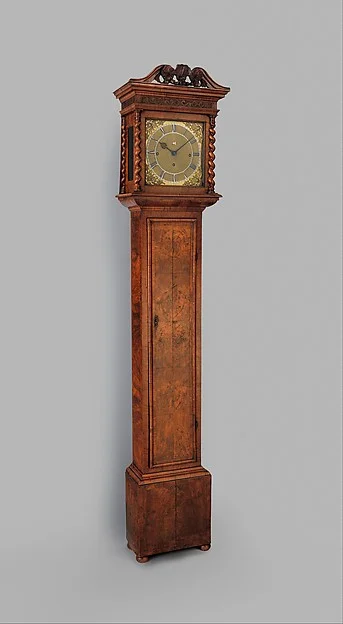
A tall clock invites the eye to behave as it does in front of a tall person. You look near the top and settle on the place that seems to look back. There the hands cross a dial, and there you can sometimes find marks of a maker, time or calendar. When the clock is running, most of the useful change is almost too small to notice directly. A hand occupies one position and a little later another. For evidence of the work being done, you would have to open an appropriate view below the dial and look for something whose fall is being spread over many hours.
A longcase clock offers vertical room. That space can house a long pendulum and provide travel for weights that power the mechanism. The forms of the cases differ enough to make a row in a museum worth examining on its own terms. But from across a room, a tall piece of furniture can disguise a very straightforward device: a weight will come down if it is given a way to do so. One question for the clockmaker is where to store that travel. A more difficult one is how to keep it from spending all its travel at once.
One working journey begins at the top
Imagine a weight suspended above the floor on a cord. Put the cord around a drum whose shaft is connected to a train of gears. As the weight descends the drum can turn. There is potential energy in the system by virtue of the position of the weight. Winding can restore that energy by raising it again. In different clocks a chain or more complicated arrangement may take the place of the cord around your imaginary drum. The connection between winding and lifting gives a readily understood way to account for where the work happens, much more directly than a look at the numbers printed on the dial.
A falling weight alone does a poor job of telling time. If you put no restraint on the drum, the motion can finish very quickly. A pendulum alone also tells a limited story; given a small initial swing, it loses energy to friction and air resistance and eventually stops. In an ordinary pendulum clock the mechanism makes the two parts useful to each other. An escapement lets part of a gear move in response to the pendulum’s swing, while the powered mechanism gives the pendulum impulses to maintain that swing. The exact movement depends on the design. The roles are easier to retain if you can say what goes wrong in either simplified case when the other part is removed.
Follow the weight again. It might be heavy and make little apparent progress while you stand before the clock. That is what you would expect from a device intended to deliver small amounts of energy over a long period. You can see the principle without seeing a movement in action by taking note of the height available between the movement and the bottom of the case. Nearby there may be room for a pendulum to move from side to side. There is a vertical path and a repetitive swinging path, and they should not be mistaken for the same kind of movement.
Nothing keeps time just by occupying a place
The length of a pendulum affects the timing of its swing. Conditions of use, the amplitude and the relationship to the rest of the mechanism can matter as well. An escaped gear is taking tiny advances set by the swaying part rather than measuring whatever speed the weight would naturally acquire in an unobstructed fall. This division lets you understand a familiar clock from the sound. A recurring tick can tell you about a controlled advance. It cannot tell you from across the room how far the weight is from the end of its available travel.
Think of a rigid band of timing marks. A gear train can translate repeated small advances to pointers that complete circuits over different periods. There need not be a direct mechanism where the weight always occupies a height corresponding to the hour shown now. If the clock is wound in the afternoon, it may still read the afternoon while the weights are newly raised. The position of the weight is a record of what has been made available to run the movement. The indication on the dial is arranged by another part of the clock.
Why does a weight need a long drop? Consider two otherwise similar arrangements that use the same design and lift similar weights. Giving one a larger range of descent gives it more possible work between windings, if the rest of the movement can use it. Actual running duration depends on more than whether there appears to be a tall case. Drum and gearing, the winding arrangement and required work matter. Do not deduce the running period in days solely from an extended lower door. Photographs can establish proportions quite well without showing a movement’s rate of consumption of its available travel.
Follow the sound on a separate line
One clock can do more than move hands. If it strikes, the sound may come from a dedicated train that uses power for a much shorter and different kind of work when the strike is called for. A passing hour can ask that a hammer move several times in succession. The hands must continue to make their ordinary progress. In many weight-driven examples with a separate striking train, different weights supply those jobs. This is a reason why several hanging weights visible in a photograph are not automatically all acting together to run the part that keeps time.
Put those observations on two lines in a notebook. On one, write that the hand continues to advance almost unnoticed. On the other put the particular moments at which a hammer is supposed to make an audible intervention. Then ask which part of the movement supplies each. If the record describes a more complicated clock with calendar or other displays, keep each feature distinct too. Does an aperture show a date by means of a small daily change? Does the case carry an inscription that seems at first to belong to that display? Close photographs of the dial help show what is represented, while a record of the movement explains how the separately labeled things are maintained.
For the Met’s clock with calendar, the name of Joseph Knibb identifies a clockmaker associated with the object. The tall decorated case in the photograph does not show every piece inside. Use the collection record and a catalog if you want to attribute a mechanism narrowly to this clock. General descriptions of what a longcase clock often does can give you a much better set of questions than they can give you a precise view through a closed door. A portable watch and a tall cabinet clock can both display hours prominently; the evidence for what moves them involves different objects.
The cabinet has its own work
A door gives someone a way to see or reach parts that are otherwise protected. Its height can show where access was anticipated. A glazed part can offer a look at the dial or a visible moving component while leaving the rest hidden. A base can give a tall case a stable relation to the room. Make these observations independently of ornament. A skilled cabinetmaker can put an uninterrupted visual panel across a working compartment or divide it to give a sense of several distinct pieces while it is functionally one space. The form a viewer admires and the space the movement requires can be served by the same dimensions.
When you compare pictures of several clocks, match the view of their dials first, then look below rather than aligning the bottoms of the whole images. The fact that one case continues much farther down may invite useful questions about the movement, the pendulum or the furniture tradition it belongs to. Keep a distinct line for later alterations or a case made for another movement where the collection notes identify one. A clock reconstructed as a display can make an excellent account of how the parts fit. Its current assembly is not automatically the only one the object ever had.
One can also be tempted to experience the cabinet as a mysterious container because it is closed. In most exhibitions it ought to be left undisturbed. Use the collection’s own open views to distinguish one fitting from another. For a clock still in use, any adjustment or handling of weights is best treated as separate work from observing the clock’s layout. Knowing that a weight descends does not establish how to move a particular one safely or address a movement that has stopped.
Return to the two nearly still hands after you have spent a little time with the lower door. The clock is now several stories in one piece: a display for the person who wants to know the time, a whole vertical travel from which the movement can draw its work, and a regulator whose repeated sway makes that work proceed in measured portions. If you come back later, it is worth looking where you began. The hand’s new position seems modest again. The clock has used a small piece of a much longer descent to put it there.