Three Scripts on a Broken Stone
The Rosetta Stone makes a famous comparison possible, but the broken edge and the grouping of its signs show why decipherment took more than lining up translations.
In this story 4 sections
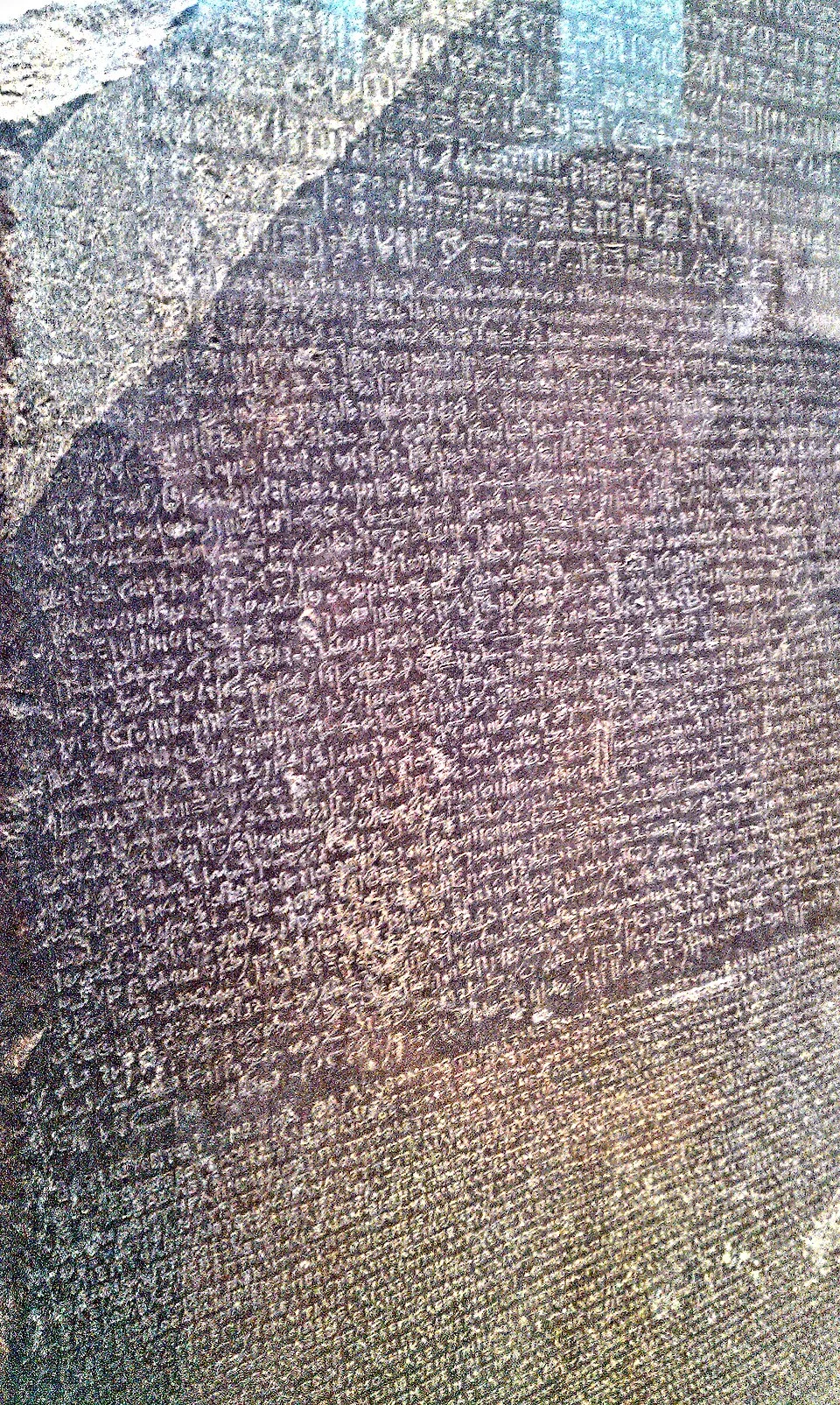
The first thing I would point out to someone at the Rosetta Stone is a gap. The top of the slab is gone. All the careful lines of writing at the top have been cut short by the irregular fracture, and there is no corresponding blank space where we can tell exactly how much is missing. It is an odd sight when you know the reputation of the object beforehand. A key ought to be intact, and the Rosetta Stone is supposed to be the most famous key to a writing system in a museum. The gap gives a better idea of the work its readers actually faced.
Below the break, there are three visibly distinct bands of writing. The Egyptian hieroglyphs at the top offer the occasional shape that even someone with no training could recognize as a creature or part of one. The band of demotic is also Egyptian writing but looks strikingly different. Ancient Greek runs through a lower band. You can distinguish the bands well before you can read them. This is where the stone can first belong to an untrained viewer: the arrangement does some of the explaining before the exhibition label has to.
What one place held in common
The British Museum attributes the fragment to a decree drawn up by Egyptian priests in 196 BCE, during the reign of Ptolemy V. The text records honors for the king and explains why he merits them. There were political and ceremonial reasons to put the message into circulation. The monument’s original audience was not trying to recover a forgotten script. Each part of the text drew on writing practices that were still in use.
An object can have value to very different readers at two moments in time. To people who devised the monument the repeated text made it possible to issue a royal or religious message in multiple writing forms. To early modern readers investigating Egyptian scripts, it put versions of a known subject together in one place. Evidence of intention comes from the text and the circumstances of the decree. It does not follow from the fact that a later reader found it useful. If we think of the stone as an instruction sheet left for people two thousand years later, the whole comparison seems easier than it was.
Two of the scripts are used for Egyptian and one for Greek. The arithmetic is three scripts, two languages. The distinction is helpful because the middle band looks far enough from the top that a modern reader might imagine an entirely separate language hiding there. The marks with which a language is written can be radically different in different settings. Ancient readers also made choices about style, formality and purpose that a clean classroom example of a language rarely conveys.
Draw a bracket around a name
A common exercise from the museum’s visitor guide starts by finding a cartouche, an oval-shaped enclosure used around a royal name. Find one at a resolution that allows the incised signs to be separated from the texture of the stone. Then try to locate another. The enclosure is valuable even before assigning any sound to the interior. It suggests that a set of signs is grouped for a reason. If you know that royal names can occur in the Greek version, you have a possible category of correspondences to test.
Imagine a shared name in a French paragraph and an Arabic paragraph today. Someone who knew one of the languages could locate the name in a transcription if they had enough knowledge of the other writing system. The name could be spelled to fit sounds that are easier or harder to represent in one language, and the marks around it would depend on the newspaper or book. This is only an analogy about a point of entry. A reader can know a good deal about how a name behaves without having discovered how the whole sentence works.
A convincing correspondence has to survive beyond its first example. If the same proposed sign reappears in another name, note what reading you would expect and check it there. If it seems to fail, the original prediction might be wrong, the signs might not be identical, or the sign might have a role you have not accounted for. In the study of hieroglyphs some signs represent sounds and others can contribute to meaning, including by providing clues to what kind of word is being read. A discovery about one name is an opening into that system. Simply assigning the letters of a modern alphabet to a row of pictures will not keep working very long.
The edges of the comparison
If you reduce the photograph to a thumb-sized picture, the edge dividing the bands looks tidier than the stone itself. Zoom in as far as you can without merely enlarging pixels. Note where a line runs right into missing material. A damaged name provides less evidence when one meaningful sign cannot be checked. If a scholar reconstructs the passage based on another source, a modern reader may see it completed in print. The completion needs to remain distinguishable from the carved evidence that survives.
There is another difficulty even in the intact parts. Equivalent blocks of text do not have to be arranged word for word. A phrase can be carried differently in two languages while the larger message remains recognizable. The useful comparison can start at the scale of a person, an action or a formula that recurs. You can see why early attempts using groups of signs as references were more practical than trying to assign the first Greek word to the first complete group of Egyptian signs in the corresponding band. At many places the first complete group may not even have been first when the slab was intact.
A small check is possible on any familiar bilingual sign that repeats a long message. Do both translations occupy the same number of lines? Where is the name of the company or place? How is punctuation set around it? Which words come right before the name? You do not need to understand the second language to see why the line breaks make untrustworthy anchors. A stone adds a different set of constraints: the size and position of the writing on its surface, the labor of cutting and the cost of dealing with mistakes. Ancient readers made their way through those conditions without expecting a chapter number or a line of type to guide them.
After the fort
The discovery that drew European scholarly attention to the stone came at Rashid in 1799, when a French military party was working on a fort. Following the French defeat in Egypt, the stone was taken into British hands and arrived in Britain in 1802. The museum’s account connects the inscriptions to a monument of the Ptolemaic period and the broken stone with a much later military site. The object has not come down through an unbroken history of being displayed for its original purpose. Its travel also helps explain why the place where it was made and the place where most readers now encounter it are so far apart.
Copies of an inscription matter differently from copies of an entire object. A legible print of the signs can circulate among scholars who do not have their own view of the stone. A cast or a good image can preserve the relative spacing of signs or show the contour of the fragment. As the image passes between media, though, a crack, mineral feature or highlight may become harder to distinguish from deliberate marks. Comparing two kinds of view can turn a supposed sign back into a mark on stone. The surface usually needs more than one visit.
You can see a version of that effect by moving to another position in front of visible carved text elsewhere in a museum. A shallow line that seemed to vanish under one reflection can reappear when the viewer moves. A large crack remains a crack, but whether you see certain portions of it can change with the angle of light. The marks might be permanent relative to the observer while visibility remains provisional. Photographing an inscription for someone else is consequently a job of showing the surface at an angle useful to them. The most dramatic picture and the most readable one need not be the same picture.
When making notes, put the visible marks in one column and a printed reconstruction in another. Use an open bracket where the visible line meets the broken edge. The blank will occupy as much room on the page as you give it. That is a useful reminder that the amount of missing writing cannot always be inferred simply from the number of signs left on a line.
A more exact account of decipherment needs other inscriptions, other readers and dated proposals. The object at the center of the gallery cannot reproduce that whole history for you. It can give you several of its conditions at once. Look at the break, the changes in script and a small group of signs that comes round again. In the space of those three observations there is a reason the slab could illuminate a reading, a reason it could leave considerable uncertainty, and a place for you to begin testing what you have been told.