Two Gazelles Hiding in a Wooden Screen
The small turned pieces in a mashrabiyya at The Met do two kinds of work. They make a surface that filters light, and they leave just enough of a break in the pattern for two animals to appear.
In this story 4 sections
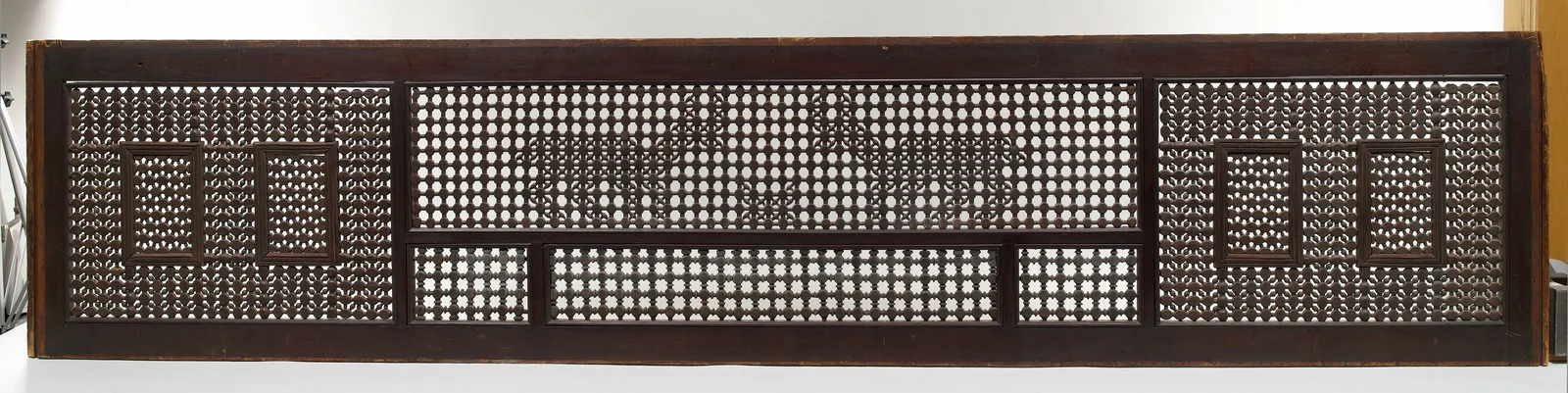
There is a delay between seeing a wooden screen and seeing the two gazelles in it. The opening view is of many small regularly spaced details, similar enough that the eye quickly treats them as one material. The animals emerge only after a second look. There is no separate picture pinned to the wood. Connections turn, widen or repeat differently, and a whole shape comes out of their arrangement. It is possible to lose the gazelles again just by moving farther away from the photograph. That is a good beginning for understanding an object that had to work in changing light and at different distances.
The Met catalogues the piece as an eighteenth- or nineteenth-century mashrabiyya attributed to Egypt. The long panel measures about 3.6 metres across. That is enough width for the joined parts to have consequences far beyond the hand that worked on any one of them. The museum explains that turned wood screens of this kind were used in Cairo in windows, balconies and some interior spaces. They moderated light and gave air a route through the screen. They could also make it harder for people in a brighter outside space to see people in a comparatively dim room. The animals belong to the same working surface as all those unobtrusive openings.
Follow the material to its next joint
A small piece of wood turned on a lathe can acquire a profile fairly evenly around its length. Turn one in your imagination: a raised ring will be larger than the recessed parts on either side and will look different as the light comes from another angle. In a domestic object made from one block of wood each ring might be decorative in much the same way. In a screen assembled from many parts, the shapes determine how much space remains around the pieces. A row made with thicker centres can close more of the view than a row at the same spacing made with thinner centres.
Start at a point where four short parts seem to converge. Notice that the small joining piece differs from the longer pieces that enter it. It has to receive them in a direction the pattern can repeat. A straight run and a run that turns have different positional demands. To understand the shapes the eye eventually reads, it helps to sketch connections as dots and lines before trying to draw the thicknesses. A line in the diagram records one relationship between two pieces. If you set out several nearby lines, you can see how a decision made at one junction affects what remains possible at the next.
The exact sequence of a workshop is difficult to recover from the finished surface. An exceptionally crisp border does not tell you the order in which the work was laid out, who turned the short pieces, or how many people performed later repairs. The catalogue identifies the material and method and offers an explanation of the general construction. A detailed photograph can help distinguish pieces that might have been made using similar operations. It cannot by itself show which pieces were on a workbench together. This is one of the pleasures of looking at well made craft: the object lets you infer a great deal about the discipline of a task without making a promise about the day on which somebody performed it.
One thing the photograph does show plainly is the change in scale at the outer frame. The light passing around the tiny turned parts comes to a stop at a broad continuous length of wood. This boundary gives the assembled lattice a clear edge and a place to meet the larger arrangement in which it once sat.
Looking from the room and from the street
Find a screen of some kind near a window. It could be a light curtain, a coarse blind or part of a different building altogether. In the daytime, stand where you can see an outside scene through it, then change your angle. A view directly through openings lets you connect more of the background than a view in which the material crosses each opening at a slant. The change can feel greater than the small movement you made. The distance from your eye to the screen matters as well. Close to the screen it may be easy to look through one opening at a time, whereas the same small openings can merge into a surface from farther away.
Screening depends on the surroundings. A brightly lit room seen from a dark street at night is a different situation from a darker room facing a sunny street. A patterned division alone does not provide the same privacy in both cases. A reader can be attentive to that limit without dismissing the historical descriptions of how such objects were used. The work is performed by the openings, the angle and the relative light together. Cairo’s architecture supplied particular circumstances under which that combination could be useful. A museum photograph puts the object in a controlled setting where most of those circumstances are out of view.
A screening surface also distributes light instead of merely subtracting a fixed amount. Clear spots cross a wall or floor at some times of day and lose their definition at others. Air can move through when there is a difference that causes it to flow. Sound, dust and views follow their own patterns. No single image of a room makes all of those effects apparent. A museum visitor can still see the beginning of the explanation in the alternating solid and open parts of the panel. The choice of how close to make the parts changes several practical things at once.
Find the figure by comparing the surrounding field
Look at a part of the screen far from a gazelle and pick a small group of connections you can recognise elsewhere. A checked pattern on a shirt offers a rough analogy. Once your eye knows how a patch usually continues, it can quickly spot a change. In the screen it is the handling of the familiar arrangement around the animal that gives the outline a chance to emerge. The change can be so well accommodated that an inattentive visitor sees only extra density or a shadow. Next to the gazelle, the repetitions work almost like the margin around a line of text. They help establish which difference has visual force.
Try narrowing your gaze to the outline you identified and then widening it to include a substantial area around it. The figurative reading gets more secure even though the figure occupies a smaller part of the view. The surrounding patch supplies a baseline. If you want to sketch the animal, draw a few of those ordinary connections outside it before describing its body. The sketch may show why a simple silhouette fills in too much. The figure works through parts that are only partially distinct from their background. Some of its shape appears through a weak edge that a dark outline would overstate.
This makes it tempting to assign a private meaning to the animals. The museum points to their presence as an example of a secondary pattern introduced into a lattice. That is a claim a reader can check by attending to the object. Without another source it is harder to know what a particular person in the former building thought of the gazelles. Their placement and relationship to the surrounding field deserve description regardless. Concentrating on those observations can be more rewarding than trying to solve the whole object as a riddle with one answer.
A piece of architecture on a museum wall
The long screen is an architectural object with a museum identity. Another Met mashrabiya is considerably more compact and preserves a niche of a kind once used to hold water jars. Put the two records side by side. Their shared name does not require them to have done the same work at the same scale, and the presence of a niche in one is no warrant to imagine the same feature missing from the other. The useful question is what each shape makes possible. An object with a shelf or projection intervenes differently in a room from a long screen that acts mainly along a plane.
If you go back to the dimensions of the gazelle panel, sketch it at a scale where you can see most of its width on a sheet of paper. Mark a couple of possible positions for a viewer in front of it, including one well to the side. Draw a straight line from each viewer’s eye toward a spot beyond the panel. That kind of sketch explains why somebody standing in a particular place might never see the animals as complete figures and could still make normal use of the screen. The two gazelles are a pleasure available under certain conditions, embedded in an object whose practical duties do not stop whenever the outline is hard to follow.
At the end of a close look, linger over the plain part for another moment. Leave yourself enough time to see the joining pieces and the way the light passes them. A viewer who arrives for the animals can leave with some sense of the decisions required to make a large, partly open surface out of small pieces of wood. The next time the animals become visible, they can stand out as an exception deliberately made possible by those same decisions.