What an Accordion Album Opens
An album by Tsubaki Chinzan opens one way in the hand and another way in a digital catalogue. The folds are part of what makes its pictures a book.
In this story 5 sections
An album can look like a small book while it is closed and like a piece of folding scenery when several panels are opened. A finger beneath one edge does not necessarily lead to a single leaf turning at a central spine. Several surfaces can move. They can lean towards each other or spread apart. Before discussing what a picture means, it helps to know what has to move in order to see it.
The Metropolitan Museum of Art catalogues the Chinzan Picture Album as an accordion album, made with ink and colour on paper in 1851. It names Tsubaki Chinzan as the artist and gives the album's dimensions as 28.5 by 18 centimetres. That compact figure describes a book that can be put away. It does not convey every kind of opening. In the online record, where several views can be chosen without lifting a panel, the images can seem independent. There is another relationship written into the paper.
A binding made out of successive folds
In a typical accordion book, successive sections form a strip which can fold back on itself. The Smithsonian's conservation paper on displays for Japanese books describes accordion books made from sheets joined into a long strip and folded in alternating directions. Not every historical album is constructed in exactly the same way. The account helps explain how a book with no single sewn hinge in the centre can still have numerous lines at which an opening is possible.
Take a sheet of scrap paper and make a simple model. Fold a short section forwards, turn the paper over and fold a matching section the other way. Repeat. Close the little stack, then lift a panel halfway along it. Several folds share the movement. If another person takes an end and draws it away slowly, parts of the strip can become visible together. The model demonstrates the direction of the folds without making assumptions about how Chinzan's paper was joined, sized, mounted or handled in 1851.
The strip and the stack pose two different design problems. The strip gives pictures neighbours along its length. The stack concentrates the folded material between covers or ends. When closed, the thickness and stiffness of the paper matter to whether the book sits flat. When opened, adjacent panels may be visible as a pair, or more than one pair may lie in sight. An illustrated surface need not acquire the same physical behaviour as a loose drawing merely because a reproduction makes it look rectangular.
Whether a line separates two things
One album can use a fold like a boundary between images. Another can ask a viewer to read shapes across a fold as part of a single view. The two effects should not be decided in advance simply because both books open with a zigzag. In the Smithsonian's record for the separately made Hana ikada, a single sheet is described as mounted to form each opening on a concertina binding. That is a documented possibility, not evidence that the same process was used for the Chinzan album.
As an exercise for a viewer, start with a catalogue image and look for a change in paper or an area of shadow. A narrow dark line might mark a fold. It might also be the boundary between a mounted image and its support, or a lighting effect. A sharp bend in a drawn stem does not automatically coincide with a fold under it. Inspection of the physical object, measurements or views taken from another angle can resolve things that a front view leaves open.
A set of thumbnails introduces an additional boundary. The catalogue has to divide one object into images somebody can click. If there are two pictures in a thumbnail, it may be because the photographer recorded one opening. If there is one, it may be a detail cropped from that opening. The arrangement on the website gives a reader a sensible path through the files. To use it as a description of the binding requires another step: read what each view shows and compare it with the object's record.
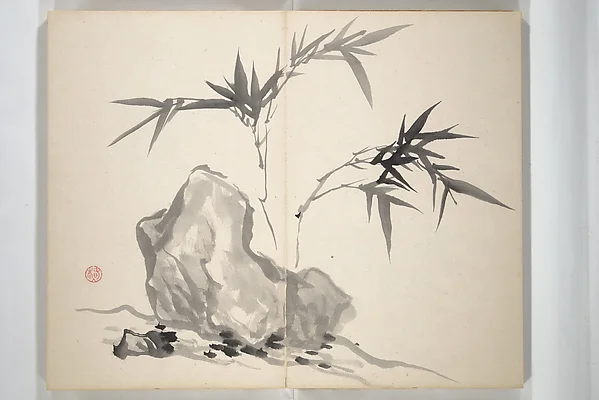
In the photograph on this page, the visible division crosses a composition of bamboo and rocks. The largest mass of rock leans toward the left; leaves hang above and extend into the space on the right. If you cover half the image, both halves still offer something to observe. Open the whole image again and the empty ground on the right begins to carry the long reach of the leaves. This is a specifically visual reason to care about the photographed opening. Seeing one piece at a time changes the balance of the picture even if the brushwork in each piece is otherwise legible.
What the reviewer sees at each distance
A wide view of an opening is good for seeing edges, mounting and the proportion of one picture to another. A detail reveals colour transitions and small lines without saying where the picture fell in the sequence. Full closure gives a sense of how the book sits as an object, yet almost none of its painted surface is available to study. When viewing an album only online, it helps to recognise that these photographic distances answer different questions.
Imagine that we wanted to know how the artist distributed white paper across several openings. Study of one highly magnified detail would be a poor first step. Several whole openings under comparable lighting would help establish where drawn forms and unpainted surroundings sit. If instead the question concerns the brushwork in a leaf or the meeting of two washes, a detail becomes useful. The point of starting with the research question is to avoid blaming a photograph for omitting information it was not meant to record.
Dimensions give context for a screen too. A picture album can be enlarged enough to occupy the whole width of a monitor. It can also be reduced to a postage stamp on a search page. In either case a feature that seems daringly large or painstakingly fine may acquire that effect in part from the reproduction. Keep the overall object dimensions close at hand until you have a clear idea of how much has changed between the book and the screen.
A fold is also where weight collects
Opening an accordion binds the weight of adjacent panels to the point where the paper bends. The Smithsonian conservation account warns of stress at folds and describes supporting displayed openings so the two sides are level. It is easy to see why with the scrap model. Open it close to one end and most of the stack remains on the other side. If you set both stacks down on the same bare table, the opening has to bridge the difference in thickness. In a real album, the materials at that bridge can be older, more delicate and less able to take a new shape.
A support changes the problem: instead of making the open paper bend to reach a surface, the surface is arranged to meet the paper. One side may need more beneath it than the other. Telling this story is different from giving handling instructions for a particular object. A conservator needs to examine where folds are strong, weak or repaired, and how the book can be supported. A reader at a display case can notice the effect of that judgment without seeing the whole preparation.
There is a small cost in trying to see every surface at once. An exhibition case may only have room for one opening at the angle best suited to the book. Turning to another drawing changes both the visual selection and the balance of the object. A digital view can add a second possibility while leaving the display still. Ideally the new image brings enough of the object with it that a visitor knows whether it belongs to the next opening or is an enlargement of the same scene.
The order that belongs to the object
A reader making notes can keep a small sequence list: cover, first recorded opening, next recorded opening, detail. If page or panel numbers appear in the catalogue, copy them as supplied. If they do not, name the view rather than inventing a folio reference. This unglamorous work keeps a record useful for a person trying to find the same picture in a different set of images. It is especially helpful when the object has visible panels but no printed page numbers.
Consider how an image lifted out of the sequence might be reused to show a painter's treatment of a flower. That reuse is reasonable when it keeps the artist, album and accession information with the picture. A second reader may care that the flower was seen across from a differently sized composition. Without a link back to the collection, the reader can recover the colours but lose the object. A label saying page from an album gives a clue; identifying the album gives a place to start.
The catalogue lets viewers look quickly from one image to the next. That is a good use of a screen. The physical album invites another pace. Its panels can gather into a stack, open a little way or take up more table space than their closed measurements suggest. The painted pictures survive all those changes in arrangement. Part of recognising them as a book is remembering that a fold, even in a region without ink, can decide which two pictures become visible together.