When a Daguerreotype Goes Dark
Robert Cornelius’s 1839 self-portrait is easy to view online. The original daguerreotype asks something difficult of a reproduction: to show a picture made on a mirrorlike surface.
In this story 4 sections
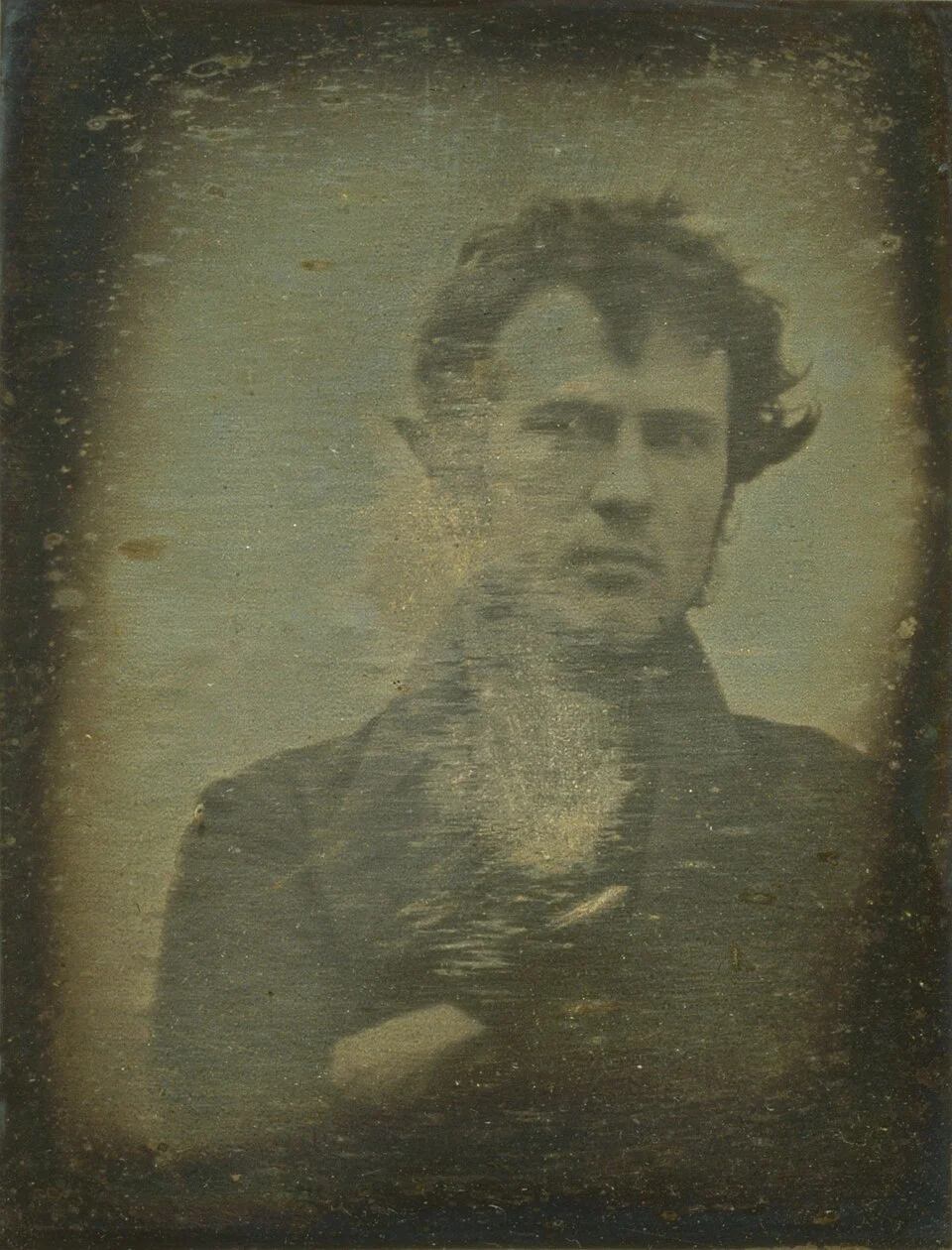
Robert Cornelius looks out from a photograph in which his coat dissolves into the space beside his shoulder. There is enough light to show the edge of one sleeve, a suggestion of crossed arms and a determined arrangement of hair. The Library of Congress identifies it as a self-portrait from 1839. Somewhere just off the screen there is a significant fourth thing that is hard to imagine from this familiar picture of a person. The face occupies a plate of metal that can behave like a mirror.
If you approach a daguerreotype that is framed or in a case, what you see will depend on the direction of your look. At one angle there may be an unexpectedly distinct image. At another the same place can appear filled with a reflected highlight. A dark ground in the picture may turn into a much lighter one; the whole balance can seem to flip. Moving enough to find the subject again is often the first bit of work involved in viewing one of these photographs. A digital reproduction can do much of that work in advance, perhaps so thoroughly that the process by which you see it is the last thing you would think to ask about.
The surface and the picture share a place
A daguerreotype is made directly on a polished, silver-plated copper surface. There is no separate negative from which impressions on paper were ordinarily made. The photographic image and its reflective support occupy the same physical object. The image consists of microscopic material on that surface, whose relationship to light differs from the smoother areas around it. This is why it can have properties more familiar from looking at a polished spoon than from lifting the cover of an ordinary print album.
Imagine seeing the polish of the metal where it reflects a dark, relatively uniform area. The highly reflecting background can then look dark, while the image material scatters some illumination back toward your eye. A face can emerge in tones you would call positive. Shift the reflective areas into the path of a light background or a glare and the balance can change; places that seemed dark can now look bright relative to other areas. The physical features of the plate have not exchanged places. You are now getting the light from the two kinds of surface differently.
Depending on its mounting, the plate may be behind protective glass. Even the first reflection you notice might be off that glass, rather than from the silvered plate. A view of your shoulder can move with you as distinct levels of reflection fade in and out. A reproduction sometimes includes bright-looking features near a case edge that a viewer might otherwise take for an original part of the scene. Those features may belong to the reproduction or the object’s housing. The easiest first check is to compare images with provenance from the same collection rather than comparing unrelated crops without context.
Put the exposure somewhere in the account
The Library of Congress describes Cornelius’s self-portrait as an early example of American portrait photography, made in Philadelphia. An early photographic sitter was not in the position of a person taking a phone picture during an unplanned conversation. A long enough exposure asks that the subject keep some things steady while the light accumulates. Diffuse contours can invite stories about how the sitter behaved, but a single reproduction cannot tell you which blur came from which motion or from a limitation of focus. Read the portrait increasingly closely only while keeping that uncertainty alive.
Take the arms. From most views they appear to gather in front of the chest. Bringing the limbs in close can make the structure of the pose simpler to trace and more settled in appearance. It also reduces how much foreground the portrait has to include. One could infer from a later anecdote or study how the maker organized the exposure, should appropriate evidence surface. No broad shadow in the coat by itself establishes that he ran into position at a particular count. A useful description stays with what the image can support while leaving the production question open.
The sitter’s direct regard and the softened background make the picture surprisingly legible at low resolution. That advantage can become a disadvantage if researchers rely on the most common crop. It may dispense with physical information: the plate’s outline, the boundary between image and mounting, anything in the surrounding case or on the back. The Library of Congress record preserves more than one way to view or identify the photo. Begin with the complete record before assuming a thumbnail is a complete copy of the object.
How a photograph becomes another photograph
A photographer asked to reproduce a daguerreotype usually wants the subject cleanly readable. They have to decide where illumination comes from and what the mirrorlike part of the plate will reflect back toward the lens. A quiet dark area beyond the camera can be useful in creating a readable positive view. A very different setup might document how the surface or housing looks under other conditions. If someone wants to study both the image and the plate, there is a good reason to preserve separate documentation rather than expecting the same frame to show everything.
Try a thought experiment with a metal tray turned toward a camera. First suppose the area reflected into the lens is the face of a bright window. Now put the camera and tray at an angle from which the tray reflects a dark curtain instead. Without changing the subject’s composition, you can change the ground over much of the frame. This is not a demonstration of the chemistry of a daguerreotype. It gives an ordinary way to recognize how a photographic reproduction can improve the readability of an image through choices outside its frame.
The catalog might also provide digital files derived from copying different materials. A new direct capture of the plate and a scan of an earlier copy should not automatically be treated as equivalent views. Each can keep some strengths from the method used to make it. Check the record to see what the institution identifies as the source for the file. If the metadata is unclear, the uncertainty belongs in your reading. A black spot that appears in one copied view can be worth noticing without immediately becoming a scar you believe is on the original.
A direct portrait plate can also carry a lateral reversal. A copy maker may reverse the picture in the course of preparing a publication. If the sitter’s clothes or an inscription seem to show which way the plate was oriented, ask whether you are looking at a record of the physical surface or at a version prepared for reading. The Cornelius portrait need not have an obvious left and right for that question to matter.
Leave handling to its own expertise
The reflective nature of a daguerreotype can produce a familiar temptation. An observer who has seen reflections on a window can imagine removing the glass and solving the visibility problem for good. A conservation setting treats the plate and its covering as much more consequential than the equivalent pieces of a modern frame. The image surface can be delicate. Case, glass, seals and evidence of previous handling may all matter. Learning how the surface looks does not require touching it or opening it. It can start with documentation of what is visible and under which conditions.
When looking at one in a collection, the simple notes are often the best ones. Record the direction from which the face was easiest to see and whether the color compared differently when you moved slightly sideways. Avoid shining a light into a case to try to improve the view. In an online comparison, note which file you used and whether it shows a plate, a wider mount or just the image. Use a later view to check a reported feature. Tiny specks and overall tones are particularly easy to misread when the physical picture and the evidence of reproduction are mixed together.
Arrange two views of a portrait in your notes if both are available. Under the first, write one fact about the subject: whether an ear emerges from the hair, or where the crossed sleeves become visible. Under the second, write one fact about the support or presentation: the boundary of the metal or the strength of one reflected area. In a picture made on ordinary paper, the second observation would often have little bearing on the first. Here the physical view can make the feature of the subject conspicuous or nearly remove it for a time. The observations belong together without saying the same thing.
The next time Cornelius appears on a small screen, the face may still command the first glance. There is good reason for that. A view chosen for a publication makes it easy to forget that the photographer also left something reflective, flat and fragile for other people to look at. One record holds a face as long as a reproduction can be opened. The other holds what the light did on a certain spot of silver. The picture we can look at almost anywhere is one way to make those two things visible at once.