When a Kabuki Stage Turns
A revolving floor can reveal a second scene while the first is still in motion. Its most interesting effects begin before anyone onstage takes a step.
In this story 4 sections
Imagine a room with two people sitting inside it, a doorway and a silk screen. You see the room head on. You know where to expect the doorway when somebody stands. Then the floor begins to turn under the room, very evenly, and its relation to the people sitting in front of you begins to change. A wall hides part of the doorway. The sitter closest to you retreats without having to stand. Something that may have been within a few meters of you during the whole scene finally comes into view from behind the screen.
This is a capacity of the revolving section of a Kabuki stage, the mawaributai. The Japan Arts Council dates the development of this mechanism to the latter part of the Edo period and describes it as a way to move performers and scenery together. It can shorten the time needed to change what the stage shows. It can also give the change a shape worth watching in its own right. For a spectator who has never thought about where scenery goes, the striking thing is that the first setting and the second can be present during the same turn.
Move the scene without asking everyone to leave
Consider how you might shift the same room with stage labor but without moving the floor. Somebody has to take away those things that should no longer be there, bring in the things for the next setting and install them in the right positions. The performers have to stand clear or depart. Time is spent carrying each separate part of the stage picture. It can be good time if the pause suits the play, if music continues into it or if the rearrangement is something the production wants you to see. A revolving platform offers the additional possibility of preparing an arrangement beyond your view and swinging it into place together.
Draw a disk on two pieces of paper. Cut out one copy if desired. Imagine a screen across the middle that makes two playing areas, and make a little mark that indicates the audience. Draw a table on one side and a gate on the other. When the disk begins to turn, a person who sat at the table can travel toward the back without walking there. The gate and table follow arcs rather than moving directly in or out. The exact configuration is a sketch of convenience, not a description of every production. It gives the moving floor a visible consequence that a plan of a fixed setting leaves out.
An actor on the turning disk has to continue to perform on the side of that movement where the audience will see it. At first a sleeve might be visible, a short time later the face goes out of view, and after that the sleeve may be invisible as well. An actor in a fixed place outside the disk would have a different relation to the action. They could still be available to the audience throughout the change. Watching which people go round and which stay still tells you considerably more about a scene than watching simply for the next backdrop.
Time the turn against a sentence
Part of the attraction of a revolving stage is that its motion has a duration the audience can follow. An instant cut in a film usually makes the second view available as soon as the first has gone. A gradual turn can leave parts of two views available at the same time. It can ask you to change what you notice before you have finished taking in what was there. In a short piece of imagined staging, perhaps a departing figure appears on the edge as a familiar room slips out of sight. The audience can recognize them gradually. The physical space accounts for the slowness without needing to explain it in words.
That is a resource, not a requirement. The stage could rotate while a curtain hides the change. In such a case the who and what remain matters more than seeing the turn. A rotation used in full view makes another possibility available. The production can attach the point of discovery to a moment of speech or accompaniment. How much of it you see from a chosen seat will depend on who and what stood between the part you were watching and the front of the stage. The mechanics deliver the new view in time. The production chooses what that interval is for.
If you watch a recording, be careful about the difference between a movement you inferred from the final scene and one you saw actually take place. The camera can cut away while the floor is in motion. A wide shot of the full stage will make it possible to watch where a portion of set crosses a fixed edge. A close shot is better for recognizing what the actor does as their position shifts. Compare a cue or piece of dialogue in two kinds of coverage if both exist. One can preserve the arrangement of the room and the other the moment a face became readable.
Three directions of movement in one building
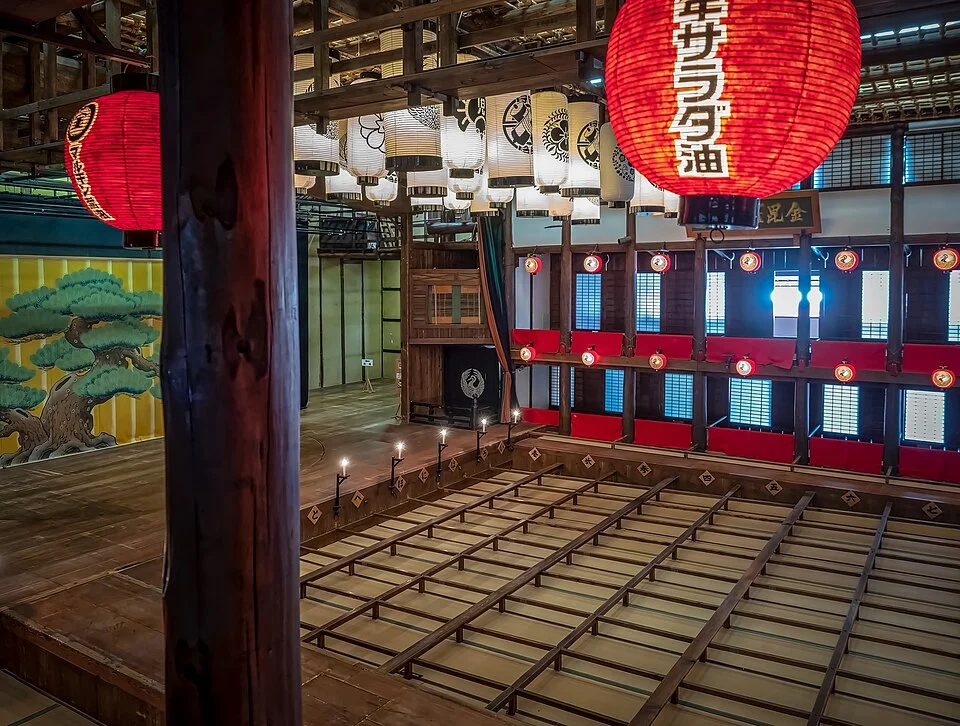
Kanamaruza, in Kotohira, is a useful building to examine because the interpretation provided for the site attends to several kinds of movement. There is the revolving platform in the main stage. There is also the hanamichi, a route through the seating area, and there are points where a portion of a stage can rise or where a performer can leave the visible floor. Each device gives a different answer to “where did that person come from?” If a spectator confuses the paths, the development of a scene can seem arbitrary. In a plan, the movements have surprisingly distinct shapes.
Think of a person approaching along a runway from behind part of the audience. Some spectators get warning while others are still looking toward the main stage. Think of a person coming up from below. The question is at what point they are recognizable above the surface. Now think of someone still sitting while the setting changes its direction. A spectator can see who it is without being able to see where the motion is produced. Each example uses a different axis and can direct attention to a different part of a room in the same span of time.
The Arts Council identifies the spaces below the stage, including places for the machinery, as the naraku. A photograph of rows of seats and the front of a stage tells little about the rooms below. At Kanamaruza, start with the site’s explanation of what is meant by a particular section and see where it is in relation to the public entrance or seating. It can be easier to understand the word after you have seen an actual view of the surface that concealed the working space. This is a case in which architectural evidence lets you reassemble two separate places into one view of how the theatre is used.
A lesson in stage devices can become too much like a list of contrivances. Explore the names to the extent that they explain the path an actor took. The important evidence might be the disappearance of somebody at the lower edge of the visible field or the fact that another entrance was available far behind the gate in a scene. Saying “a mechanism did it” applies to all these cases. The direction, position and duration of the movement are what made one useful in place of the other.
Leave the roof and walls in the plan
A turntable drawn on a bare sheet can look as though it could work in any room. Set that drawing inside the outline of a theatre. Find the audience, places of entry, limits at the walls and a little area where an actor can wait without being part of the scene. Consider whether a setting has a back whose view you do not want the spectator to have just yet. A tall bit of furniture, the leading edge of a low platform or the end of another part of a set can form a temporary occlusion that travels over the course of the turn. It is easier to see why a stage design takes the outline of the room so seriously.
A model can be quite small and still make the argument. Use a rectangle of folded scrap paper as a doorway and one paper shape as a person. View the disk from an angle low enough that the doorway can actually hide the shape. Mark at about what point the person first appears. Try replacing the doorway with one that has the same footprint but a shorter side. You might get a much earlier view of part of the person. A designer preparing scenery full size has more limits to consider. The paper test helps show why the intended order of reveal must be studied from seats rather than only on a diagram.
At the end of the turn, remind yourself what the floor was doing before you noticed it. Perhaps the viewpoint of a seated person has moved just enough to make an audience think that someone left. Perhaps a room once seen as the whole of a place turns out to share a wall with another one. A new setting is an ordinary demand of theatre. The revolving stage gives the production an interval in which the audience can watch the previous world and the next world renegotiate the same ground.