When the Large Gong Returns in Javanese Gamelan
Listen for the stroke that closes a cycle. Once you hear the space between two large gongs, the smaller gongs, changing pace and overlapping parts become easier to follow.
In this story 4 sections
There is a low stroke in much central Javanese gamelan that can seem to arrive late. The voices, metal keys and smaller gongs have already been moving for some time. A listener waiting for the start may have been attending to the wrong end of the stretch. The low sound can mark a completion. Its arrival gathers quite a long passage into one unit, and the next run begins from that point. When the stroke comes back after further playing, it becomes easier to hear that parts of the preceding passage were directed toward it.
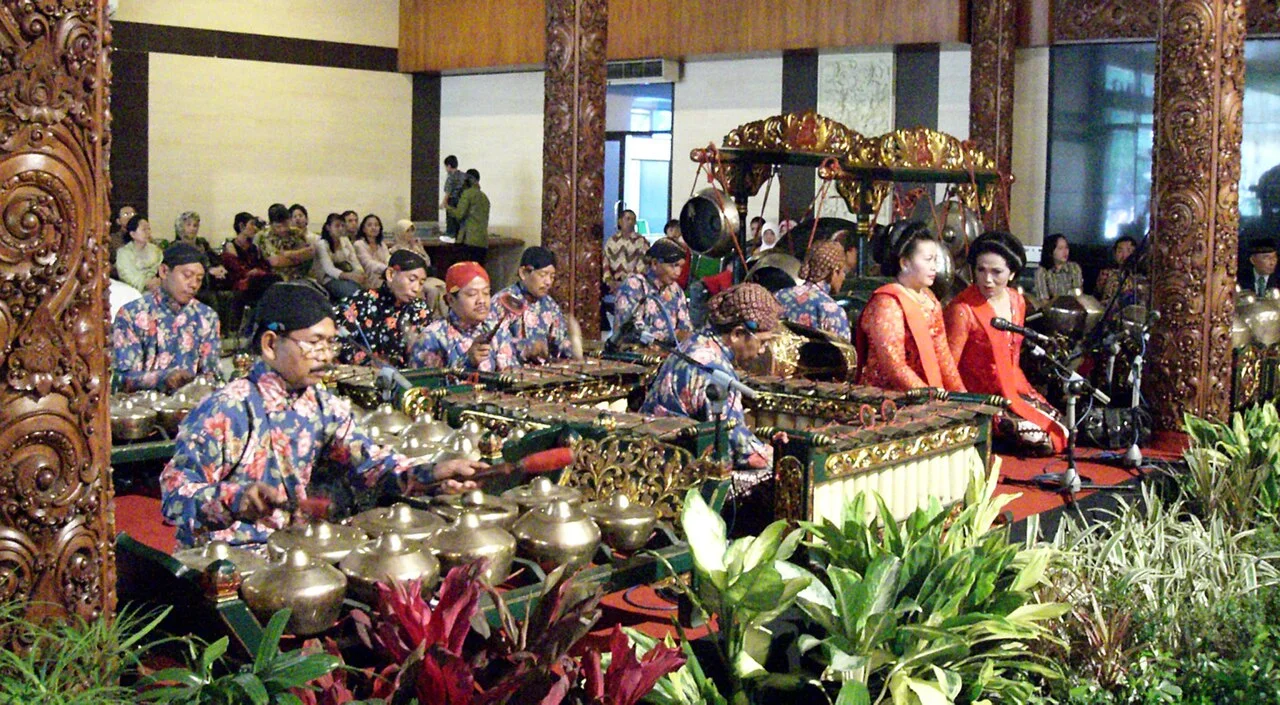
The large hanging gong is called gong ageng. A major span marked by its sound is often called a gongan. Wesleyan University’s instrument collection describes several categories of gongs that articulate parts of this arrangement. The kenong, a large horizontally mounted gong, and the kempul, smaller hanging gongs, can mark subdivisions. The large stroke is easy to describe on paper. Finding it in a living performance also requires listening to the register, the sound’s decay and its relationship to other signals. The cover photograph shows an ensemble in performance during a wedding in Jakarta. The recordings and programme notes linked here offer separate examples from Yogyakarta.
Start with two arrivals
Play the opening recording in the Smithsonian’s notes, Ladrang Sri Widada, or use a performance whose form is identified. Begin listening without assigning a number to every event. Find a deep stroke that sounds as if it has room to continue after impact. Hear what follows and find the moment that gives you the same kind of arrival again. Some other sounds may also ring out and be easy to notice. The relationship between the suspected large gong and the material around it matters more than a judgement about which sound seems loudest through a given pair of speakers.
Hear the stretch again and see whether you can recognize places inside it where a smaller gong provides a similar point of reference. They are useful early landmarks. Once a large and a smaller marker have become familiar, it is possible to pay attention to how a melody crosses the smaller one or how a different strand of sound becomes prominent toward the end. The cycles create opportunities for other parts to move and vary. A bare sequence of gong strokes tells you the proportions of the form in roughly the way a line of columns can tell you the proportions of a room. In both cases the proportions become clearer when you also attend to what happens between the supports.
Begin with a recording long enough to hear the reference point several times. A few seconds of clean sound can help identify the colour or attack of an instrument. It usually gives little help with a cycle whose significant events are spaced much farther apart. Likewise, seek a source that gives the title of the piece. The pattern mentioned in a written guide belongs to a form or to an identified example. A short video showing a roomful of instruments can help you locate them visually while leaving the form of the music unspecified.
Find the beat count in one identified piece
The Smithsonian notes identify the form in Ladrang Sri Widada as having thirty-two beats to each main cycle. If you want to count, use that recorded example and begin by finding a relatively steady underlying pulse. A quicker surrounding part can be playing several notes while you count a single beat. Try counting in comfortable groups and listen for their relation to the prominent strokes. You may find a recurring subdivision sooner than you find a continuous count that feels secure. That is useful progress. It gives you a reference point from which you can work inward or outward.
The way you count the meeting of two cycles is important. Working from one large gong to the next, decide whether the first gong closes the group just heard, and aim for the next one as the end of the group you are counting. Then look over your count. If you included both boundary strokes as ordinary beats of the same cycle, your notes can make the span seem to have one extra event. Time belongs to both sides of a boundary in listening. A written count needs a single convention to be comparable to someone else’s count.
If you hear a sound continuing beneath the new count, listen for when it was struck. The long decay of a gong can cross an interval over which another performer is already making new notes. A recording often puts that continuing tone and the new attack in the same audible space. Marking the end of a cycle by the disappearance of every trace of the tone would identify a different moment. The stroke provides the landmark. Its sound can have a life well beyond that landmark as the passage moves on. An unexpectedly early note after the stroke may belong quite naturally to the players’ activity on the other side of the boundary.
On a second pass, keep a record with just three marks: a line at the large gong, shorter marks at the smaller sounds you recognize, and an occasional dot when the pulse became difficult to follow. That unfinished record can be compared with the notes without turning the whole piece into an exercise in transcription. A listener can hear a group of structural tones fairly reliably while the finer movements are still a mystery. It is reasonable to return to the same performance with a different focus and add to the paper a little at a time.
A steady form can take a different amount of time
Two passages with the same organization can occupy different spans in seconds. A change of pace can alter the amount of time available for a sustained or elaborated line between the reference points. A person who recognizes the main pattern only by estimating the number of seconds until the big gong can lose it when the ensemble moves into a different pace. The relative placement of smaller sounds is often a better aid. The Smithsonian’s notes discuss changes of feeling as cycles slow down or speed up. That change belongs to the experience of the piece even when the large divisions of the form remain recognizable.
When a passage changes momentum, hear the way the drumming and other instruments make the change apparent. The kendang is a drum; the word names a family of instruments and practices rather than one fixed signal. A recording can let you notice that very different kinds of sound take part in a shift at the same time. The beginning of a slower-feeling section may make some quieter material easier to hear. At another point a more compact passage makes the arrival of a gong feel almost immediate. The intensity of the stroke itself is only part of the effect. The time prepared around it contributes to the sensation of arrival.
This is also a place where a counting scheme has a limit. Writing several numbers under a passage can make you more confident about the duration of its groups. It does not explain by itself why one performance feels different from the next. There can be a range of approaches to how the notes flow inside those groups. Use the count to find your way into the listening, then spend another pass keeping track of a sound or gesture that the count did not record at all.
See the other parts in the room
A full Javanese set can include metallophones, gongs, drums, a bowed instrument, flutes and other parts. Slendro and pelog are tuning systems represented in large sets such as those described by Cornell and Wesleyan. The presence of many instruments in a room supplies a clue about what an ensemble can do across performances. The sound of any passage depends on which players and instruments are taking part then. A photograph can show the instruments in their positions with wonderful clarity and still leave the particular grouping in a recording open. The instrument descriptions are a good way to learn to recognize forms before trying to name everything that reaches the ear.
From the side of a room, the impression of the large gong can depend on how the sound reaches that spot. The position of instruments and the acoustics around them change what a recorder catches easily. A listener using small speakers may miss part of a low sound while hearing the bright strokes clearly. In that case, listen to the notes just before and after the marker and see whether they help reveal the missing weight. A playable recording with accompanying notes lets you attempt the exercise without assuming that your equipment reproduces exactly what a guest heard in the room.
Then listen without marking a thing. The low stroke can arrive as a point of rest and as preparation for more music. It takes a while to hear how both descriptions can be true. The players have been making changes around the gong, and the absence of a small mark on your page leaves a chance to notice more of those changes. The next cycle is familiar in shape and still new in detail. That is a particularly good reason to keep listening after you have learned where to count.